Can’t I Just Use A Water Softener For Hard Water?
It would seem the perfect solution. Water softeners are often used in homes to prevent white scale buildup from hard water. Why not use it to prevent the hard water that can weaken our bonsai?
Trouble is, water softeners introduce sodium to our water. It’s only a small amount, and plants do use very small amounts of sodium in cell processes. And yet horticulturists do not use water softeners. Even small amounts of sodium introduced into water, over time, weakens plants.
Instead, horticulturalists use acid injection or reverse osmosis water systems to control the hard water buildup of calcium or magnesium.
Let’s take a quick look at all three of these systems.
What is the water softening process? Water softeners swap calcium and magnesium salts for sodium and potassium salts. This is ion exchange, one salt for another, and while it does get rid of the troublesome salts that tend to make white deposits, the sodium it’s replaced with is still not good for plants.
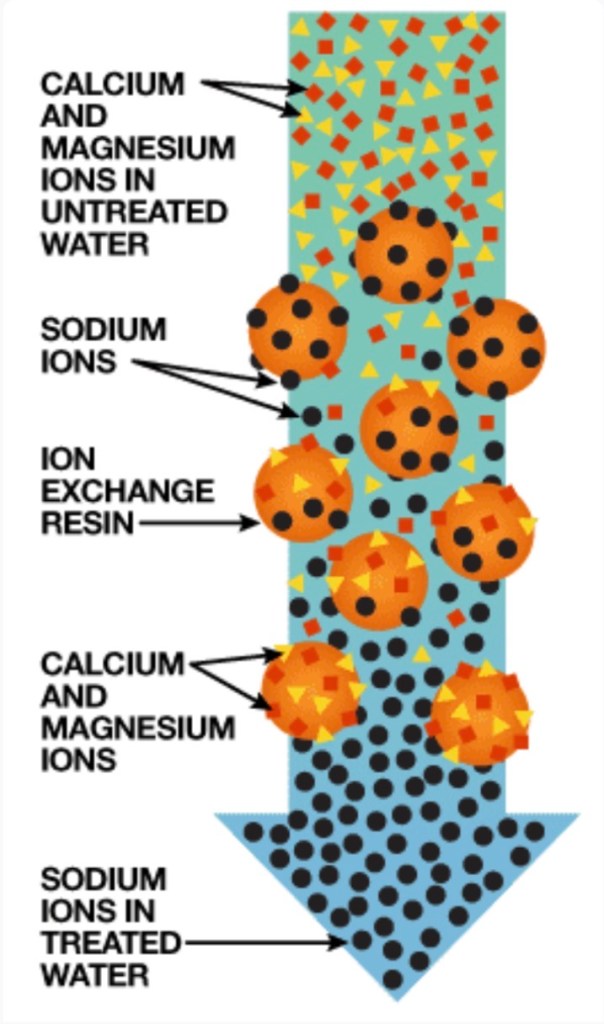
This is the water softener process. By the end we’ve swapped salts and now have sodium in the water. Few plants do well with even small amounts of sodium, long term. (Image courtesy of H2O Distributors)
What then reverse osmosis, and how does it help prevent hard water?
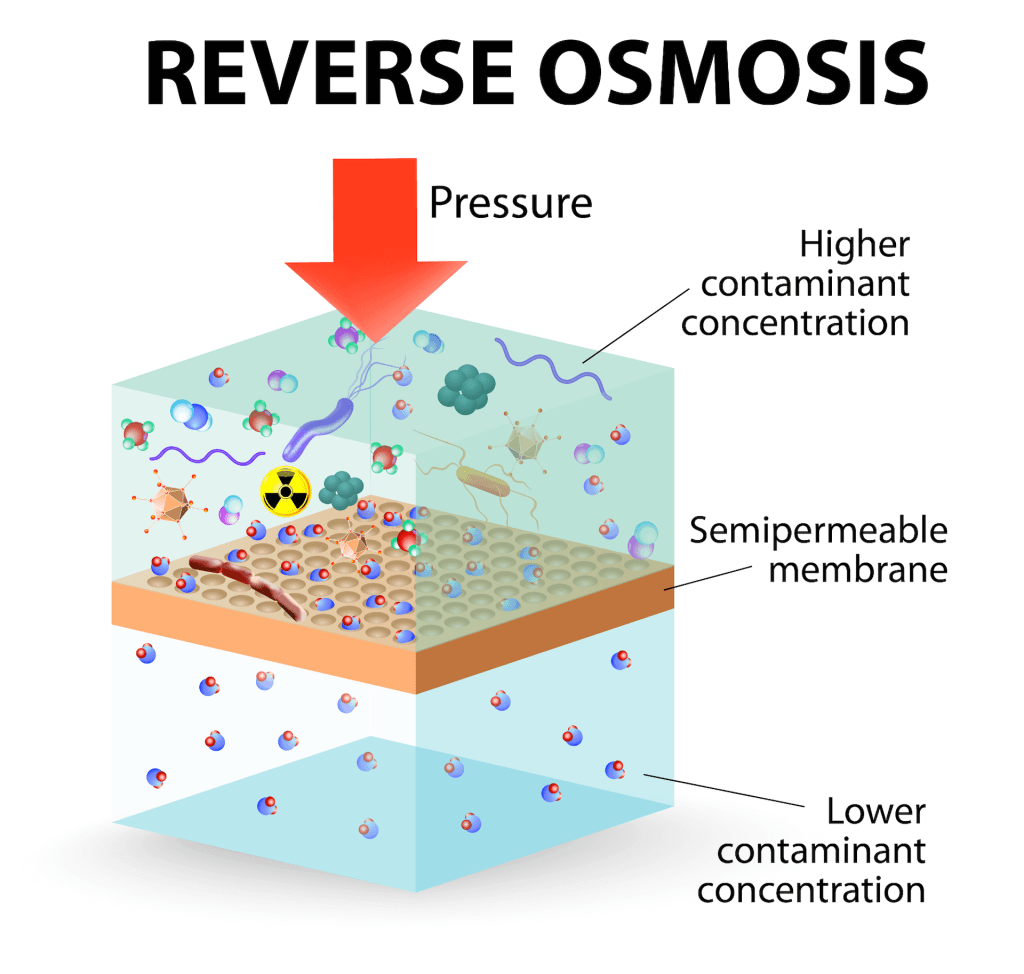
This is a reverse osmosis (RO) process, useful for severe hard water issues. Under normal conditions, water passes from areas of low solute concentration to areas of high solute concentration. This is osmosis, a natural process, and it requires no energy. Reverse osmosis goes in opposite direction the water wants to go—the image above—so it requires energy. (Image courtesy Advanced Water Solutions)
Among the many impurities an RO system can take out are the dissolved salts that cause hard water.
A problem with RO is that it can be so successful that it’s close to distilled water, which is trouble of another sort. It may have little minerality. So it can leach minerals from the soil, with mineral deficiencies resulting. One fix is to add some non-RO treated water to the RO water, mixing it.
And then, what is acid injection, and how does that help?
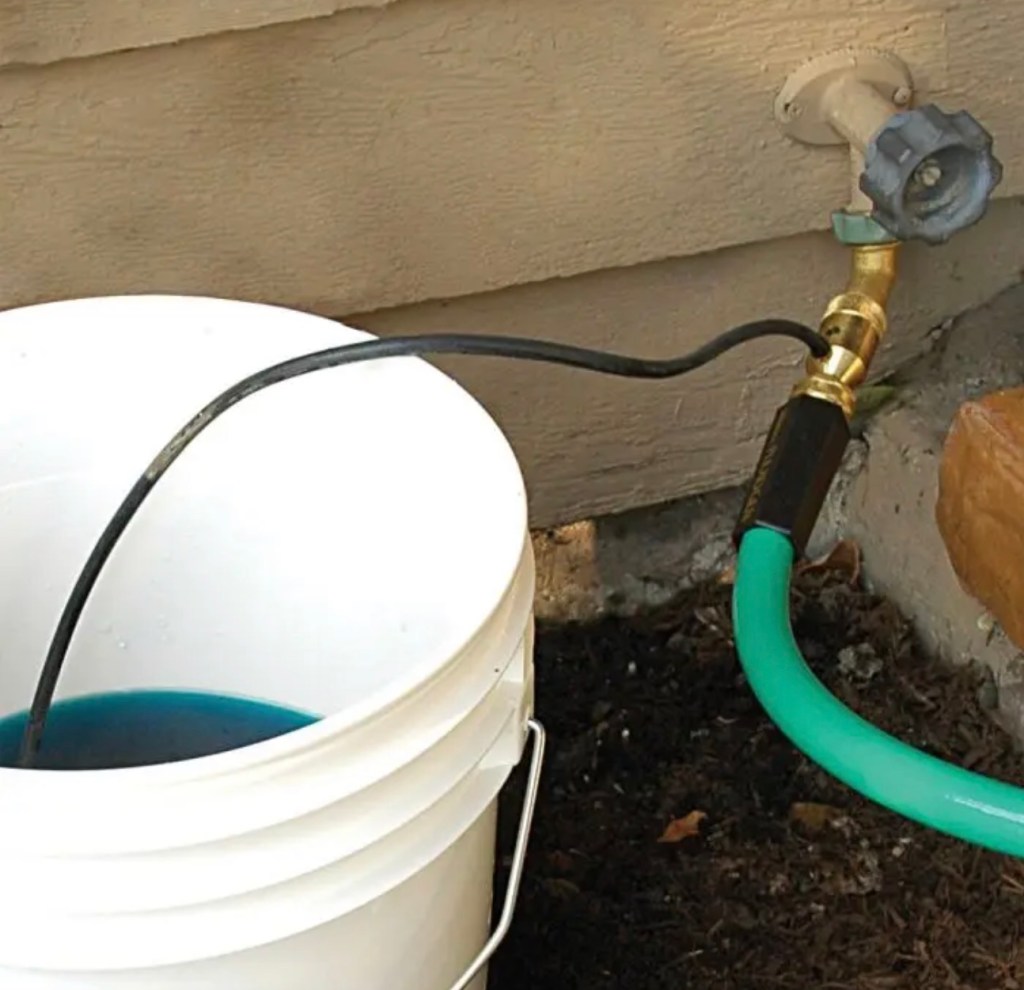
Image of a simple acid injection system. The bucket holds your dilution of acid (or fertilizer, as shown here). The line going into the bucket siphons the acid (often citric or phosphoric) into the watering hose, where it mixes to your desired pH. Some calculations of the dilution in the bucket are necessary. More complex systems exist, such as Dosetron. (Image courtesy Gardener’s Edge)
Acid works differently from both water softeners (which replaces ions) and RO (which removes contaminants). Acid injection utilizes a chelation process that binds with the calcium and magnesium bicarbonates and carbonates, preventing them from forming scale. The salts are not just transformed and harmless, they are soluble, making them useful to plants. So, what could have formed insoluble white scales on our pots and soil surface become useful minerals: fertilizer.
Kinda cool, right?
But, do you need RO or acid injection? Maybe not.
Many folks get good water quality from a municipality or well (or rain). If you have a pH in a healthy range—roughly 5.5 to 7.5–and a low hard water measurement—total dissolved salts less than 120–you’re probably fine.
But if you’re outside that range, you may wish to manage your water quality. Only, don’t use a water softener for your bonsai. Your non-bonsai indoor plants will be likely happier without it, too.
For more about water quality, try these related posts:
1 Comment
Timely post. I have been looking into better watering systems as I have seen poor growth and chlorosis on a lot of my species. The municipal water here in Northern California is about 125 ppm (the edge of problem hardness). This is the level our water report lists and what I measure with my home EC meter.
John Eads recently recommended a pour through test suggested by Cornell University to monitor nutrient uptake in nursery plant growth situations. Basically, you know the EC of your water plus fertilizer that goes onto the plant. Once the water has equalized with the soil substrate, more water is then poured into the pot and the water that flows through is collected. The change of EC supposed to be a measure of the nutrient uptake by the plant.
What I have found, in my garden, is the flow-through drainage is 4 to 5 times higher (400 – 700 ppm) than my initial water input! My guess is I have been under watering, not having free draining water flush through my pots with every watering. Thus resulting in very high “salt” content in the soils as they concentrate with each dry period.
I am working with some soak and drain practices to reverse this measurement. but it seems to take a lot to change the soil composition.
Have you used this measurement of the flow-through hardness? What might be the hardness of flow-through water in your garden in Portland? I would appreciate your thoughts.