Correcting Water pH For Better Plant Health
When we drink water, our kidneys adjust the blood pH to 7.35-7.45. Plants also have the ability to change pH around their roots, up to 1.5 pH points. But in more extreme pH situations, plants suffer.
Water pH measures the concentration of hydrogen ions. If you have more hydrogen ions, you have acidic water. If you have more hydroxide ions, it’s alkaline. The pH scale runs from 0 to 14, with 0 being ridiculously acidic and 14 being obnoxiously alkaline. 7 is neutral.
For the best plant health—and to grow the broadest range of species—we should aim for the middle. 6-7 pH is usually ok, with 6.5 being about optimal.
The thing is, this isn’t a simple scale. A pH reading of 2 is not twice as alkaline as 1. It’s 10 times as alkaline. It’s logarithmic. This means a pH of 8 is 100 times as alkaline as 6.
That might seem like a scary range, but plants are pretty tough. Your pines and azaleas will prefer things acidic, junipers are famously adaptable, while crabapple and elm can perform well in alkaline situations. Many plants do OK if things are not ideal.
But when we’re well beyond a good pH range, mineral deficiencies and toxicities show up:
- In highly acidic situations, calcium, magnesium, and phosphorus become insoluble, so the plant can’t take them up
- Metals like aluminum and manganese become soluble in highly acidic conditions, which results in toxicities
- Highly acid water can damage root cells
- In highly alkaline situations, nutrient lockouts happen, seen in stunted top and root growth
- Leaf chlorosis, or iron deficiency, is seen with highly alkaline water
How then do we know the pH of our water?
There are several methods of testing water, the easiest being a hand-held, battery operated, digital tester, which gives readouts of both pH and dissolved salts. Alternatively, you can use drops from an aquarist’s store to test pH. Avoid litmus paper, which is a vague reading.
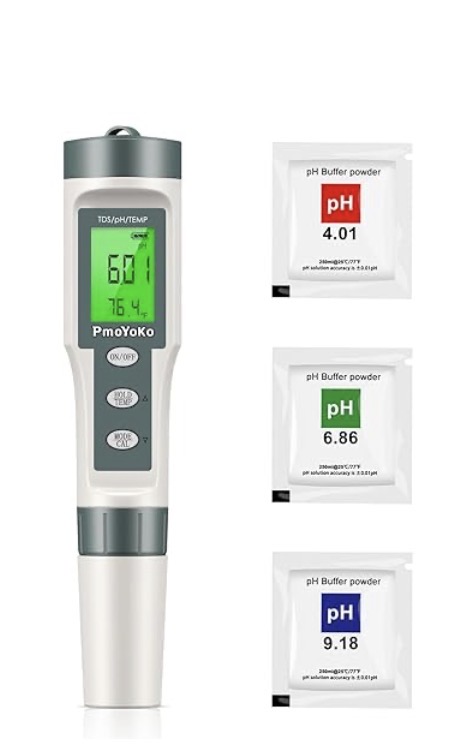
Above, a digital tester for both pH and TDS (dissolved salts). As it tests both key measures of water quality, this is the recommended way to test. Stick the end in water and hey presto, a digital readout.
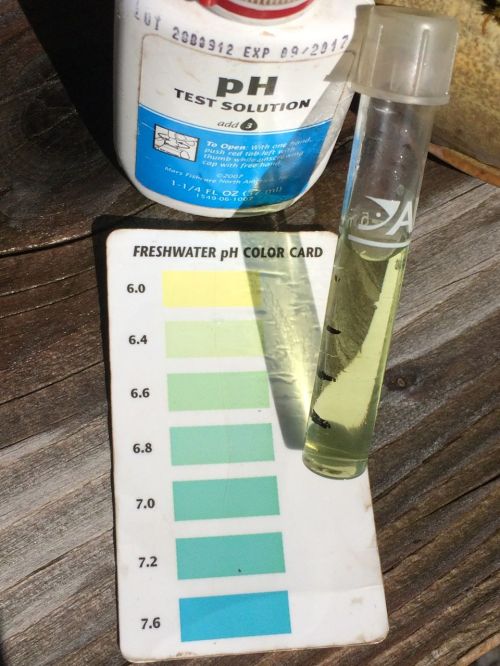
For just testing pH, an aquarist’s drop test kit is good enough. Fill water to the white line, add three drops of test solution, cap it, and shake. This test came out about right for bonsai—about pH 6.2 or 6.3. A pH of 6.5 is ideal.
If you’ve soft water that is alkaline, you may be fine. Usually high pH comes with hard water, and that’s a real challenge for a plant. (See this post for more on hard water and how it affects plant health.) In general, changing your pH to be mildly acidic corrects moderate hard water issues.
OK then, enough of the warm up to the subject… How then do we adjust the pH coming out of our hoses to get the best bonsai health?
Most water problems will be too alkaline. In that case, the easiest fix is to use a siphon and inject acid. Fertilizer siphons come in many sizes and complications and expense levels, the simplest being a siphon with a hoselet that goes into an acid dilution. It sucks up a certain amount to your bib, which then mixes in the hose as you begin to water.
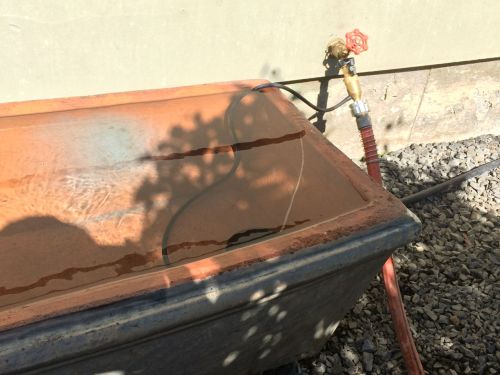
A simple brass siphon that attaches to your hose bib, with a black hoselet that snakes into a tank with the acid dilution. You’ll have to fiddle with the dilution to get the pH you want out of the hose. These are not foolproof, so keep checking your pH.
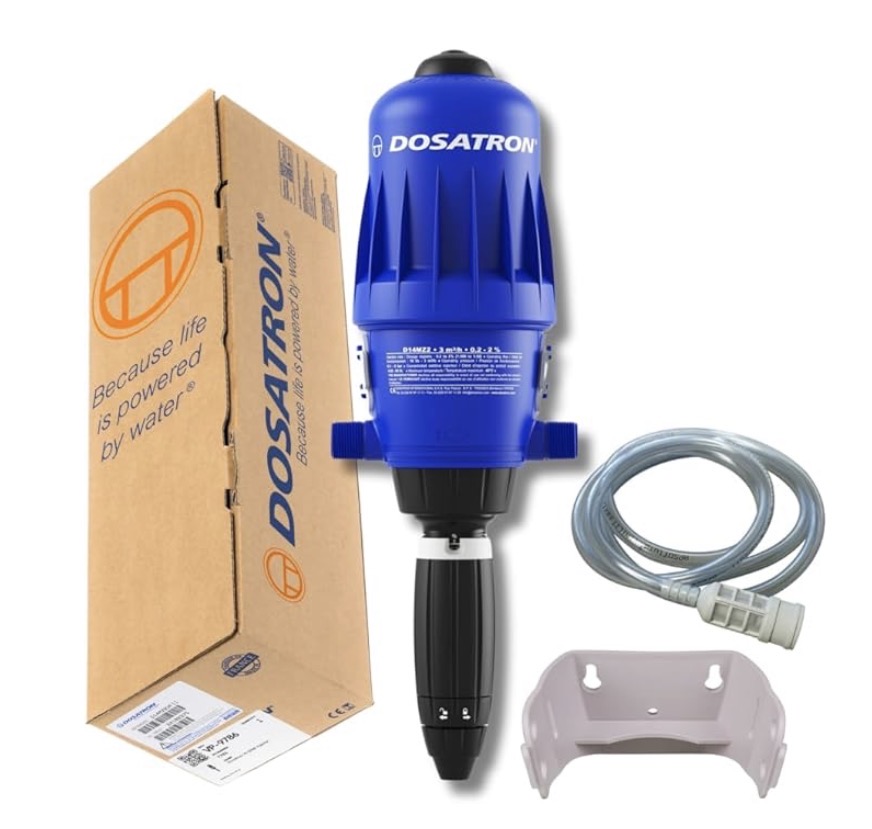
A system with more control is the Dosetron system. Above is the Dosetron D14MZ2, the injection system we use. It’s more expensive than the simple siphon, and has a tangle of plumbing to sort out at the bib, but it does have several controls which can make either acid injection or liquid fertilizing a top end experience.
Which acid?
- Vinegar is easiest for home applications. We used muriatic for a few years before discovering it can lead to chlorine burn on sensitive plants (Vine Maple, for one). Vinegar is also safe—no chance of burning yourself, unlike muriatic, which is dirty hydrochloric
- Be sure you’re using up the vinegar dilution in a few days, as over time the pH will rise. A more stable acid is phosphoric (most commonly used acid for hydroponics), but take care when using if concentrated
- Keep testing the pH through the watering hose as you get the dilution dialed in
If your water is too acidic, like a 3.5 pH, then adding baking soda will buffer it and bring the pH up. Again, test the water out of the hose to get the right tank mix dilution for whatever siphon you’re using. Whether using acid to bring pH down or baking soda to bring it up, out of the hose the water should be somewhere between 6 and 7 pH, with 6.5 about optimal.
And then…be patient!
- If water quality was the problem, better plant health is often seen within a few months to a year. Conifers may take two years before they look better
- Any kind of water source, from a well or a municipal source, should be checked occasionally for pH
- Some municipal water sources in particular can shift over the year, from a pH in the low 6’s in the winter to over 9 or in the summer, which they do to protect the pipes and prevent metal leach
- Stay consistent. Keep testing your water to be sure your system is working
Please see this related post on water hardness, which covers what to do in extreme hard water situations.
12 Comments
Michael,
Water utilities issue water quality reports that include pH. I assume your position is that testing at home is more relevant, but checking with the utility could be a place to start for your readers.
That’s a great place to start, Ross. Thanks for the suggestion.
In our area the water can fluctuate so much (3+ points) that unless we’re looking at the reports carefully and often, can get complacent. I think one of the reasons is the water is soft, so the pH bounces around a lot with such little buffer.
Michael – Did you get the relationship between hydrogen ions and pH mixed up at the start of the post? I believe that acidic solutions with low pH have excess hydrogen ions (actually hydronium H3O+) while alkaline solutions with high pH have excess hydroxyl ions (OH-). Glad to see the discussion. I use phosphoric and a knock off Dosatron. – Marty
Thanks Marty for the great catch! Corrected-
Great article, Michael. I’m curious whether you’ve seen side-by-side comparisons where correcting pH alone produced measurable improvements in otherwise healthy bonsai. Many European growers seem to have excellent long-term results with relatively hard municipal water.
Hi Jens,
Yes, I’ve seen several situations where pH was the only variable changed and things like weak pines with disease on multiple trees had transformative health and growth in one year. Enough that for those situations, which were severe, benefit was found. But there is a case by case thing here, with what people are growing and how they are growing it—-the whole system—-which does allow some to work with hard water. Most of what I write leans into optimal situations, what is recommended by horticulturists and tends to have the best returns.
every time I put acid (vinegar or lemon juice) in a bucket of water, the next day that bucket of water has gone back to be as alkaline as it was before. does that water do the same thing when I water a plant with it?
That’s a good question but I’m not sure of the answer. You might try phosphoric acid. (Be VERY careful with phosphoric, which can cause severe burns.) You won’t see much if any bounce with phosphoric.
Is there an idea range for TDS? I’m sitting around 240. . . .
Yes, once you get into the 150 range you have moderately hard water, and if your plants are looking pale and weak that could be a reason. Each situation seems a bit different, but at 240 you might want to add some acid and see if there’s a health bounce.
I’m still struggling. Moved into a High PH hard water area about a year ago. Lost some Maples and Azaleas before realizing the problem. Currently using RO blended with city water about half and half and adding Citric acid to get PH down to about 6-7. Seems to help but have to water with sprinkler can. Like more info on Acid injection, so I can use the hose to water. Since I have about 100 plants. Wondering if with the injection the hard water will still be a problem. Appreciate any advise.. Thanks
Hi Rick, I’d recommend looking into the simple siphons you can get for hoses, or the Dosetron options. The amount of acid you add to your dilution container will differ according to how large the container it is. And the type of acid used will change the calculation as well. So we all have to do some math there to achieve an appropriate level of pH in the hose. There are better tutorials online about how to do this than what I have on the blog, sorry about that, but they are out there and it’s a common way to correct the problem you appear to have.