To Cross a Wire Or Not To Cross A Wire
Given that many of us were taught to never cross a wire, suggesting that we could might sound treasonous. There are, however, situations where crossing a wire can be the right move (and yet hopefully not get you kicked out of the local bonsai club).
Many of you who have studied with me know I challenge you not to cross wires, in our wiring exercises. But there are situations where it has utility.
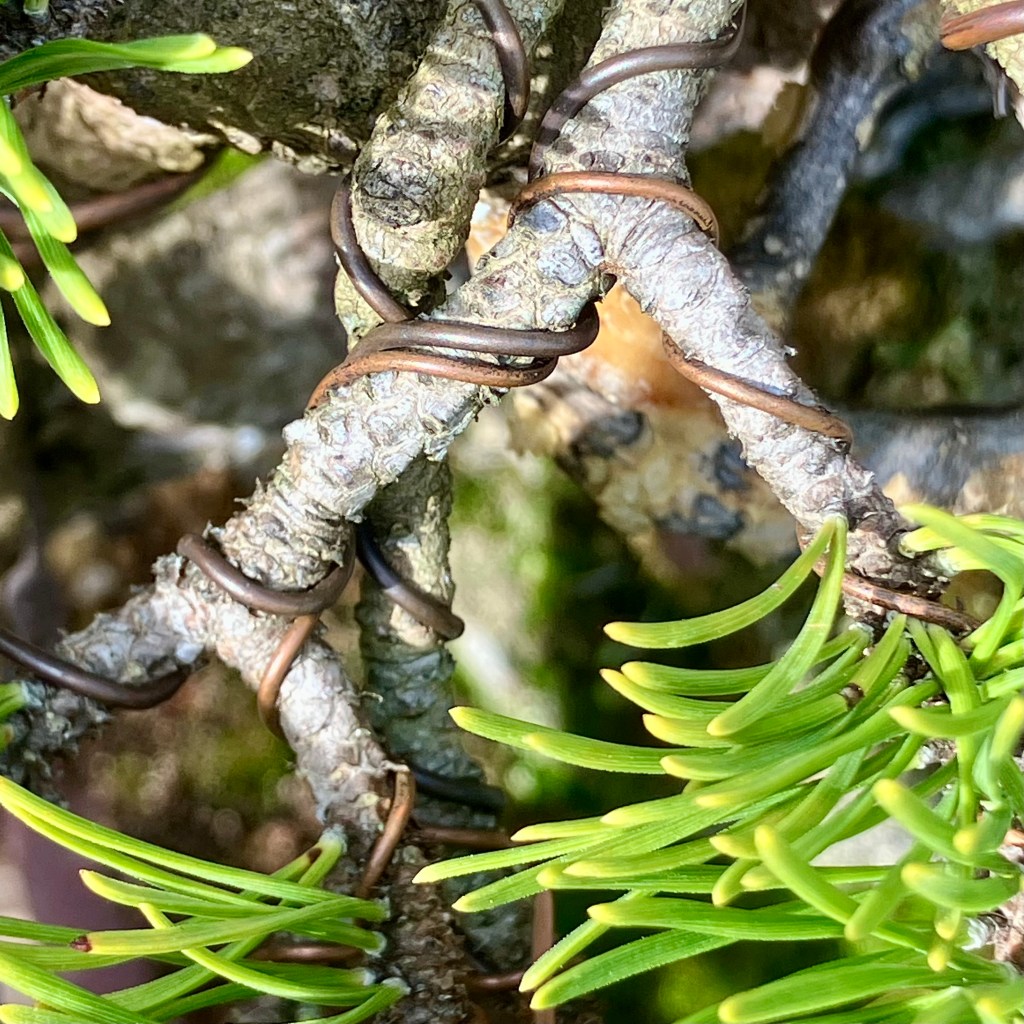
This is the usual—a large wire put down first (the darker one), then a smaller wire politely laid next to it (the lighter one), without crossing anywhere.
However—a crossed wire is a lesser evil than a bad anchor.
An “anchored” wire is what we call a stabilized wire. When we position a wired branch, the anchor prevents it from wobbling. Usually this is done with at least one full turn around a connecting branch. Sometimes—and here is our first crossing possibility—this is at the end of a thick wire, with a thinner wire being anchored by wrapping it over the end.
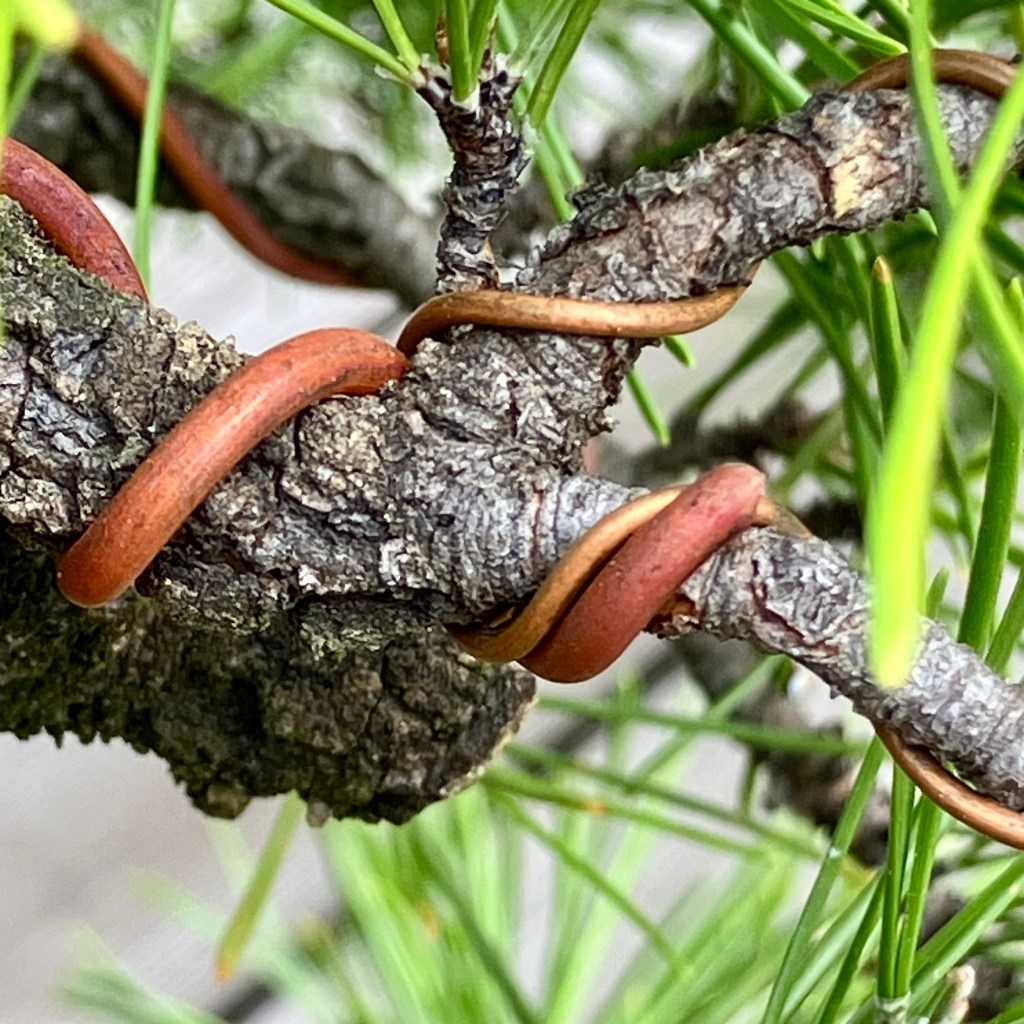
Anyone see the cross? This is well done. There is a cross there, but it’s on the bottom so you don’t see it. This is a typical situation for a crossed wire (seen a lot in Japan)—a large wire stopped short because the branch gets too skinny and you might damage it with the big wire if you wrapped more, and then the smaller wire (the next wire put on) wrapped over the tag end to be the anchor.
Are we scandalized yet?
Well, it’s only wire. And the above solution does provide an anchor, which is the key thing.
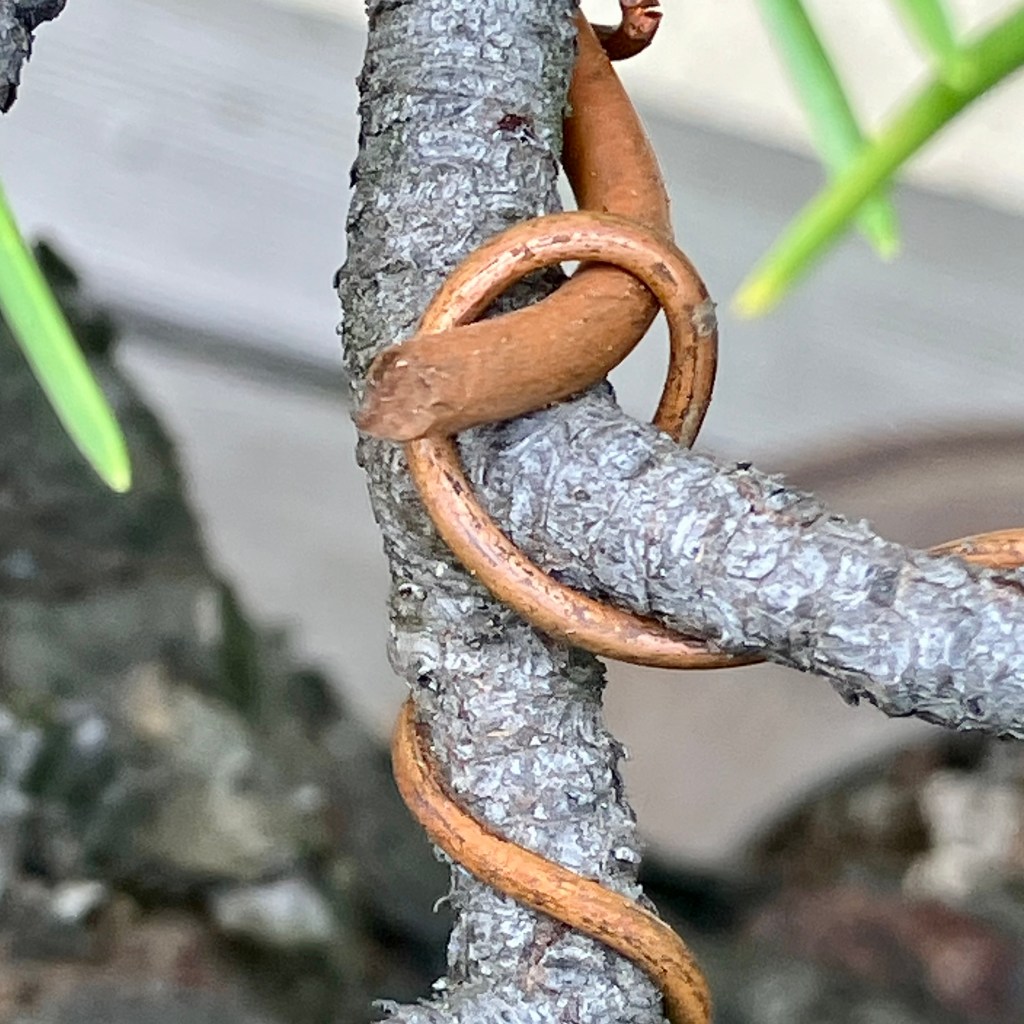
Same idea, but with an even shorter tag with the big wire, and the cross happens on top where we see it. This one doesn’t look so nice. And likely only a fair anchor.
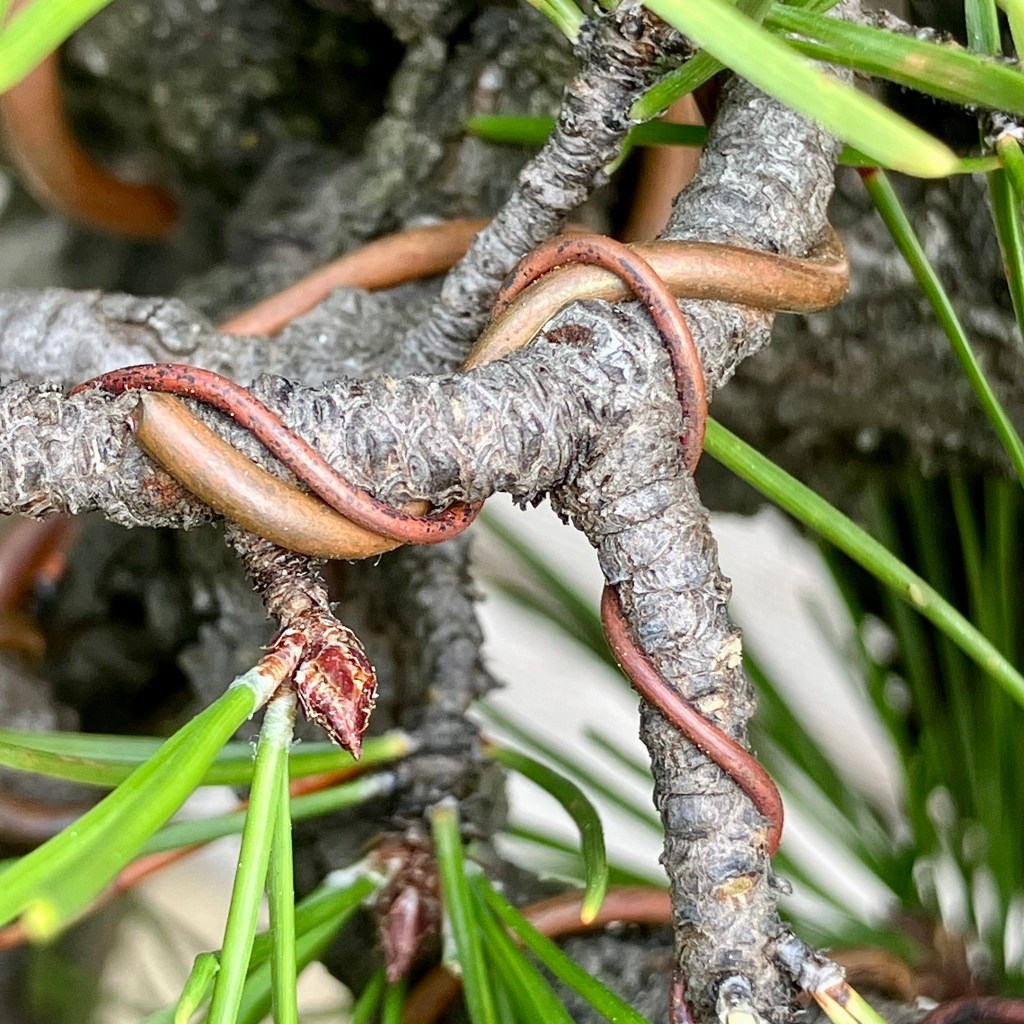
Another cross, a bit more visible. The big wire almost has a full turn, which would provide a good anchor for the second wire if laid parallel, but the cross gives it extra anchor.
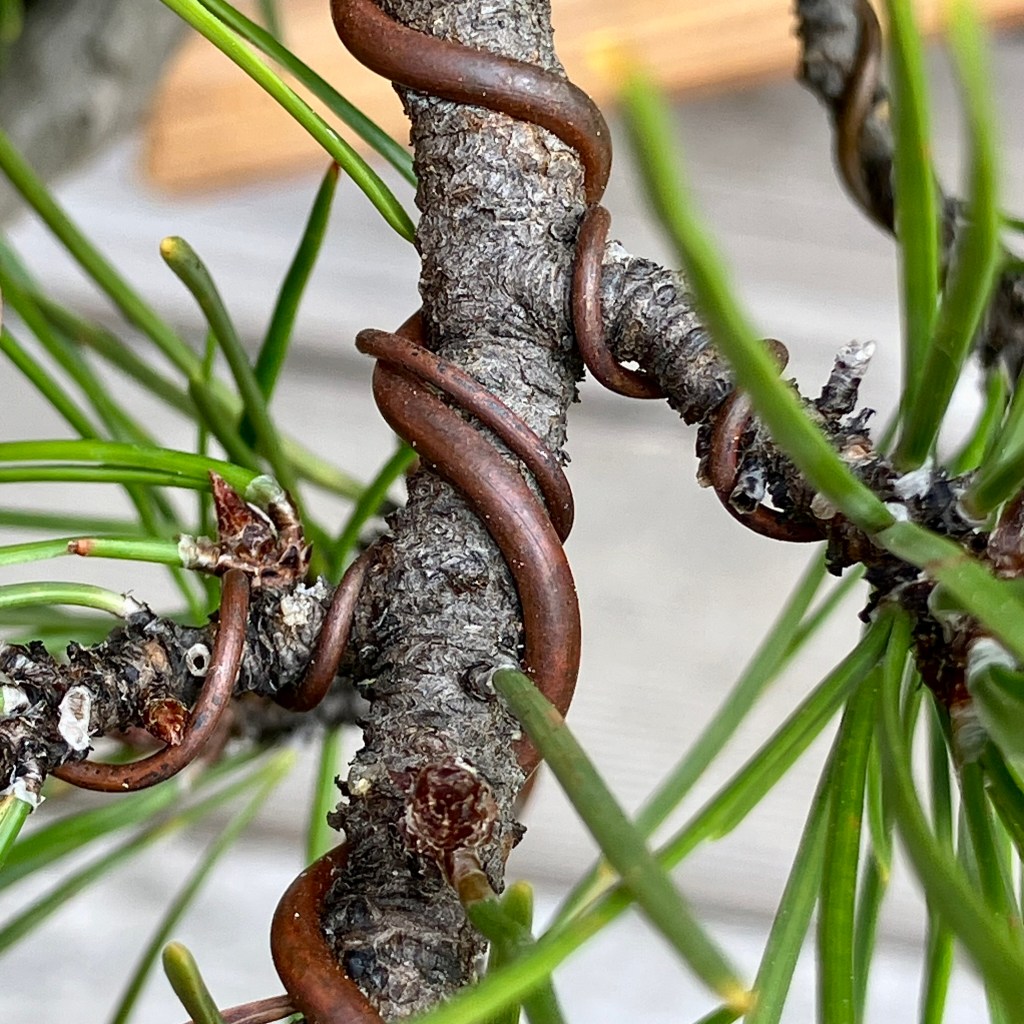
A cross between secondary branches. This is an important example for the situation happens a lot. Notice there’s not enough room between side branches for the big wire to make a full rotation around the main branch without damaging it, so the spiral of that large wire is kept elongated. Then the two branchlets are wired together with a crossed wire, circling the main branch 1.5 times, which is an excellent anchor.
A big point to make is that if you put big wire—size 6 and 4 copper—on branches, it will damage those branches if the spiral is too tight. Elongating your big wire is gentler on the branch. The tradeoff is you’ll likely not have the wire planning to avoid crosses with your secondary branches.
If you were taught that all crossing is naughty, retain your humor, this is all good. Keep breathing.
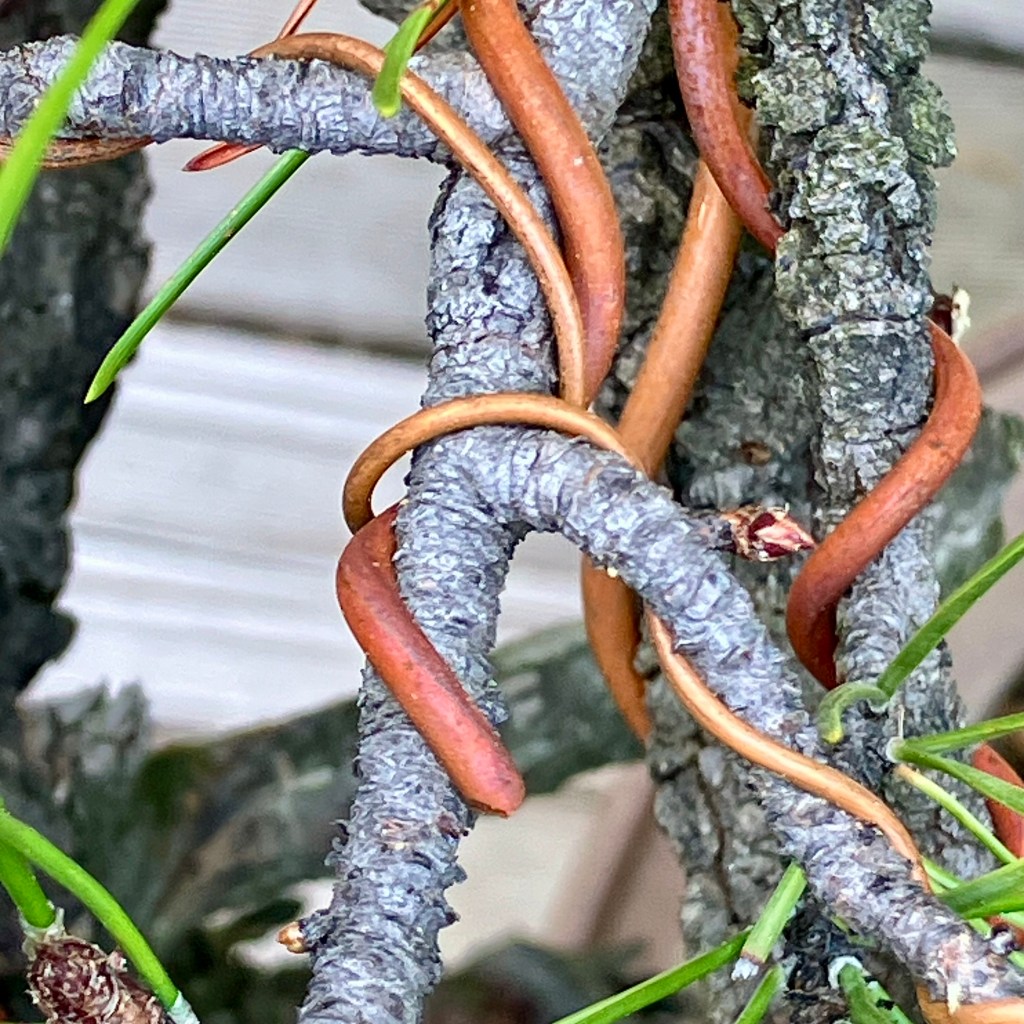
A situation similar to the last one. The main wire, a big one, didn’t have the room to make a full rotation, so the secondary wire wraps around it to make a good anchor for the two side branches. It would look a bit better if the cross happened below the branch, but at least this solution has a good anchor.
To sum up the advantages of a CROSSED wire:
- To provide a good anchor in a tricky situation a crossed wire is acceptable. Wire must first function, and its primary function is to bend the branch where you want it. Without a good anchor, you can’t do that
- In first stylings with big wire, getting the spacing right for the side branches to be wired is often impossible with large wire, like size 6 copper and above, and in that case crossing the smaller wire over the bigger wire, like a 16 over a 6, helps to avoid damage
- In short, in some instances crossing wires helps prevent branch damage
In fair weather and fair branching, we may prefer NOT CROSSING wires for these reasons:
- It looks cleaner and is less visible
- It’s easier to take off. Often it’s the thicker wire underneath that needs cutting off, which makes a mess and takes time to sort
- Better suited to developed trees
This wiring decision often depends on who you study with, or your clan “lineage.” Crossing a wire in one garden in Japan is sacrilege (Toru Suzuki), whereas it may be expected in another (Masahiko Kimura). My teacher, Mr. Shinji Suzuki, was in the middle. We might cross wires at the very tips.
Although I teach the be-polite-don’t-cross method, I do have one preference based on experience. Over the decades I’ve done bonsai, I’m less a fan of many crossed wires.
My reason isn’t how it looks so much as how I prefer to take wire off. Which is piecemeal. I take wire off as it tightens, which gives more time for the other wires to do their work. Otherwise we waste wire and work. Crossing wires is faster to put on. But if you take wire off as I prefer to, it ends up being rather slow if you’re trying to get at a wire underneath another one that isn’t biting in yet. If you prefer to take wire off all at once, this doesn’t apply.
Some crossed wire, especially first stylings of coarse trees with big wire, and at the tips, makes sense to me. I think we could relax some of our rules around wiring, for none of us studied under the same teachers, and all trees in Japan are accepted in the shows regardless. We might loosen up a bit…within reason.
Studying how to not cross wires is time well spent. Studying the situations where one might cross a wire is also time well spent. And then, as the examples may show, this is case by case. Perhaps gauging how good the anchor is can help decide which wiring method is best.

2 Comments
Very reasonable! Love the explanation. Thanks for not being a Nazi and leading us down a path of amiable reason.
This is Bonsai not Gestapo