“Beavering” A Large Low Branch
When I was a kid we lived in Amherst, Massachusetts, and on the weekends would run up to the Berkshires, in the foothills of the Appalachians, to fill a few gallons with fresh spring water. It’s a beautiful wet and wild area. I caught my first brook trout (12”) up there, and saw my first beaver ponds.
Aside from their wanton destructiveness to trees, beavers are rad animals. The ponds and assorted swamps and wetlands they create refill aquifers that streams don’t, provide oases during fires, and tend to keep humans away who don’t own chest waders, which is quite a few of us.
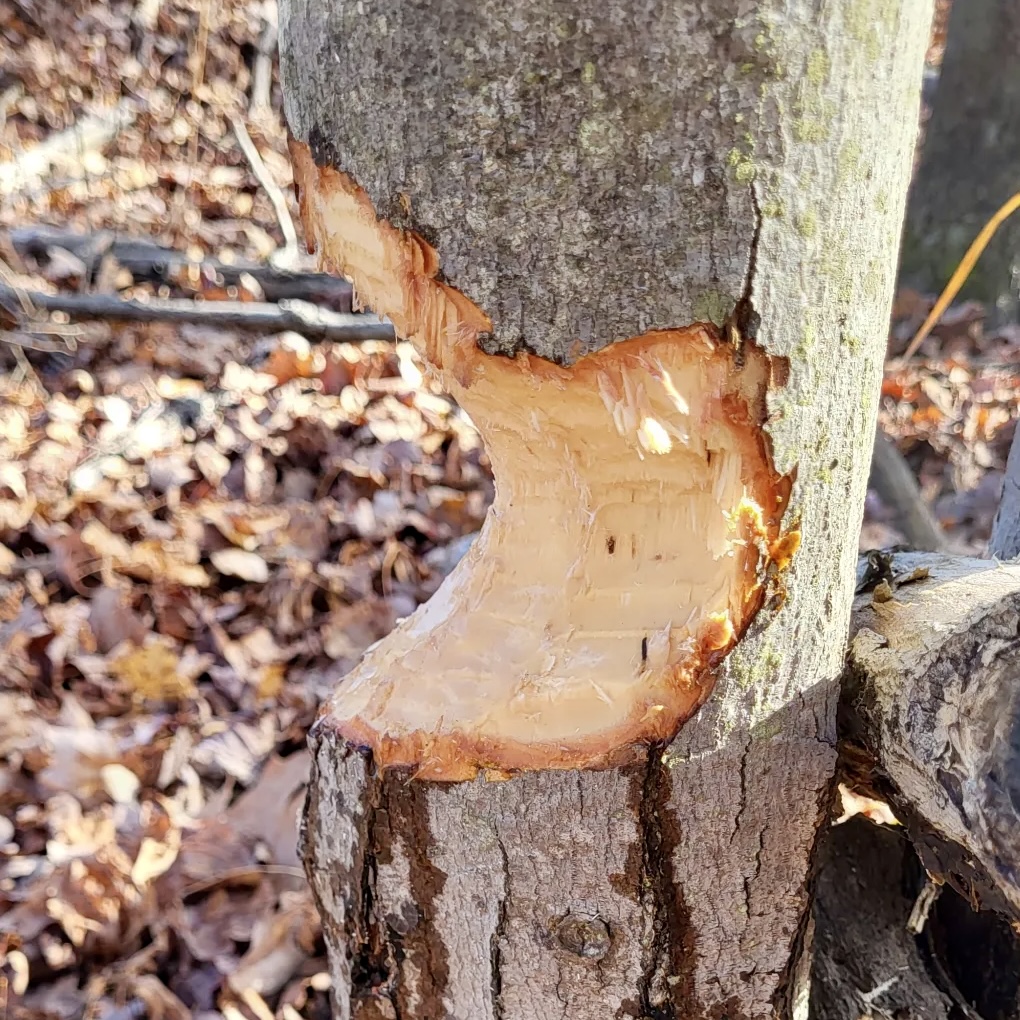
As a kid up in the Berkshires I saw half-gnawed through trunks of trees. Beavers are known for being busy, and are celebrated engineers, but they are not known for finishing what they start. The above photo is a half-gnawed trunk that a beaver has abandoned.
The following bonsai technique is based on this trait.
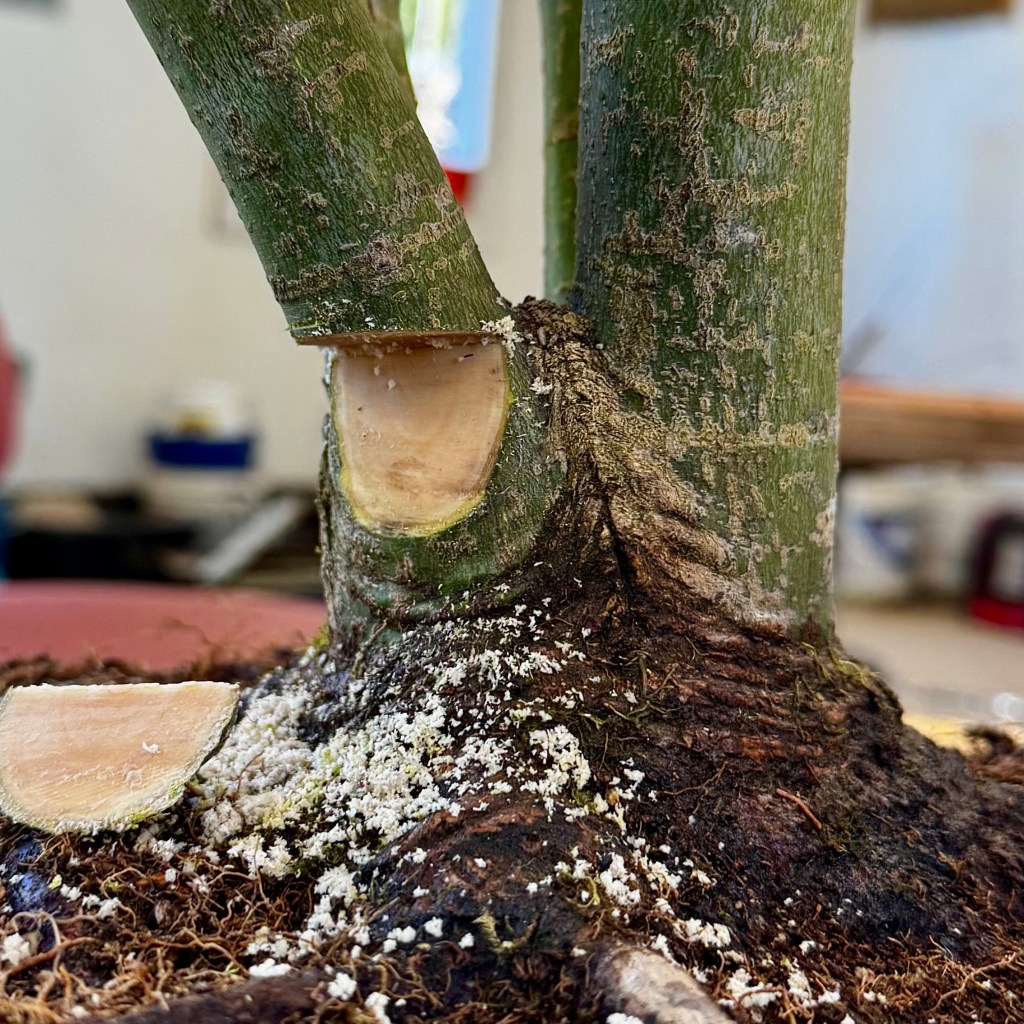
Here’s a young Japanese Maple that has four trunks (only three are visible). After an over-long wavering about what to do about that, we decided to cut one off. Trouble is, with a low trunk like this, if you cut it off all at once you’re asking for trouble.
One of the dangers of cutting off a low branch or sub-trunk is that it might kill off the supporting root system. Which is right below it.
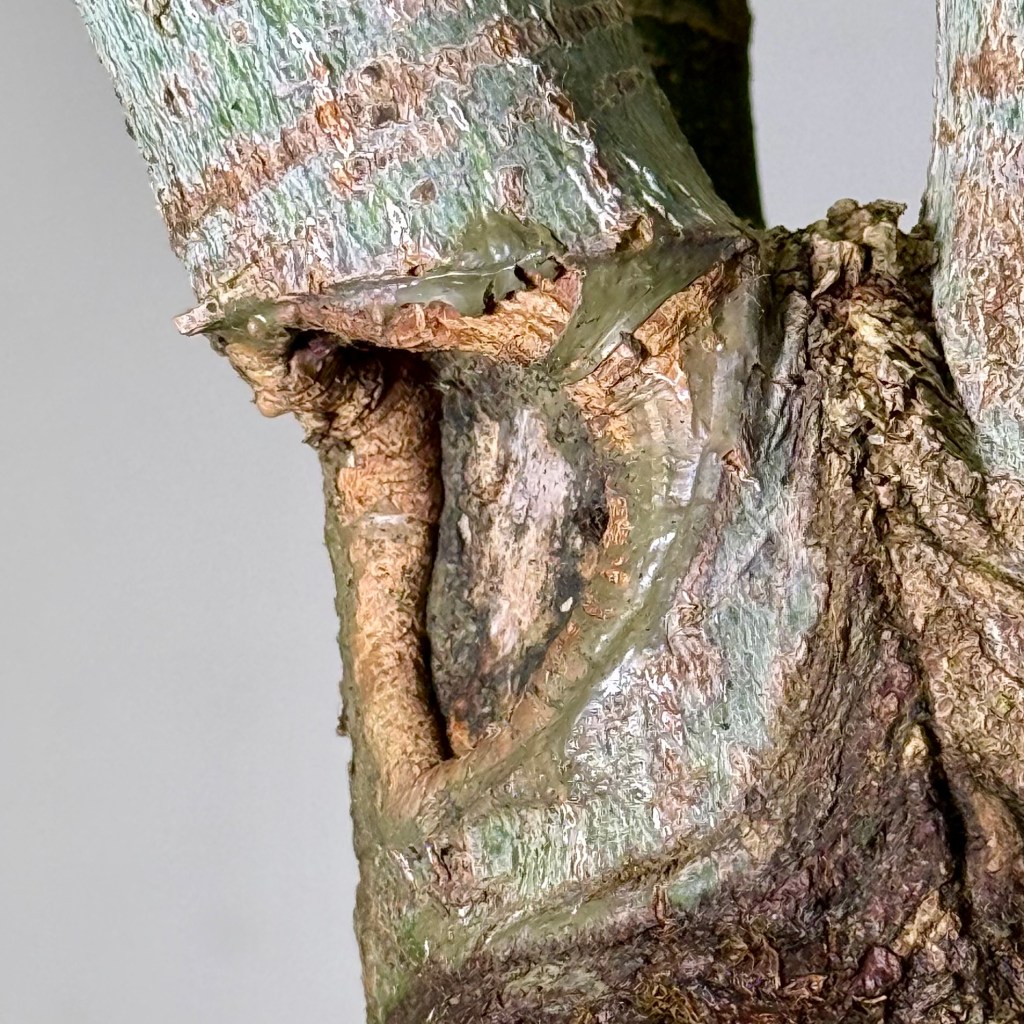
To limit the potential for root-kill, half-cut the trunk and leave it alone for a year. It’s best to cut from underneath, which allows the tree to start callus and woundwood formation on the bottom of the cut.
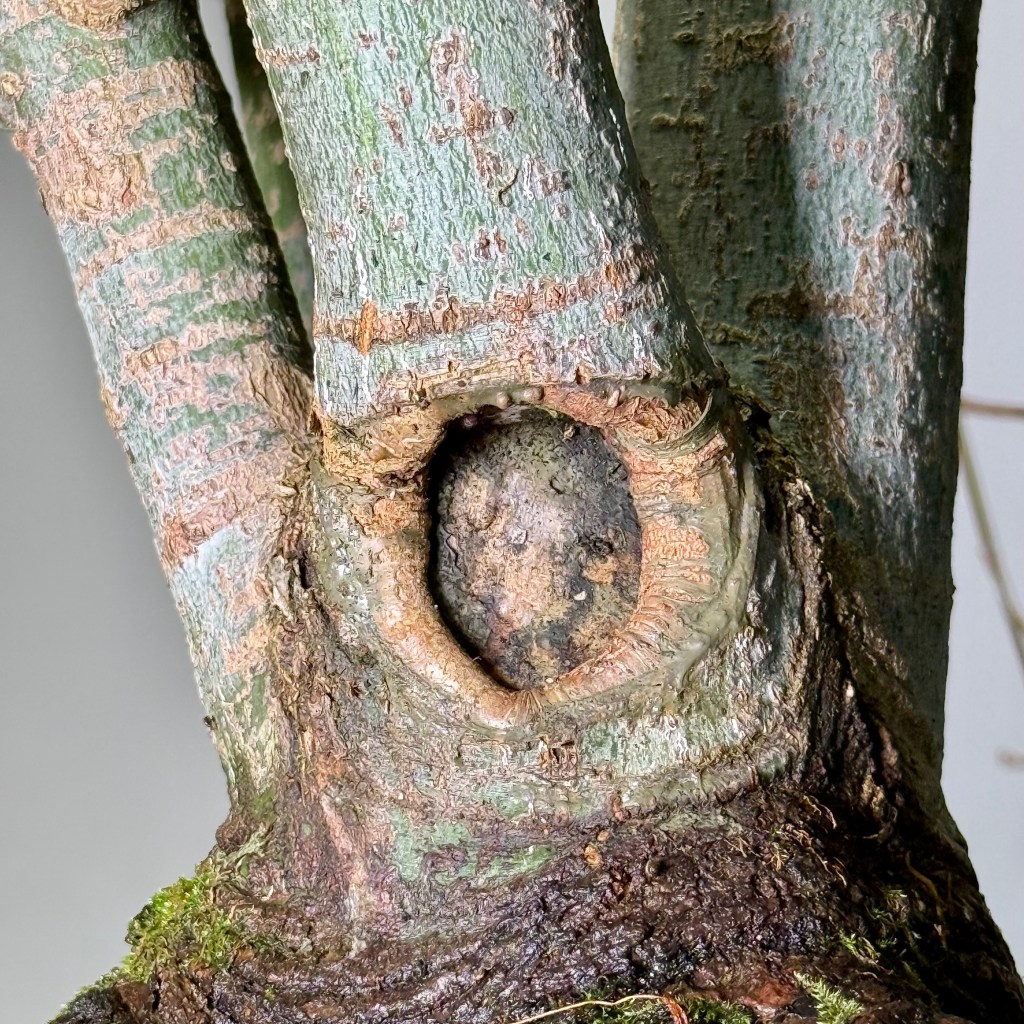
Another view of the same area, partially closed, a year later.
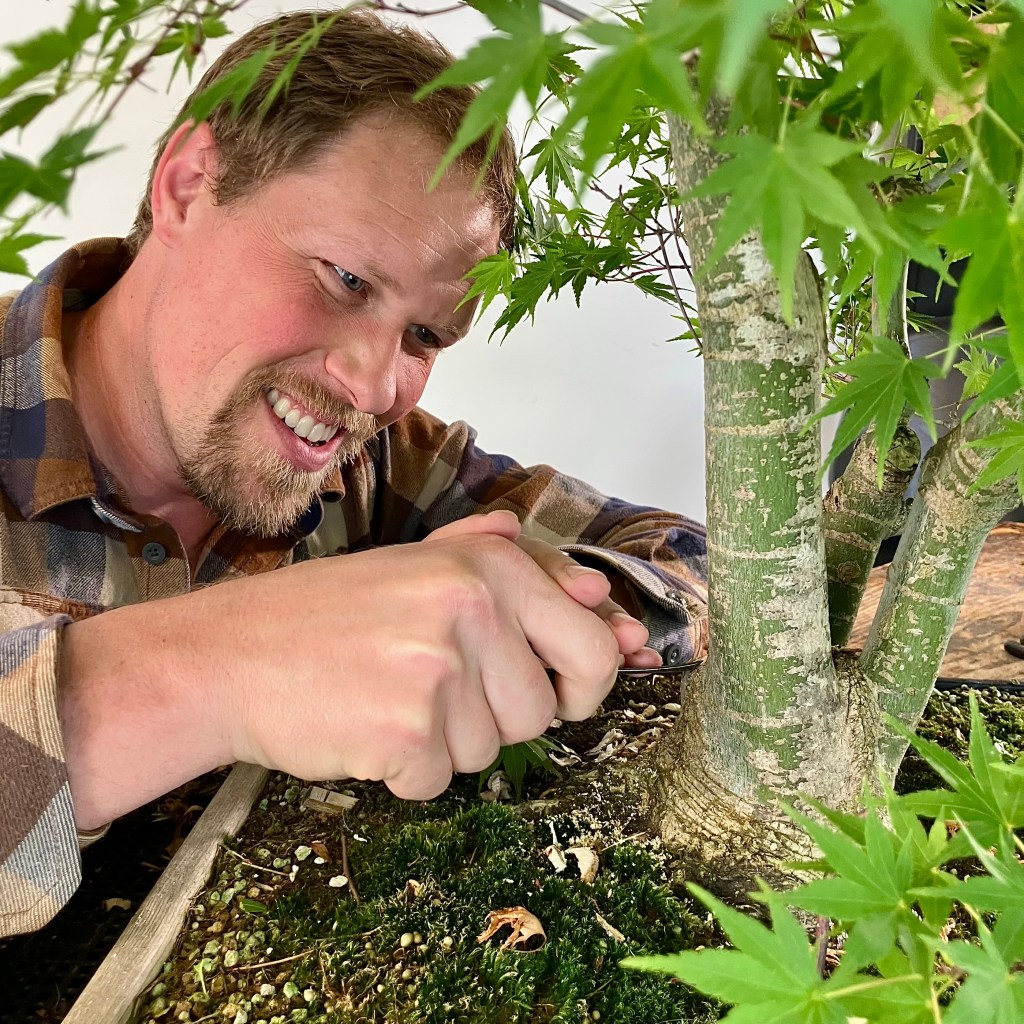
Last week we finally cut the trunk off. Aaron works a chisel for some clean-up. Removal is best done in the growing season when the plant has strong capacity to respond.
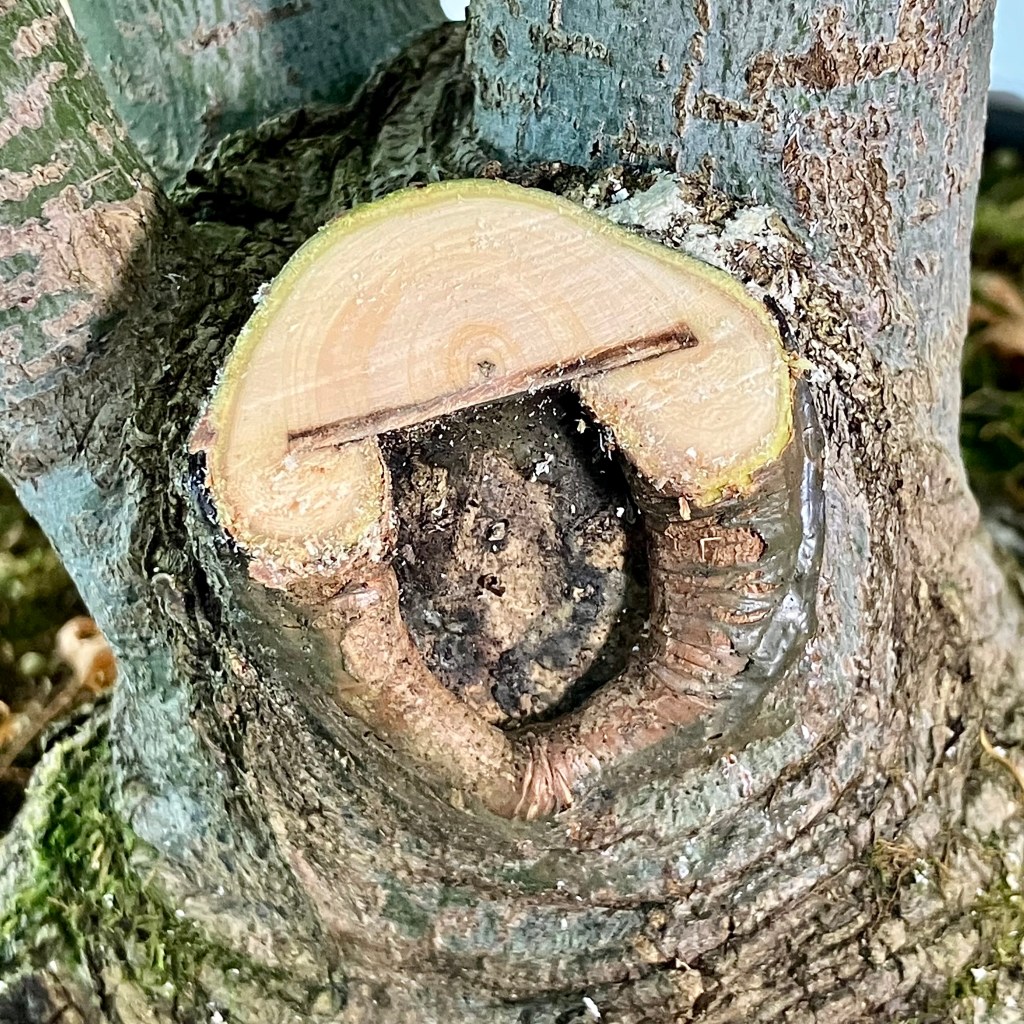
A fun photo before Aaron cleaned it up. The cut exposed the woundwood curling around the cut, showing the dieback of the old cut as a clean line. The tree is about an 8-year old tree, from an airlayer. After this the wound was cleaned up, sterilized with isopropyl alcohol, and sealed.
9 Comments
Michael,
I’ve been experimenting with a similar approach on a variety of species, particularly Korean and Japanese hornbeams. Several of my field-grown trees have large, thick branches, and instead of removing them with a single chop at the trunk, I’ve been reducing them gradually over multiple seasons.
My impression is that this encourages back-budding closer to the trunk and can eventually produce buds right at the branch junction, giving more options when the final cut is made.
I’ve also had good results using the Ebihara wedge cut when planning to remove a large branch or sub-trunk. It seems to improve healing and often stimulates budding around the area that will ultimately become the new transition point.
Thank you for sharing your observations and contributing to the discussion.
Mats
Great, thanks for these insights!
Great information as always Michael, i have used this technique too after you posted about reducing a branch foliage on a branch you were going to remove and allowing tree to reallocate its resources
Yes, simply weakening a branch over time can have a similar effect as the beavering technique.
What’s the straight line in the final picture?
Hi Michael—-Yeah, that’s hard to make out. It looks like the original cut was not immediately sealed, so there was consistent dieback of about 1/16”. When the cut was made at an angle, you see that dieback represented as a line. It looks like a piece of something stuck into the trunk, but is only a kind of optical illusion. Funny isn’t it?
I live on the Deerfield River about twenty miles from Amherst. Beavers are everywhere! While not the subject of your post, I have collected a number of hornbeams along the railroad tracks which were “chopped” by the beavers about 12-18 inches above the ground and which had resprouted branches lower on the trunks. I love to tell people that the trees were created in collaboration with a beaver!
Excellent interspecies bonsai collaboration story!
Hi Michael,
I have a number of very young trees. I’m guessing young seedlings/saplings could handle the removal of an extra trunk pretty easily. At what point (age or size of the extra trunk?) are these techniques needed?