An Important Distinction: ‘Decandling’ and ‘Breaking’ Pine Shoots
This is an edited post from 2016 on a topic I get asked a lot—deciding whether to break or decandle a pine.
For starters, let’s define decandling and breaking—
Breaking (or pinching) means taking part of the shoot off, usually with fingers, as the shoot is extending in early to mid-spring, and before the needles have come out.

Scots Pine candles at the ideal time to break them.
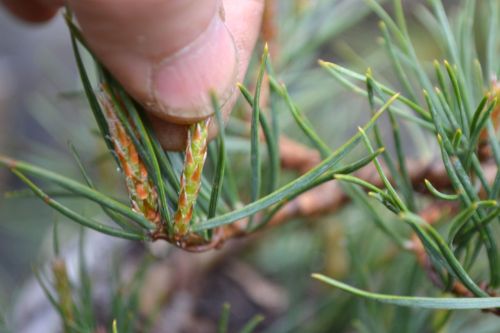
With the fleshy part of the fingers, bend the candle and break it off. Decide which candle to break according to its strength: take more off the stronger ones. Less off weaker. And leave the weakest alone.
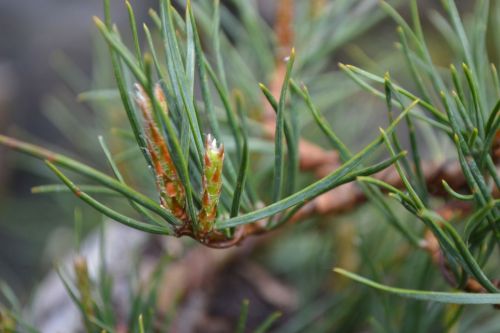
Right candle broken approximately in half. Very important: be sure you don’t have a “neck” below where you’ve broken it, a section where no needles will come out. Scots Pine have almost no neck, but with other species, like Japanese White Pine, that neck can be half the candle length.

Left candle broken.
Decandling means cutting off the entire pine candle off in late spring. This is a later technique, and often the new needles have come out already.

Japanese Black Pine before decandling. (This photo is more than a month early for decandling—usually this shoot would have its needles out.)

With a sharp bud scissors, the candle is cut off at the base.

Notice the small candles at the base. These must also be cut. We’re trying to “reset the spring” by decandling, and so everything must be cut.
Both maintenance techniques are good—one isn’t cooler than another, we simply apply them to different pines. And both are generally used on older, established bonsai, not young stock.
Which species for what technique?
- Single flush pines—such as Japanese White, Lodgepole, Shore, Scots, Limber—should be pinched
- Multiple flush pines—such as Japanese Black and Japanese Red—should be decandled
What happens when we break candles?
- With this early spring technique, needles that remain on the shoot continue to grow
- the pinched shoot is weakened while other, non-pinched shoots are strengthened
- over the summer buds set near the end of the pinched shoot, often between sets of needles, which then elongate the next spring
What happens when we decandle?
- With this late spring technique, new shoots arise from the cut site, growing through the summer, with needles coming out and maturing in the early fall
- resets the spring and balances shoot energy
- gives a shortened growth cycle, which results in shorter needles
What happens if we decandle the wrong pine?
- Older single flush pines lack the energy to grow twice a year
- if we decandle a Japanese White pine, or a Lodgepole pine, or any other in that weaker group, it will grow buds that summer that don’t open up
- that means we just created a summer that didn’t produce any needles, and we’ve just weakened our pine
April 2026 Bulletin Board:
- Errata: Mr. Shinji Suzuki is not presenting at the Portland Japanese Garden, but at the Portland Art Museum on July 19. Apologies for the confusion. The PJG is hosting his visit. Tickets are selling fast! Here’s some deets for the museum event: The Way of Bonsai

6 Comments
Great information Michael. I noticed you didn’t talk about the technique of candle breaking with double flush pines, in addition to candle cutting at the appropriate time.
My understanding is that both can be used (breaking followed by cutting) in combination to further balance energy. What are your thoughts on using both techniques with double flush pines?
Hi Oliver! Yes, you can pinch overly aggressive candles to rein them in a bit and prevent the twig below that from fattening too much. Once you have a highly developed plant this is not generally necessary, but it is a trick to keep in mind. For double flush pines, and just the several that are very strong. Sometimes you can get a single 10” candle that grows much stronger than any other on an 8” black pine, and then you might nip the top of that extension.
Thank you for your clear explanation between decandling and breaking along with photos. I’m by myself growing JBPs so it’s a difficult education at times.
Thanks Linda, I’m glad you enjoyed the post! And I understand black pines can be tricky. Keep at it! I have a few Black Pine related posts about decandling on the blog. Also Jonas Dupuich of Bonsai Tonight has a great set of posts on his blog.
I recently acquired a mature mugo pine and wonder about de-candling and/or breaking for this tree
Hi Randy! That’s a tree to break rather than decandle. But, it rarely needs breaking, as the shoots are usually very short.
There are very few pines that are strong enough to be fully decandled. Japanese black pine and Japanese red pine are the two main ones.