When Do We NOT Make A Concave Pruning Cut?
“Make a concavity when finishing pruning cuts.”
This is what we’re taught. And, for most part, it’s not bad advice. We use ball cutters or a chisel to hollow out an area where a branch was.
The callus and resulting woundwood that grows over the cut has some meat to it, so a depression makes room for that and allows the area to cover over without becoming a bump.
One situation calls for a different approach. A very large wound.
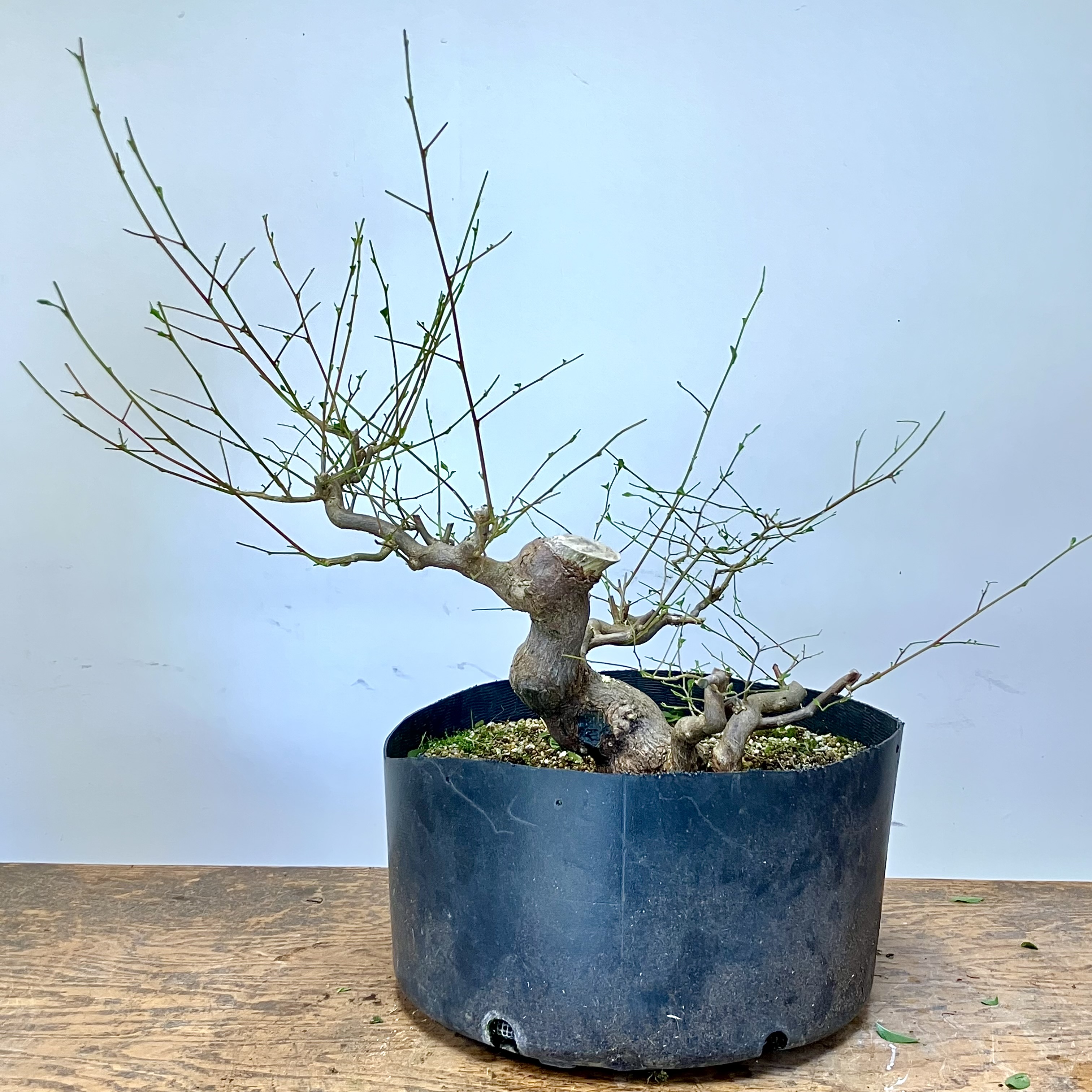
Our example tree, a Styrax japonicus, Japanese Snowbell. This spring we took off an air-layer, which left a large, trunk-sized cut. The bottom half of the tree still had promise, which is not always the case. But we still had this huge cut.

Our team—Arturo stabilizing and Ted braving the surgery. Using a fine-toothed Japanese pull saw helps with such exacting work.
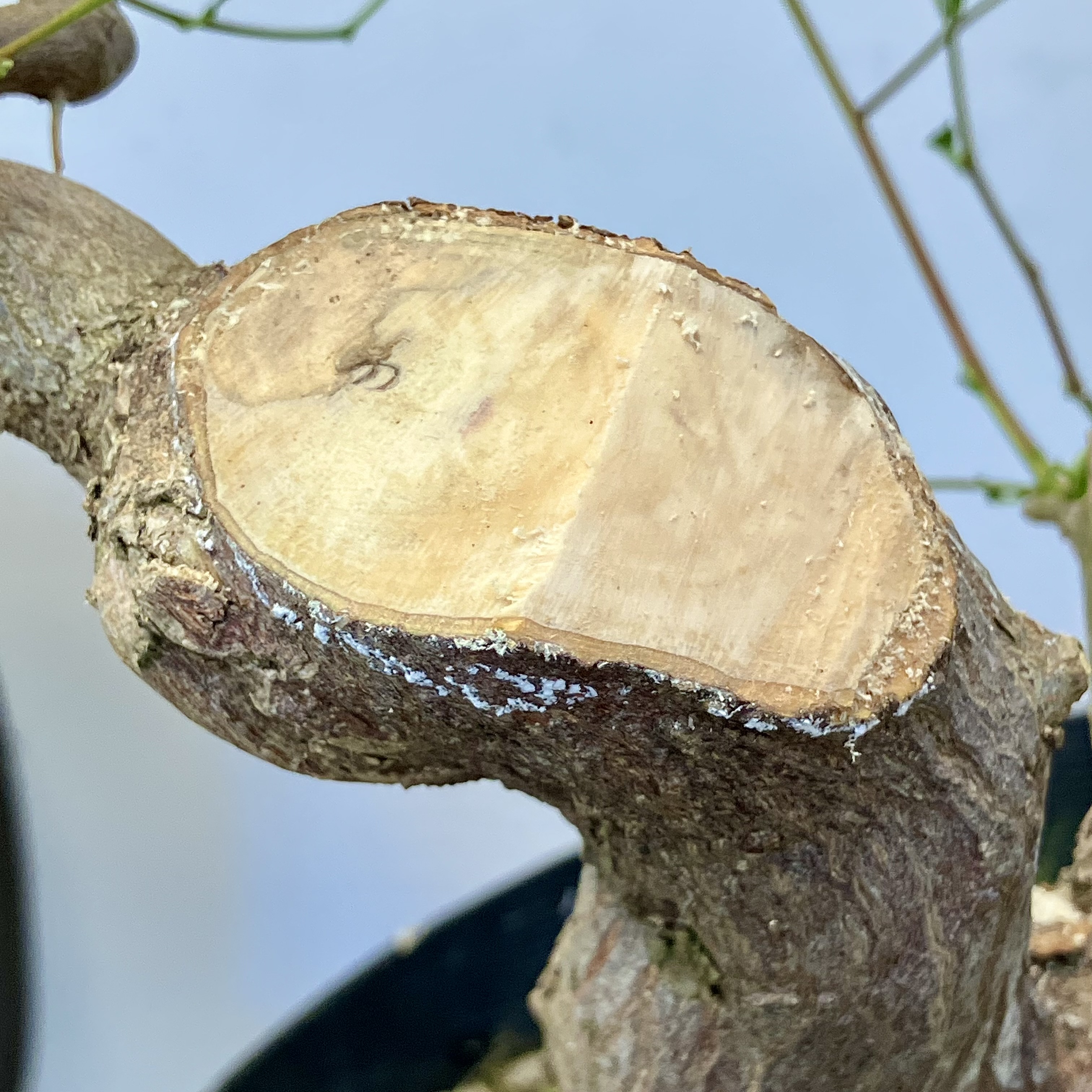
Notice that our cut is not a simple straight cut. It has two facets. The rise between the two will be smoothed over. A cut line in chalk is still visible.
The main thing is that this is not a flat cut, but one with a convex surface.
With a very large wound, of 2” or more, outward curvature gives a future advantage. If we did a concavity here, the wound might still close, but we’d have a depression. For a wound 1” and smaller, a depression might be perfect for the depth of the woundwood creation.
Trees make thin or thick callous. Apple is thick. Pine is thick. Satsuki is thin. There is enough variation that they become variables along with the size of the wound in determining what shape our surgery arrives at—concave, flat, or convex.

Small wounds are usually concave. Large might be convex, like this Styrax wound. We use Kirikuchi for wounds like this, for its strong activation of callus growth giving a better chance at closing a big wound.
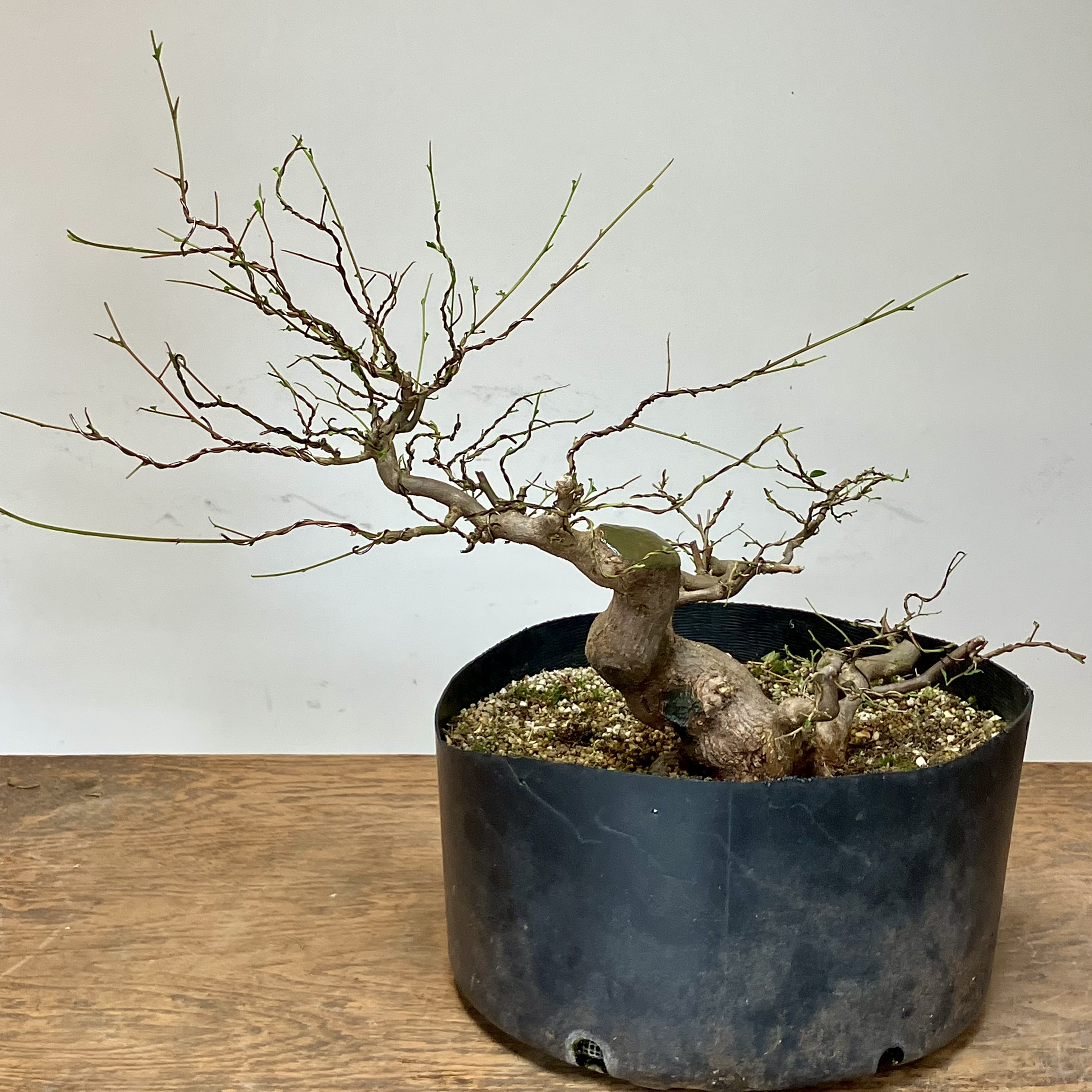
The final tree. It has a long way to go. A big wound like this on a Satsuki azalea might need another approach, like deadwood, for they rarely close a wound this big. But Styrax are likely to. Eventually, and with some cajoling.
The shoots above the wound have also been left to run. We may let them run a year or two to help close the wound. The design of the tree has a long way to go as well, so there’s no rush there.
We have a little tree from the air-layer that is fun, and now have another possible bonsai from the lower part. From one, two—a good spring.
6 Comments
Good discussion. Any thoughts about approach grafting a side branch to the wound edge (if possible) to help in the wound closure? Regards Tom Tynan
Hi Thomas,
Good question——there’s a technique called bridge grafting across a large wound. The whip gets attached to both sides of a callus, and when it grows help close it faster. At least that’s the idea. I’ve tried it several times without much success. You might try it on a thick-callused plant.
Any of these techniques to close wounds faster—-such as growing out a shoot at the edge of a wound—-tend to make another wound. So sometimes concentrating on closing your wound with growth on top and choosing a good wound closure putty or liquid seems best. At least, it may make a cleaner closure.
Good article Michael! It’s good to know the differentiation between cut technique.
Would emphasize two things about large cuts on satsuki or other azaleas. One these cuts, as you alluded, are normally slightly convex, following the curvature of the trunk.
Second, to preserve the lifelines large branch cuts (> .5” or so) on a potted azalea are usually 2-3 step. 1 /3 to 1/2 way through one late winter early spring when active. (And double seal) Then finish in late fall or early next spring. or For exceptionally large chops cut sniffer 1/3 through in fall.
Then in the next spring when tree is active, finish the cut. Leaving small amounts of foliage above/ or on the cut side of the cut between cuts. This will give virtually 100% intact lifelines vs about40% lifeline dieback over a longish time.
The major exception is robust and healthy trees coming right out of the ground or from a box. Satsuki Kenkyu
Great topic! when and how many times do you rework the edges and have you tried using kirikuchi with the ‘old plastic wrap technique ‘?
Thank you for another wonderful example!
Like Paolo, what do you do with the sharp edges on the cut?
Hi Steve——we clean up the edge with a sharp exacto blade or knife, then seal all the way to the bark. Either liquid or putty, both can be effective.