100% Pumice As Soil
For years I’ve been impressed with the bold root growth in boxes with collected yamadori, in 100% pumice. Trees as distinct as Pine and Maple have predictably strong root growth.
Once I recall trying to stick a chopstick into the pumice of a Vine Maple I’d collected only the year before and failed, the roots were so dense. Since then I’ve often wondered about pumice and its potential as the sole soil component.
Two years ago, out of a curiosity I could no longer control, I put two Japanese Maples in pumice in a modest-sized bonsai pot, thinking, here’s a tree that likes water. If it struggles in 100% pumice, there’s a ceiling.

A Japanese Maple 2 years after potting in 100% pumice. The tree was grown under 40% shadecloth and grew as vigorously as any in my usual 50/50 akadama / pumice deciduous mix. It had no burned leaf tips or any sign of water stress.
We sifted the pumice to 1/8”. Fairly small.
Last year we repotted one maple, and this spring I repotted the second one. This isn’t an impressive data base, but what I found was intriguing enough to share.
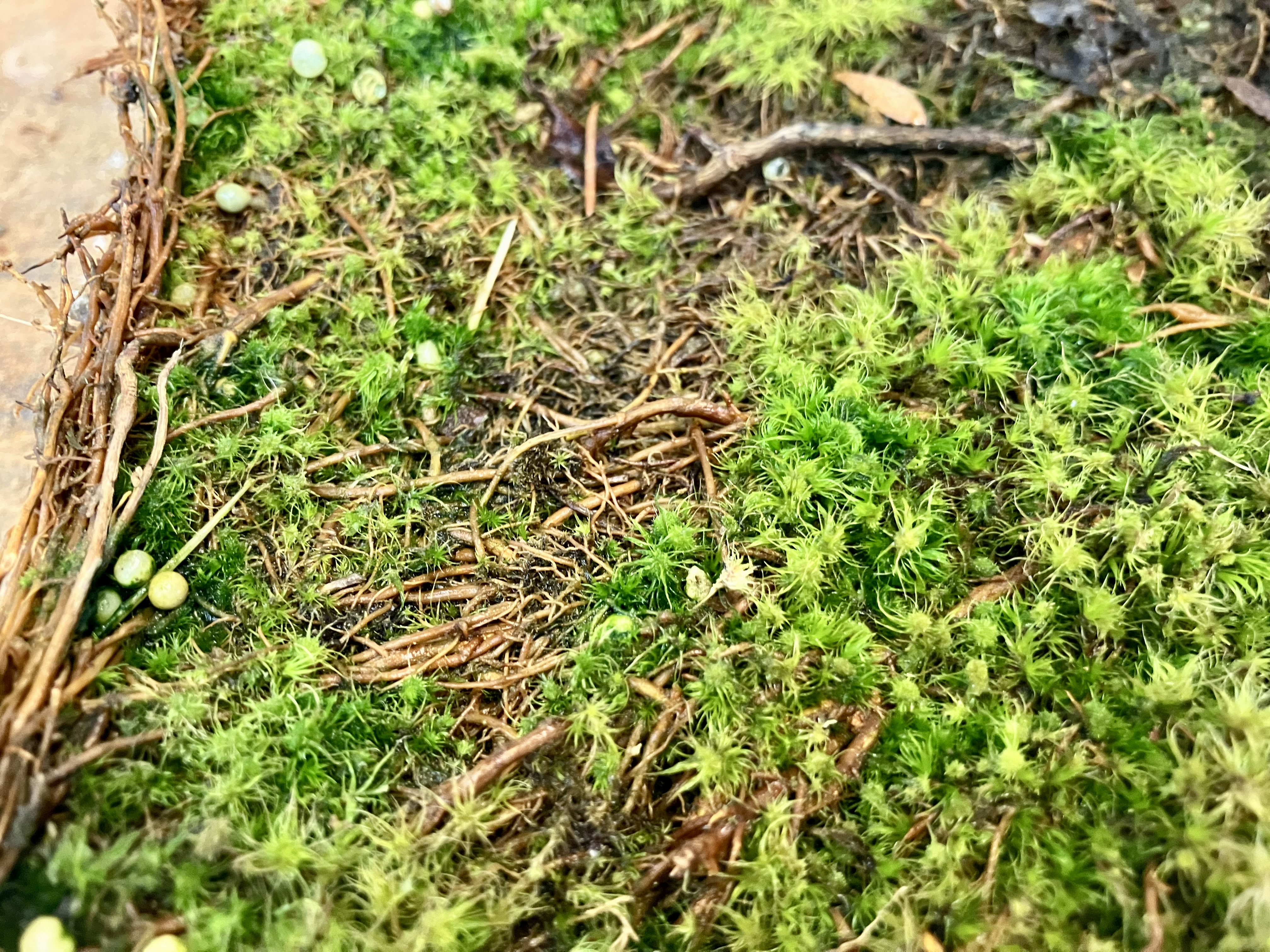
Worried that the top of the pumice would dry out excessively fast, I added a thicker top dressing of sphagnum moss than I usually do. Strong, bold root growth happened here, which fuse well and which could create good nebari. So it wasn’t 100% pumice, more like 95% pumice. Next time I’ll try a thinner layer of moss on top to see if there’s any difference.
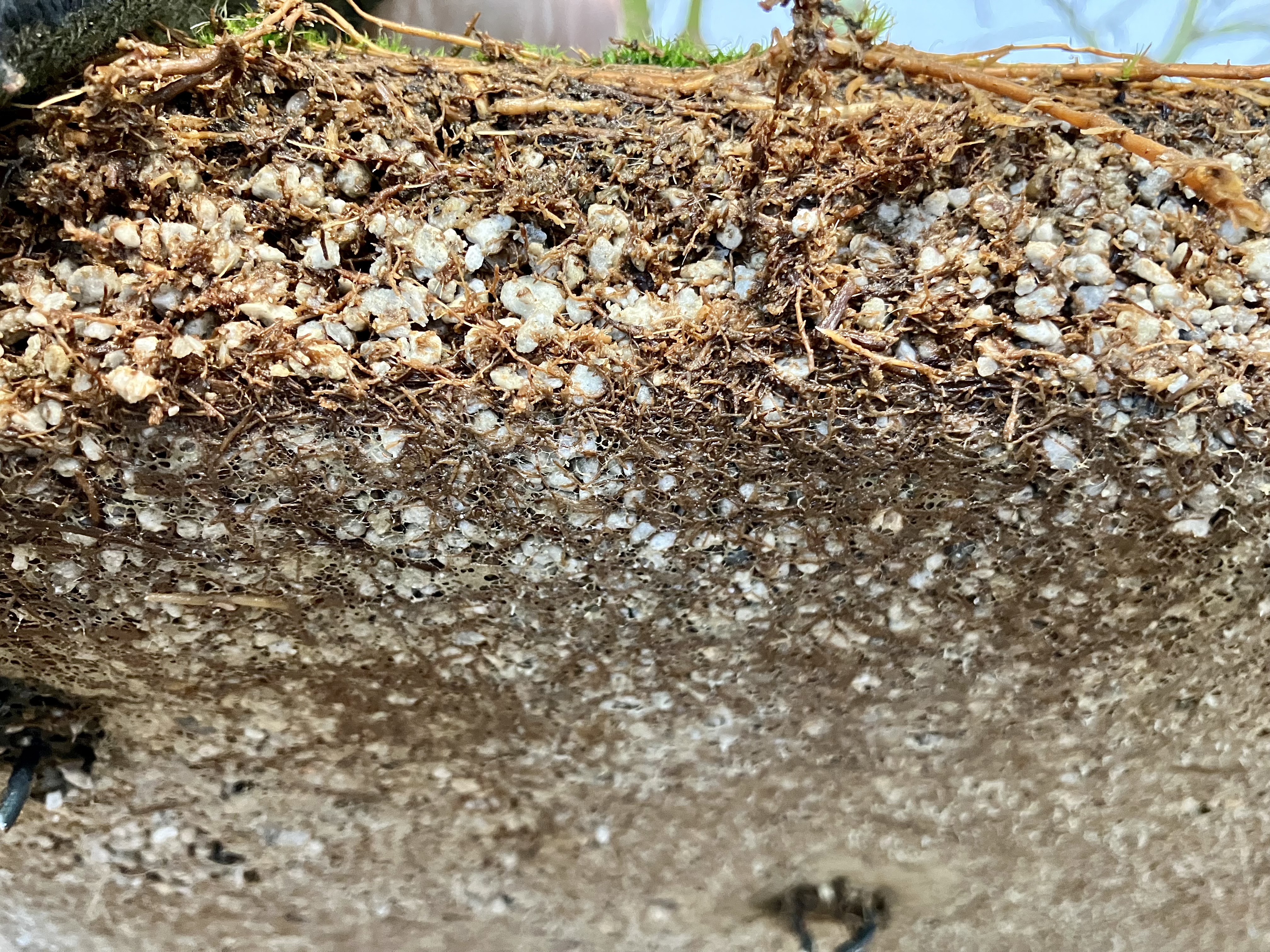
Underneath was promising for bonsai. The fine pumice grew fine roots. One thing I shared in Bonsai Heresy was that if a plant has fine ramifying roots, they like it there.
Roots need three things: oxygen, water, and nutrition (covered in chapter 5 of Bonsai Heresy). If they don’t find those, they stop growing. Given the fine root growth in the small pumice—about what I’ve seen in akadama—these roots were happy.

This is the sort of root system that has good longevity in a pot, without becoming woody. I expect with a larger pumice size we’d see more large roots in this lower zone.
It may bear noting that I’m using local pumice from Oregon or Washington. This is lighter with more pore space than the pumice from Japan or in other parts of the U.S. In some situations it floats when watered, though not as much as perlite.
Pumice can be as expensive as akadama in many places. I want to use it because it’s cheap here in the Pacific Northwest, so clearly I am invested in seeing it do well. Which is hardly a strong position even for citizen science. So—take this “soil share” with a hefty grain of salt…
28 Comments
What’s the nutrient holding capacity of pumice?
Good question—though I don’t know the ion exchange data, I did once look up the mineralogy of pumice and was surprised how rich it is. As for fertilizer, we used Osmocote on these maples, and that or an injection system into the water hose would provide constant fertilizer if pumice has a low holding capacity. In any event, given our results and how it matched the shoot growth on those in other (more expensive) mixes, it seems promising that there is a way to make it work.
How often would you water these trees in the 100% punice
We watered them the same as pots containing 50/50 pumice/akadama. Once or twice a day in the warmer months.
Good day Michael. Do you wash your pumice?
I have seen pretty much the same results and have used a lot of pumice because i never could afford Akadama. Do good things today.
Hi Lee—-no, I don’t wash any soil element. During repotting season I have trouble drying anything out, being so moist here, and I’m not organized enough or have space to do it in the summer. I do flush pots out when watering in, though, until the water runs clean, which is maybe similar.
Nice work. Any thoughts on this for a dryer climate such as Spokane? I plan to give it a shot with a couple of developing maples this spring.
Hi Marty—it might work ok there in Spokane with that 1/8” pumice. When I lived in Arizona I was surprised that Boon’s mix did as well there as other climates I’ve lived. The soil we use may have less relevance to where we live than I used to think.
Perhaps it’s not that the soil is relevant to where the trees live, but it is relevant to the materiality of where we live.
i certainly don’t even those outside the Pacific ring of fire however
It is a good point, Will-
Two Questions, Two species:
For a Spruce that is not so healthy, would 100% pumice help it in your opinion?
For Developing Chojubai, would this little study you’ve done suggest to you to develop chojubai in 100% pumice? rather than an 80/20 blend as you’ve described before?
Yes definitely for spruce, they get strong in boxes in pumice. I often add more pumice even when not using 100% just to add more air to a mix, and to improve health.
Good thought with chojubai—but as I’m developing those plants, I expect greater shoot growth with the addition of an organic soil element.
Neat experiment! I know one of the small drawbacks to pumice is the lighter color, but I guess if you have a layer of sphagnum on top that doesn’t really matter. I wonder if it would be possible to dye the pumice with sumi, or at least the top layer, to help it stand out less in areas where there is no moss.
You could try to dye it—-if you use ink, use a permanent india ink. Then again, be careful what is in the ink…
Has anyone tried Perlite vs Pumice?
Yes, good question—-perlite is wonderful stuff. Warren Hill promoted its use decades ago. Andrew Robson uses quite a bit, and likes how light it is in large pots. I’ve potted yamadori cliff rose and other curious broadleaf desert plants in it when I lived in Arizona, and was impressed by the root growth and the insulation value.
My husband and I moved from the UK to New Zealand 20 years ago and Akadama was an unknown concept so we used sifted potting mix and pumice for years. In the last 5 years I’ve moved more towards either 100% pumice or 3 or 4 to 1 of pumice to compost. My trees do well and I have great root growth. Akadama is now available in this country – but only if you have mega bucks – it’s way too expensive for us to think of buying – I’ll stick to my tried and tested pumice substrate.
Thanks for the report Ann! Yes that akadama can be prohibitively expensive. But then even pumice can be for those far from volcanic areas.
Hello Mike. Nicholas Montiel here. I don’t know if you remember me trying to hang around you and Ryan about 10 years ago. I been using 100% pumice in Juniper nana for about 10 years and had awesome results. For me the microbiology doesn’t seem to as active. My skills in plant nutrition are lacking but I think it takes more time to build up the nutrition holding capacity. Weirdly i also don’t seem to notice the plant slowing down with time in the pot thing seem consistent year over year if not gets more vigorous. Any thoughts on some of these observations.
Hi Nick! Thanks for the report—- I think pumice would require a fairly steady fertilizer application, some sort of slow release (as we use, a prill) or injection liquid through a hose. An organic fertilizer might be good. Plants do seem strong in pumice, with more energy momentum over time. Might be lack of breakdown. Not sure.
Hi Mike, thanks for the info, very interesting.
You said you used 1/8th size pumice. Is it fair to say that this was smaller than what you would have used if it was the normal mix with akadama? I’m just wondering if the thought process was that since the pumice would typically hold less water maybe that’s why you used a smaller size to compensate for that?
Hi, yes, I think the size matters a lot to water capability. 1/8-3/16th inch is my deciduous size, so it’s about the same. Smaller soil holds more water no matter what the particle is, so your thinking (as I see it) is correct.
Great information Michael. I live in NE Oregon and there doesn’t seem to be much pumice for sale here. I come to the Portland area once in awhile. Where is that area would you recommend I buy pumice? Thanks in advance
I live in Portland and buy my pumice at Concentrates in Milwaukie (https://www.concentratesnw.com)- they have it in 3 sizes usually- fine <3/16", medium 1/4-3/8", and large 1/2-3/4". About $7 bucks for a 1 cubic foot bag.
Concentrates is good!
Hi August—- The landscape supply places have it, usually, those that sell decorative gravel and such. If you come to Portland area try Pro-gro in Wilsonville or Mt. Scott Fuel in Portland.
Thanks so much for sharing the results of this experiment of yours with us! Most appreciated.
I have access to Japanese hyuga and there is just no better substrate in my experience than that for stimulating new root development. It stands to reason then that if building trees it should also form at least a part of the growing mix. I’m not sure about refined trees although in theory it should be brilliant too.
I am currently using it for various trees including Trident maple and collected wild olive which has no moss on the surface, and that in the hot African sun. However this has not stopped plentiful surface root development.
I personally do not like perlite. It’s too light and the dust is harmful. Potted trees are easily blown over in the wind too. Unlike hyuga/pumice it can also not be reused as it’s reduced to dust (and then holds far too much water in my view), as you have previously written too. But it’s cheap.
My mix for developing pines is 70% crushed silica (as I cannot get granite) and 30% peat. I think the stone, or rather the heat it holds promotes root development. However I would be keen to try the pumice (fine particle) to replace the stone as the stone of course just takes up space where the pumice can hold moisture, beneficial bacteria and fertiliser.
Love your blogs, always very insightful and helpful Michael.
Thanks for the thoughts Terry! Hyuga can be wonderful for developing roots. It is a good pumice. Interesting your reports of good surface root growth with it, without moss.