Extreme Pruning-
In bonsai, “pruning” is a catch-all word that covers several related plant actions.
On a bonsai, a scissors could be considered a pruning tool. Then there’s the periodic hard cutback into old wood, using concave pruners. Then there’s extreme pruning, applying a saw to every last trunk and large branch, leaving little or no foliage.
Last month I saw a good example of growth following extreme pruning.
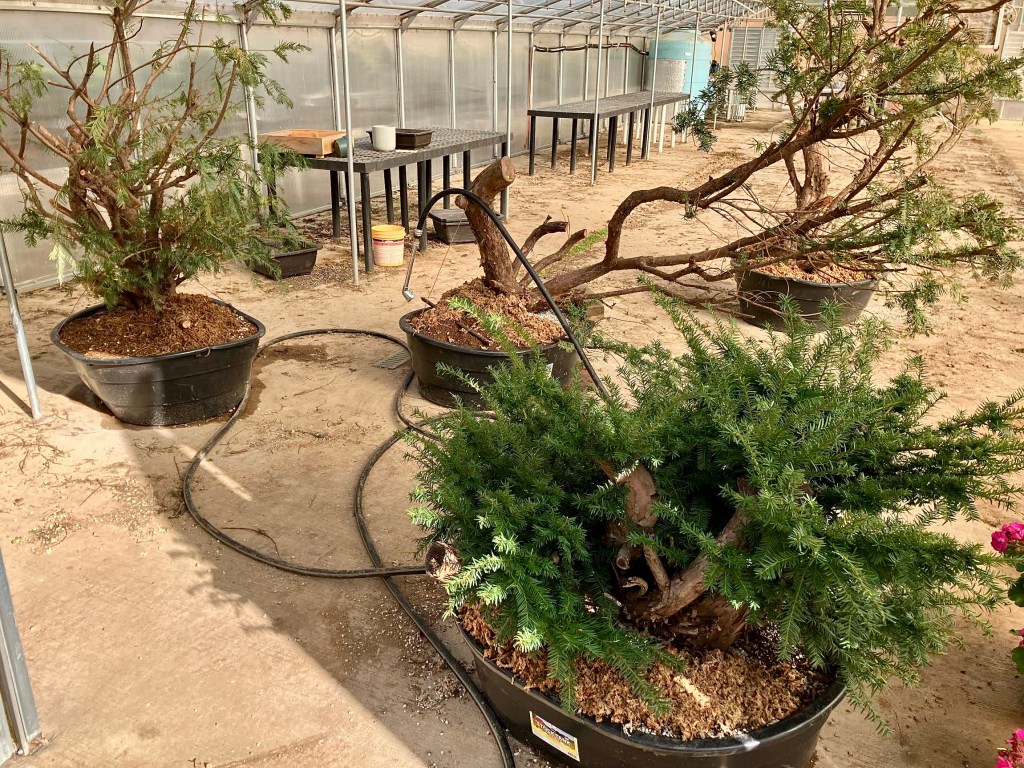
Yews just after collection. These are big yews, taller than a person, and these are not pots, but tubs. The plants in the background were not extreme pruned the year before collection. The one in front was. This early extreme pruning gives the yew in front a big advantage—the large in-the-ground root system flushed many low shoots that can support the plant in its first year in a container. The ones in the back will have a harder time this first year.
Not all plants respond well to this. Some plants can be extreme pruned before collection and some should not be.
You may have noticed that few recently collected ancient conifers from the mountains have pruning scars on them. Most of these trees are compacted to begin with, with little to cut off. Secondly, these old plants need all the photosynthetic surface area they can get to reestablish roots.
Some common bonsai plants do not respond well to extreme pruning—leaving little or no foliage—even if strong: Pine. Juniper. Others usually do well with extreme pruning: Azalea. Boxwood. Most deciduous trees.
Timing is the last consideration. Plants such as yew, azalea and deciduous may be extreme pruned in the spring as growth starts. That gives the longest season of growth for the plant to rebuild its resources.
6 Comments
I was under the impression that boxwood generally died back from extreme pruning i.e. leaving no or few leaves. Does this vary with the species/variety? Do you have to cut back the top, fertilize heavily and leave it in the ground for a year to prevent dieback?
thanks.
Hi Allen— Yes in some situations. A weak boxwood will behave poorly after strong cutback, but so would a yew. If the plant is strong and it’s cut early enough in the year, they usually respond well to cutback with new shoots.
If you wanted to phase toward a collection, I would switch up the cutback and heavy fertilization—-fertilize strongly first, then cut back. Then collect the next year. If the plant is weak that’s a two year wait. But definitely possible!
Great blog for us bonsai people who are collectors on occasion if the opportunity arises. I’m always on the look out in old landscapes such as this for material. If the landscape owner allows you a whole growing season to extract your material, this is ideal. You cutback (big time) in the spring and dig in late fall after a couple of freezes if your climate allows it. Beware! Digging one of these is a full day job or more.
Good advice, thanks Steve!
How about cut back on my mikawa yatsubusa?
Hi Robert, I find pruning back dwarfs is the same as their larger cousins. The timing I mean. Mikawa however as a pine is not going to bud back and throw out long shoots in one growing season as a yew might. Always need to cut back to good buds with foliage on a pine.