Directional Pruning: A Case Study
We tend to think of large cuts as being structural, and small ones as being maintenance. This is an example where small cuts are structural.
Though the example here is a dwarf flowering quince ‘Chojubai’, how to sculpt your bonsai with scissors may be applied to other deciduous trees.
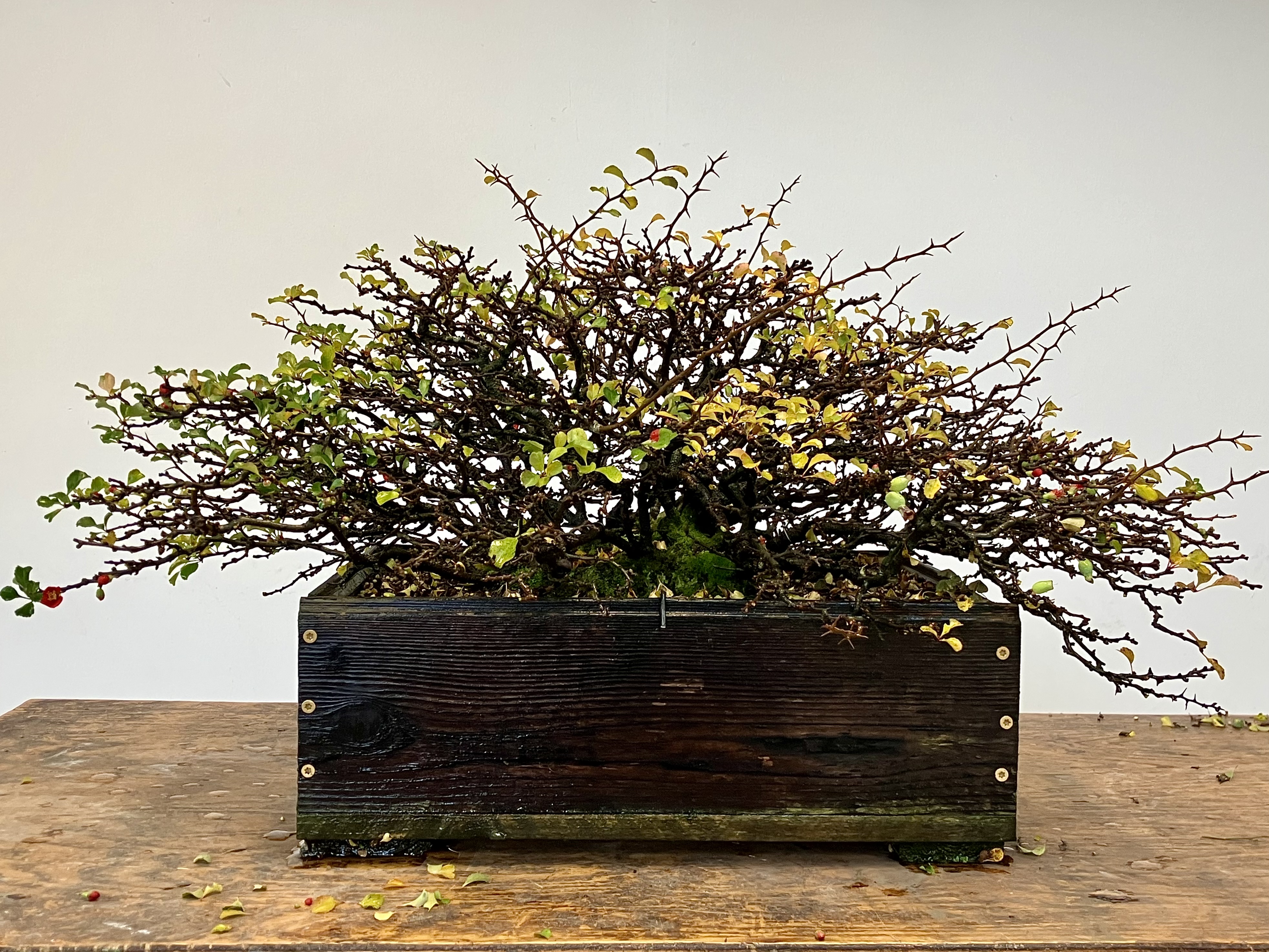
A Chojubai with shoots that grew over the summer following a June trim.

If you cut here, the future shoot will grow in the direction indicated by the red lines. The buds on Chinese Elm and Chojubai are small. If you have trouble seeing tiny buds, consider magnifying glasses and a movable light.
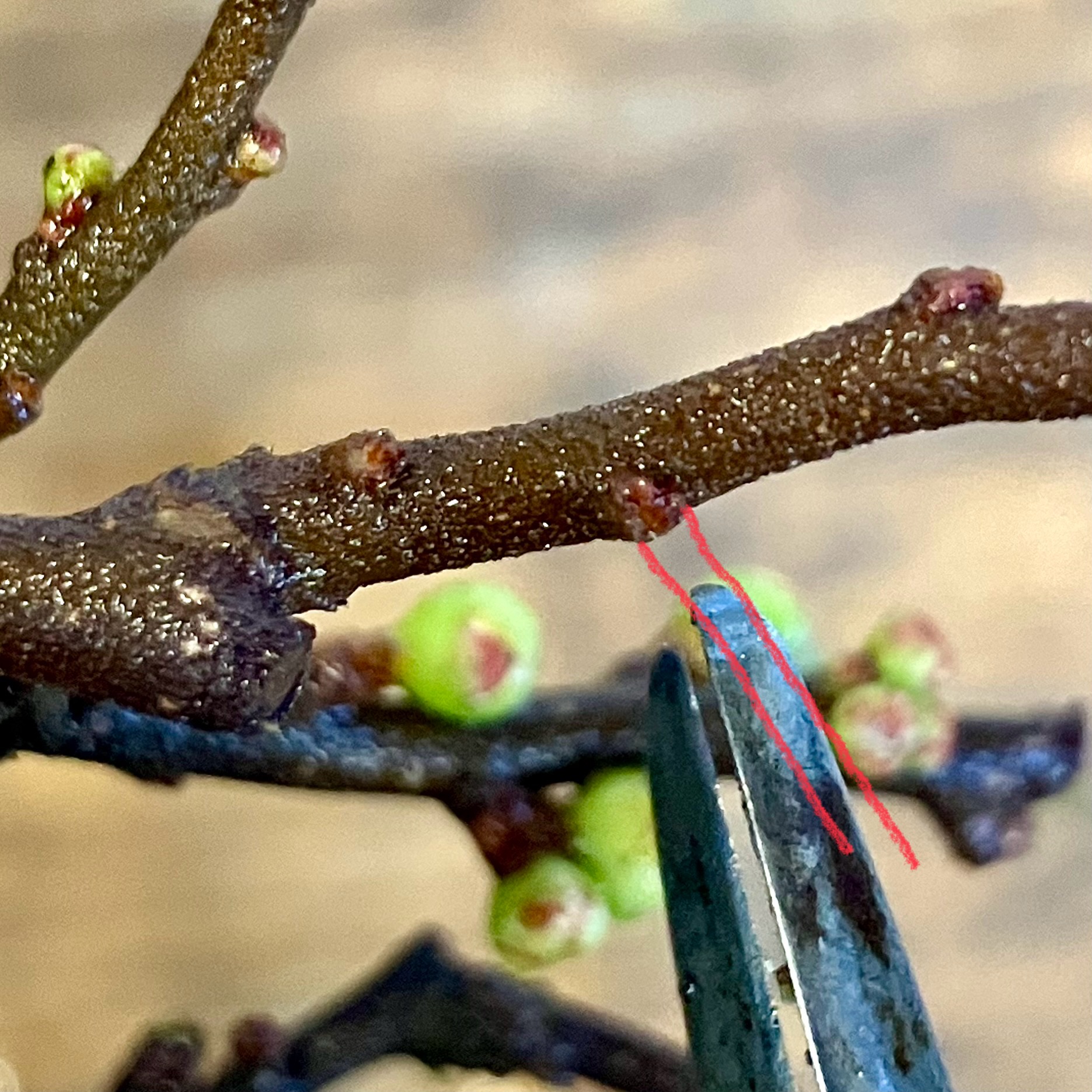
If this second bud is chosen, the shoot will grow this way.

A third bud, a third direction. In each option we have a choice of direction. If we choose poorly, the future shoot will grow into the tree and we’ll end up with a tangle. (This assumes you want to continue scissors-only work, for wiring is always an option. The following suggestions assume no wire.)
It is possible to cut to desired shoot length without paying attention to buds, especially if you’re busy and have a lot of plants to get through. But you may end up spending more time in the long run.
Shoots that grow to the inside of the bonsai design will need removal or cutting again to redirect them. Haphazard pruning of deciduous trees not only sets up more work but it wastes earlier work.
But—there’s always a caveat—scissors-only work is slow work, as we need to look at each bud direction to determine future shoot direction.

This specimen has had directional pruning for 15 years, with most cuts around 1/2”. Notice how the branches all flow outward. At the micro level they have idiosyncratic movement, which is hard to replicate with wire. But if the shoots had been cut randomly, without attention to bud direction (and hence future shoot direction), this Chojubai would be a snarl of branches with no organization.
Training this way does take a few seconds more per cut to identify and plan future shoot direction, but you may find it has a big dividend in the shape of the branches and the bonsai.
Note: For this example, I recommend cleaning up all dead leaves from branches and from the soil before winter storage. Dead leaves enhance growth of funguses like Botrytis, which is a benign fungus for most plants but can cause twig dieback on Quince.
6 Comments
Great Tips! When you ave a chojubai in a box with an 80/20 pumice/bark mix, with the goal of development, how often are you repotting?
And that’s a great question… much less than a normal plant. Trees seem to fill out pots fast. Most shrubs, slower. Chojubai is one of the slowest. In a 3 gallon nursery pot you’ll be at 6 years or more before you may need a repot. At 1 gallon, sooner, though.
Love these posts on Chojubai ! You are know how to lure people into Chojubai .
Am curious – are there any other plants that have the same grow patterns like Chojubai ? Meaning nodes in all directions like 270 degree coverage rather than simple alternate
Hi Abhishek— Yes actually many plants are like this, like apple or birch. The flat sprays are less common, like elm. The chojubai internode is so short, though, that you get micro control over the direction with choice about how long the shoot is before you cut. For some reason (not sure i can explain this) but the chojubai can then get that idiosyncratic feeling to the branch line. It doesn’t happen naturally—left to its own devices you have long straight shoots.
In case of small buds that are not easy to observe, I use headlamp, or “touch and feel” method using sensitive ends of my fingers to locate and select desirable bud.
Hi Greg, that’s another way to do it! Thanks for sharing-