Root Grafting Stewartia
This week, a photo essay of a Stewartia root graft in a recent winter Seasonal class. These winter classes are focused on repotting, and a great time for root grafts.
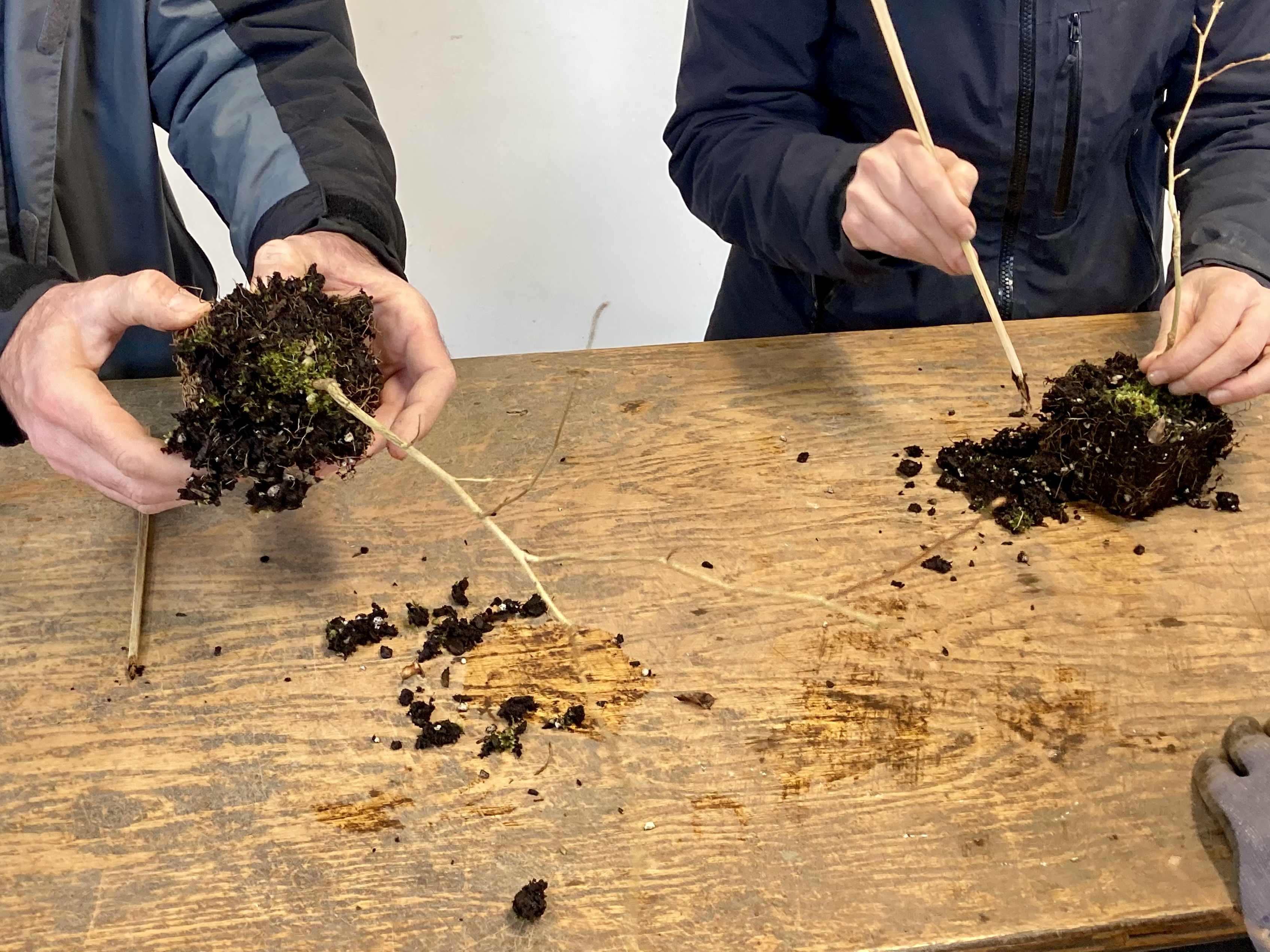
A couple prospective Stewartia seedlings for the root grafts.
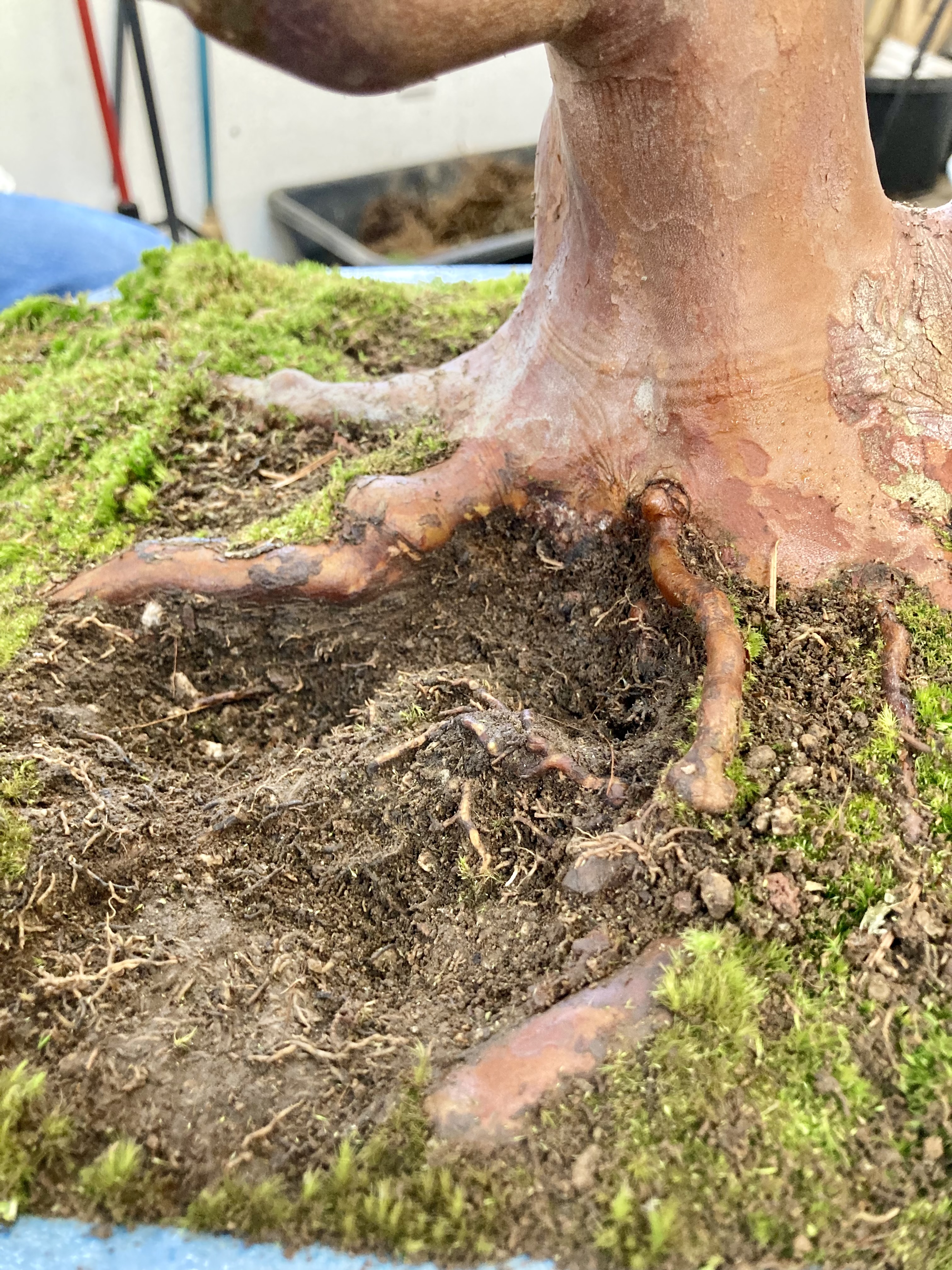
One site excavated to accept a root graft scion. This area could have better surface roots.
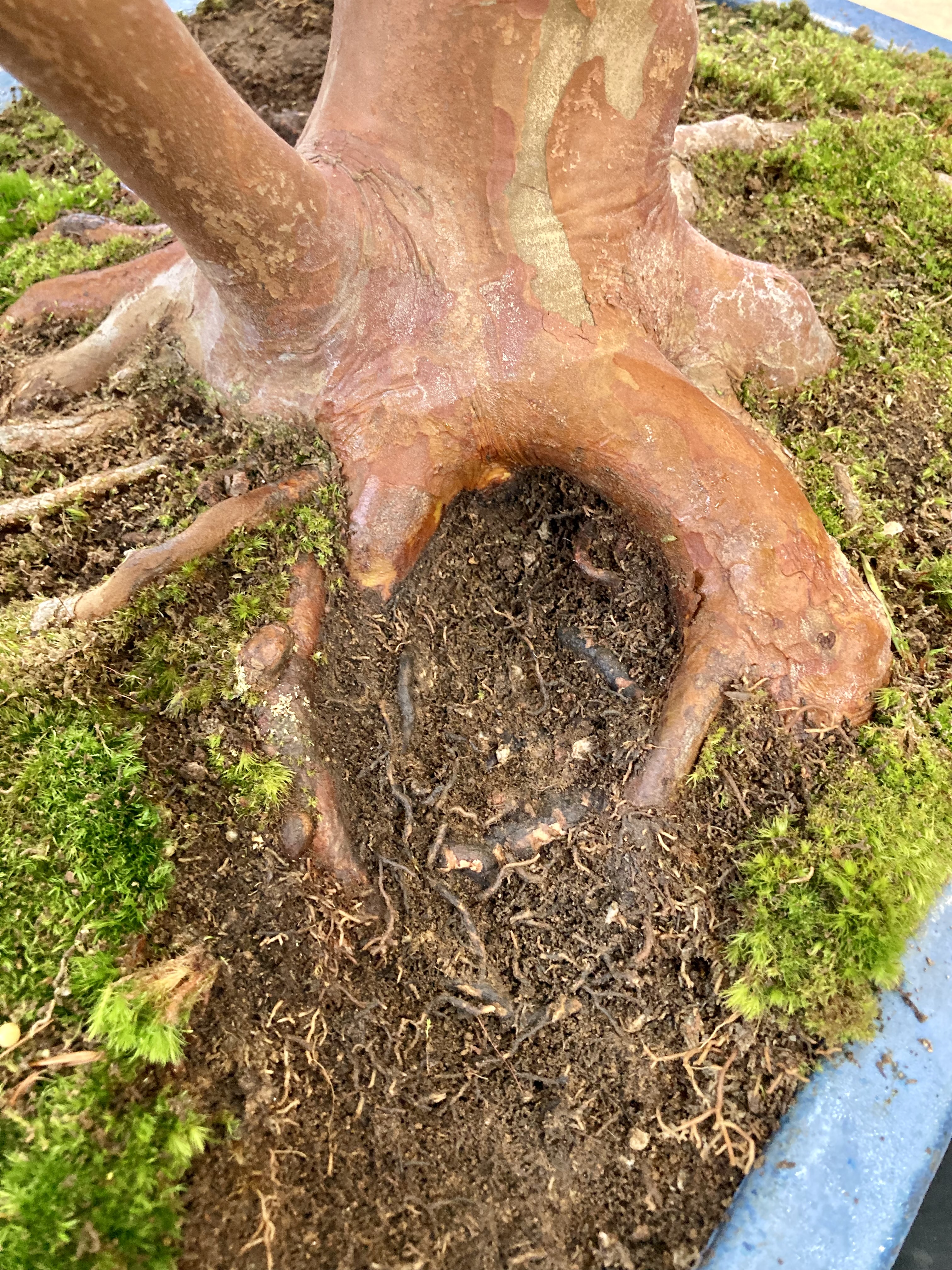
A second area that needs nebari roots.
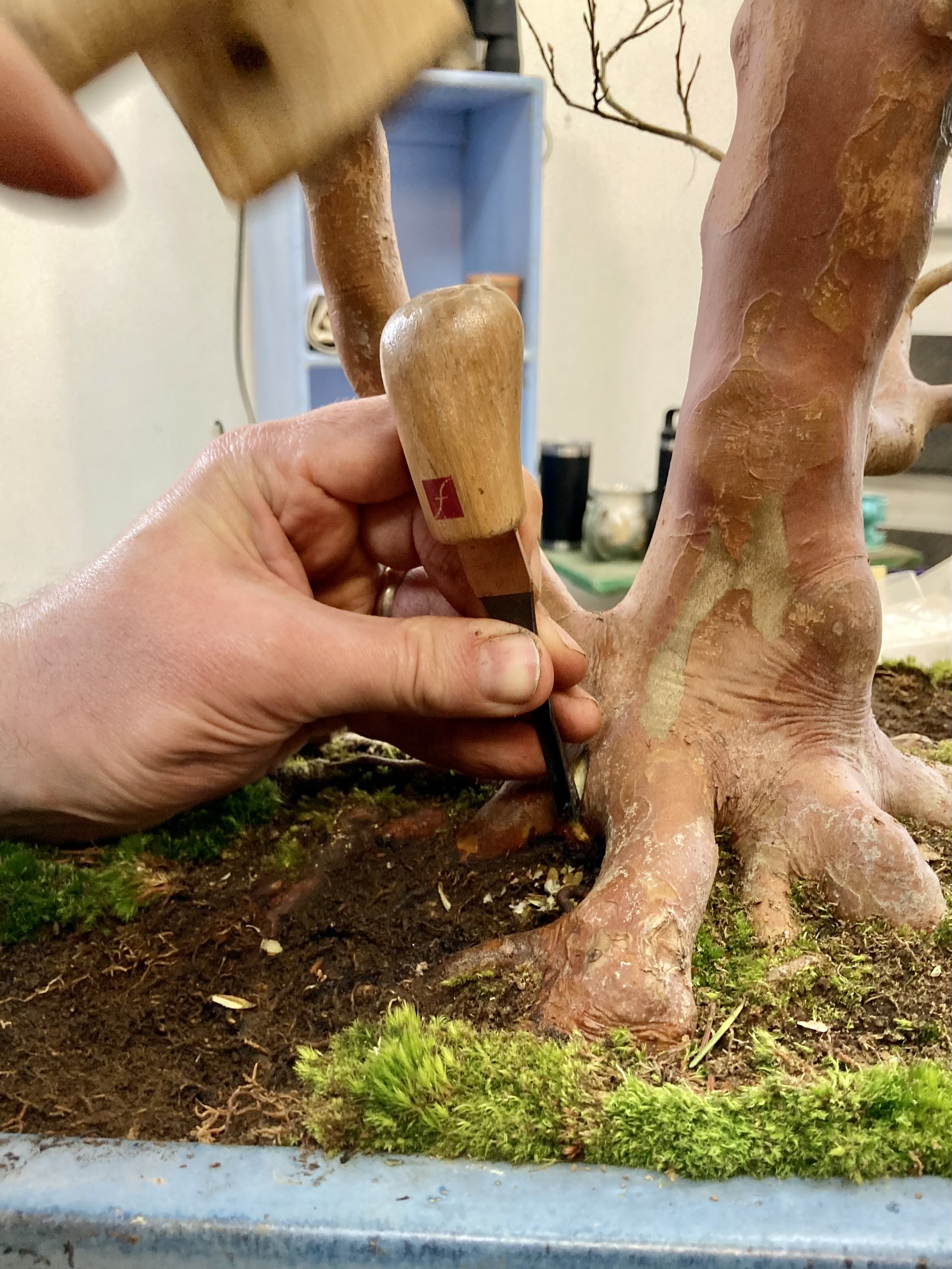
Chiseling out the groove to accept a seedling’s lower trunk.
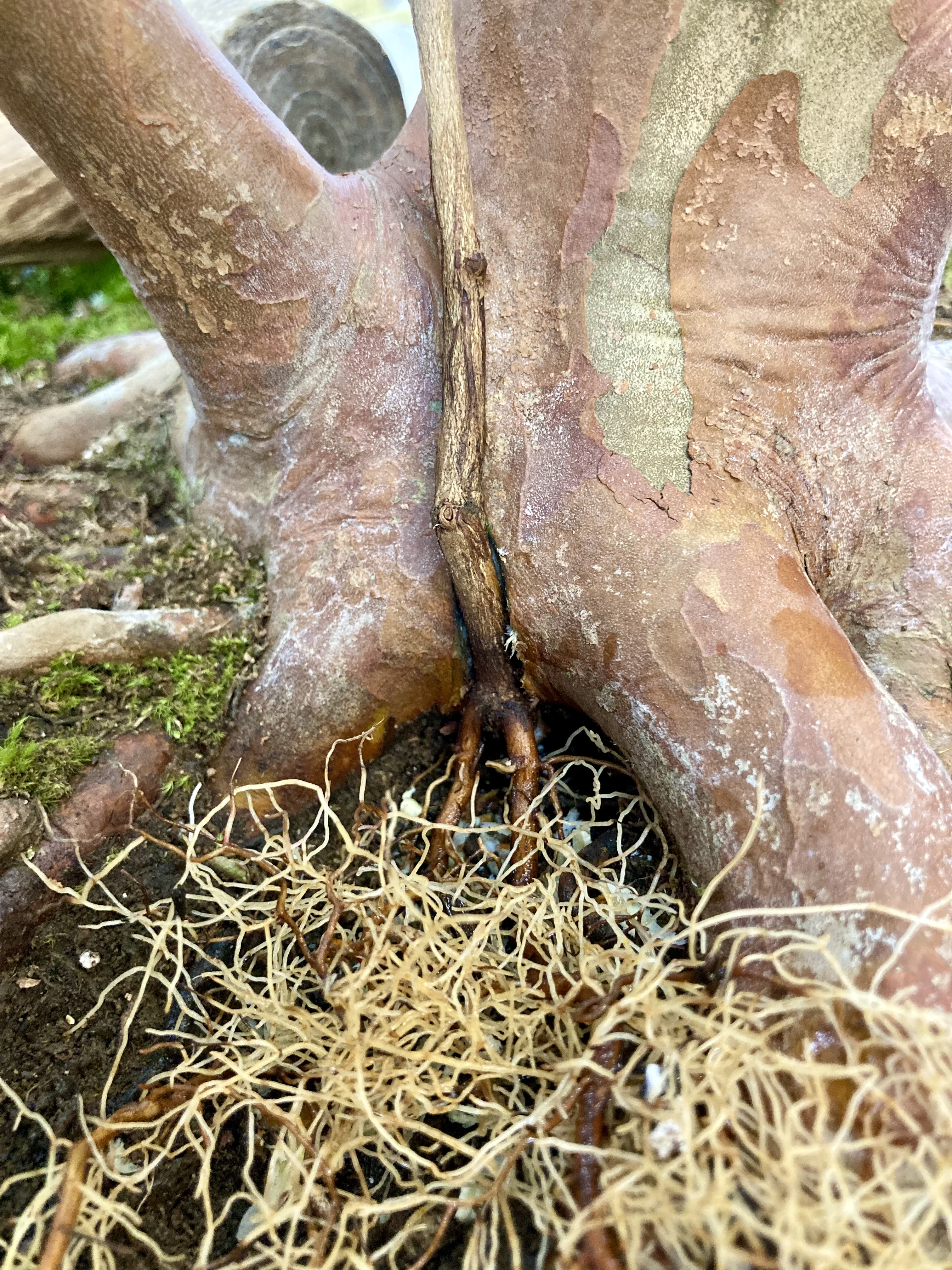
Testing the graft’s position and depth. The scion should be flush with the stock’s trunk.

After setting a nail with a rubber bumper on it, but before filling in with fine soil and topping with sphagnum moss. The root graft is a type of approach graft. Unlike an approach graft where the object is to create a branch, for the root graft the top of the shoot is cut off in a year or two leaving the roots. Otherwise the technique is the same. The groove is cut so the scion fits snugly, it’s pinned in place so it can’t just pop out as it grows, and then once it begins to fuse—a year or more later—a wire tourniquet is put on the unwanted part. After six months, the root (or the shoot) is cut off and the graft is off and running.
15 Comments
Do you remove any bark from the seedling?
Good question—-no, I find it’s best not to. The bark of deciduous trees like Stewartia is so thin that it grafts easily without removal of any tissue on the scion, and removal can damage the small seedling. For most approach grafts of deciduous trees I don’t take tissue off the scion, on approach or thread graft.
Thanks 🙏.approach graft with removing tissue Including the japanese maple?
Hi Thang— Yes, same technique for japanese maple. Usually the only tissue removed is on the stock, not the skinny shoot scion. That is often too delicate.
Do you mix your spagnum moss with other moss? Do you grind your spagnum like for top dressing? Thank you for your articles! Always a pleasure to learn and u have an engaging writing style❤️
Thanks for the kind words Tristan! Yes, we usually mix some live moss we like, a short-napped one that won’t run amok, into the sphagnum. Which we do grind over a large or medium soil screen.
Michael,
Another presentation showing TOP notch quality work. I was surprised by reading your response to not remove bark from the scion. I don’t want to pepper you with questions but now I’m curious if you wound do the same technique for an approach graft on a juniper?
Likewise wound the depth of the graft (flush) would be similar if it was for the purpose of grafting a branch?
Placing a tourniquet seems brilliant, and I will consider doing this on the bottom end for Juniper approach graft to wean the branch off, its primary nutrient supply.
I have always viewed root grafts as a technique for correcting a deficit. Now I’m thinking perhaps I should consider this as a planned strategy for growing rapid wide nebari. I sometimes allow wide based trees (Elaeagnus umbellata and Ilex serrata) to grow out suckers as sacrifice branches which seems to allow the nebari to proportionally grow larger. Similar concept without the grafting. Redwoods also do this.
I’m going to pick a tree and start practicing.
I’m a big fan of practicing growing skills like grafting so when the time comes when I really need it I have some experience doing it.
Sorry to ramble. Your work is inspiring. I hope to meet in person some day. In the mean time a big Baketsu of gratitude for sharing your mastery of the subject.
Best,
Mats H
Hi Mats, yes, the technique is the same for juniper. Because juniper closes wounds a bit less well than many deciduous trees, be sure your channel for the scion is very snug. On the juniper you may take a bit of tissue off the scion to assist in fusing, but on deciduous I find this is unnecessary and it often weakens the scion. The very thin bark of deciduous trees accepts fusing with little encouragement.
Michael, With Stewartia being such a smooth barked tree, what has your experience been with the post graft/healing appearance of the trunk? I’d think the smooth flat trunk appearance would be damaged.
Hi Steve thanks, it would seem Stewartia is trouble that way but I’ve found it’s the opposite. No other tree that I can think of closes wounds more invisibly. In a couple years it can be hard to see where a wound even was.
Appreciate you responding.
Hello, I don’t understand about the wire tornique, any reason why not to repot when doing root graft? Will it help to fuse if we use (cut repair sealer) like kiricuchi? Great post, thx u for sharing.
Hi Paolo, I wrote a reply to Adam here which may answer your question, if not, please let me know! But the sealant is something to avoid, as you can easily get it in between scion and stock and then it won’t fuse very well.
Do you have any pictures of the wire tourniquet? If not, could you describe that a bit more?
Hi Adam, sure, that’s a good idea for a future post. But as a sketch, when there’s evidence the graft is taking——where the shoot exits is getting fatter than where it enters——that’s a good time to do the tourniquet. A small one is fine, like a size 1 mm aluminum wire in a loop around the shoot, which you tighten to snug right next to the trunk of the tree. Then you let it grow for some months in the growing season and it should choke off the part we’re not interested in, the big loop around the back side. Then it’s best to cut off that big loop in the growing season while it’s growing, in the cool months when it’s just beginning, in the spring.