Juniper Deadwood—Which Resists Rot Best?
Deadwood is a prized feature on many conifer bonsai. For the most part, shari and jin on the upper part of the tree rots slowly, as it dries out faster. If in contact with the soil, however, rotting is accelerated.
As a general comment, any collected juniper’s wood will outlast a cutting-grown juniper’s wood.
This is likely related to how tight the rings are. Many collected junipers have a ring count in excess of 100 rings to the inch.
In contrast, it’s possible to grow a 2-inch Itoigawa juniper from cutting in 10 years. The growth rings are wide on these. And the rot resistance appears to be lower.
There may also be species variations in juniper deadwood rot resistance. If seen, it may simply be the slower growth rate due to a shorter growing season for some collected junipers, like Rocky Mountain Juniper, resulting in closer rings, compared with California Juniper. Or, more resin sequestered in the wood in some species than in others.
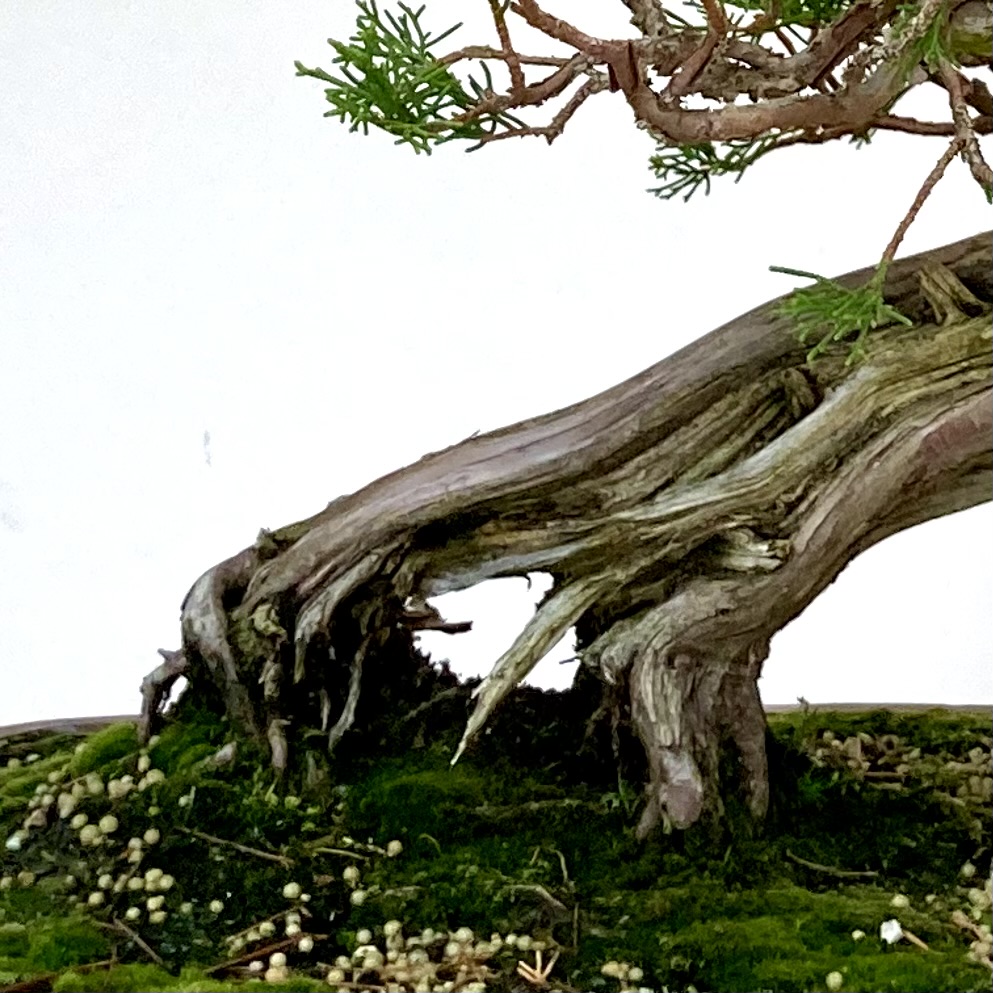
A cutting-grown Itoigawa Juniper, about 40 years old, with a familiar situation, a rotted base. Cutting-grown junipers have wider growth rings than collected.

A collected Rocky Mountain Juniper, with no rotting near the base. This is old, dense wood. But eventually even jin on collected trees will rot.
What can we do to slow down rot?
Lime-sulfur helps, as it kills the microorganisms that rot the wood.
Even better is an application of wood preservative that penetrates into the wood. If you try this, consider thinning with isopropyl alcohol to give better penetration, and then paint many coats on. If shininess is apparent don’t be too concerned, as this will dull in several months.
14 Comments
The experts regularly say use wood preservatives but fail to provide any guidance as to which wood preservatives. Are all wood preservatives found at Lowes, Home Depot, Menards, etc. safe to use on bonsai? Has anyone tested these various products that they tell us to use?
Thanks for the comment! Although I tend to be reluctant to offer brand endorsements, we’ve used PC Petrifier and the wood hardener from Ace Hardware with good results. In Japan we used resin from dried sap collected in the mountains (you could try bow rosin) crushed up with isopropyl added. Make a very light amber and paint it on. The resin hardens the wood. Anyhow a few options-
CPES is great if you can find it. It’s also $$$. I’ve used PC wood hardener in the past with some degree of success.
The idea that the tighter ring spacing of collected junipers leads to the wood lasting longer before rotting reminded me of the similar concept I heard about when visiting some of the bristlecone pines at Great Basin National Park in Nevada. The theory was that bristlecone pines often could live to be several thousand years old precisely because (and perhaps counterintuitively) they lived in harsh high-alititude environments that reduced the annual ring thickness to be much narrower and tighter than other pine species under more favorable conditions, and that those tight and narrow annual rings made it more difficult for rot/pests/disease to penetrate into the heart of the tree.
Thanks for the comment, Jeff! Makes sense. Amazing trees, I visited them years ago in Nevada and California.
Hi Michael, I use Minwax Wood Hardener sometimes when turning punky wood. I apply multiple coats with a brush. Is that the kind of preservative you’re talking about, or what do you use (or recommend)?
Thanks, David
>
Hi David, yes, you can use Minwax. I tend to dilute it as I think it penetrates better and doesn’t leave a sheen. I do prefer the natural resin found at the bases of some conifers, crushed and diluted in isopropyl alcohol. If you don’t have access to wood, Minwax or PC Petrifier are good substitutes.
Higher annual ring counts corresponding with increased rot resistance lines up with Shigo’s CODIT model for decay in trees.
Thanks for the corroboration Pedro! Shigo is an interesting figure in dendrology…
Great information
Which wood preservation product do you suggest/use to protect cork bark Japanese black pines?
Hi Jason, thanks for the comment!
For deadwood I use the same products regardless the species. Either a thinned out product you buy like Min-Wax or, my preference, resin crushed and dissolved in isopropyl alcohol. Works as well for pine or deciduous.
You mentioned the Resin – Alcohol formula several times. It’s sounds fascinating. Perhaps you could expand on this with a separate blog post.
Hi Dave, thanks, I like this idea! I’ll do a post about it-
as a painter I use canada balsam and larch turpentine in some of my glaze recipes, heated and fused with distilled turpentine. would these natural pine resins work?