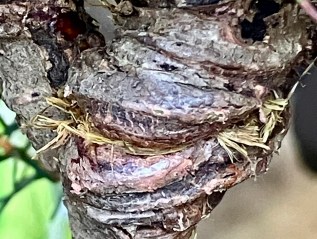
I’ve been grafting smaller ponderosas with black pine and red pine for some time. Before I went to Japan I grafted a very small ponderosa with 10 Mikawa Black pine scions. 9 took, and one failed the next year as it was weak. So I had eight grafts on a small tree…and then when I styled it years ago, I only used two grafts to create the tree, and cut the rest off. People in my backyard have been surprised it is grafted as the black pine and ponderosa bark match so well.
The first photo: A few grafts on a bankan (twisted-trunk) Ponderosa pine. The scions are a black/red pine hybrid, which I chose for the thin Red pine-looking needles. This tree has a very Red pine feel to it. And ponderosa foliage on small and moderate sized trees just does not look good to me. I know for some this is controversial, but it does look a lot better than the ugly grafted trees we see with black pine base and white pine top. And it is a way to use the wonderful material we have in a new way.
(The scions are slipped inside plastic bags, with spagnum moss, and duct tape is placed over the bag to prevent overheating in the sun.)
The second photo: This is another ponderosa with a big powerful trunk that I’m grafting with black pine. The grafts on pine do not need to go in any particular direction, as in deciduous grafts. You can reverse polarity in the scion, and have it go backwards…as in this photo. That way your branches can come off the trunk in the ‘downward angle’ that is preferred for pines.
Posted in Uncategorized | 7 Comments »
This Mountain hemlock has been one of those intriguing trees that is so big at 65″ it is almost more of a conversation piece than a bonsai. And yet thinner trunked trees can be considerably taller and still ‘work’ as bonsai. I collected it about 1 1/2 years ago, and put it in pumice in a cedar box that was sort of cobbled together in an effort to have it appear to be on a slope of a hill.
Having dreamed about that hill for a while, at the March 2010 Seasonal we put it on a temporary plywood slab (having not yet made or found a nice final slab) and erected a muck dam and at least got the footings of this unstyled tree underway. The chopsticks drilled into the plywood was a spur of the moment idea. When I woke up that morning I had no idea how to keep that muck wall overhang from falling over.
It may be ready for styling this fall, although I’ve always felt it would be a very light styling. There is already so much of a natural and wild and windy feeling about this group that I won’t be doing much.
Here’s a bit of a photo essay:
Posted in Before and after, Uncategorized | Tagged clump, group, Hemlock, Mountain hemlock, muck | 4 Comments »
A post from last year was something of a quiz that asked how to improve a particular Japanese maple. This is a follow up post…
The lower right branch was airlayered off and integrated into the nebari on the right side to create, eventually, a double trunked tree. The parent tree has been tipped slighted to the right, and branches have been moved around a bit, in particular upwards.
Later this year or even next year the branches of the new trunk will be wired, but for now it is best to leave it alone.
The different color of leaves and timing of leaf emergence is common when you have a part of a tree with great roots, and another part—the recently airlayered part—that is on few roots.
These are the two previous posts:
http://crataegus.com/2009/03/29/japanese-maple-update/
http://crataegus.com/2009/01/21/japanese-maple/
Posted in Uncategorized | Tagged airlayer, double trunk, Japanese maple | 2 Comments »
This is what I call, only partly tongue in cheek, the ‘Lazarus’ tree as it had only large roots and no feeder roots when put in a box, and after 8 months in my backyard under a mist system, sprang back into life again. Every month I would dig a bit through the pumice and check for white root tips. Anything to give hope, but for months I was stymied. Then the darn thing woke up in the fall and grew those lovely fine feeder roots, and I opened a bottle of wine. It’s a nice tree, but sadly, I only had a Charles Shaw Cabernet. I will have to pay more attention to my wine stocking in the future.
The first shot is in the wooden box that I built, and then, noticing that it was staying wet too long, drilled a million holes through the sides to air it out faster. I had boards laying over the top of it to prevent rain and misting water from reaching the soil. Before there were growing roots it would take two months for the box to dry out. Which is plenty of time to rot roots…
And in a Yamaki pot. Big tree, big pot. This was potted during my March 2010 Seasonal. Late summer 2010, probably August when it has a few more long pointy shoots, it might be styled. If it’s ready.
Posted in Uncategorized | Tagged Rocky Mountain Juniper, yamadori, Yamaki | 7 Comments »
If you haven’t heard yet… Ryan Neil is now back in the States. Ryan studied six years with Kimura and his return home is certainly the major bonsai news of the year. I hope you will join me in applauding his achievement, and welcoming him home. And the best way you might do this is to bring him over to wherever you are—your club, your backyard, your convention—and congratulate him in person. And then have him show you a few things about bonsai.
I’ve been a fan of Ryan since we first met in Japan years ago. He is genuine, winning, and talented, and I am sure we are about to see a new era in Western bonsai.
Congratulations Ryan, welcome home.
With Ryan’s permission, I offer his email here for anyone who wishes to contact him directly:
ryanjneil@hotmail.com
Michael
Posted in Uncategorized | Tagged Apprenticeship, Kimura, Ryan Neil | 5 Comments »
In April of 2009 Bonsai Focus editor Farrand Bloch flew me down to California for a photo shoot at Boon Manakitivipart’s place. Boon was very generous in supplying the tree. I had a couple hours to study it, and then the cameras came out. Here are a few photos from that day (but for the full article be sure to see the magazine, BF 1/2010):
Posted in Uncategorized | 8 Comments »
My study group in Seattle went out on a field trip to collect native accent plants. These photos document our adventure into the wilds:
The excellent Peter Chapman, demonstrating the saw technique that we’ve been working so hard to perfect…
The fierce Peter and the indomitable Elsa Durham in saw kumite…
The intrepid Grant Rauzi with a licorice fern, deftly separated from a log with a saw…
The total take of accents, including licorice fern, coral berry, and red huckleberry…
Potted: Licorice fern growing on a rotted piece of wood, with moss temporarily attached with raffia.
And another licorice fern found growing on rotting log, planted in a pot with kanuma.
Wiring aficionado Joyce Tsuji with a black pine in the second Seattle study group, with our koi expert Dick Benbow, engaged in the first styling of an Englemann spruce…
And the noble students Ruth Chaus and John Muth, determinedly applying copper to their conifers…
Happy accent plant hunting everyone,
Michael
Posted in Uncategorized | 4 Comments »
In Japan, the New Year is ushered nicely into place with a grand three day cleaning fest, in the first three days of January. This is quite a bit more involved than the usual house cleaning, it is more like a very early spring cleaning where you get way into the closets, the cupboards… and if you’re in a bonsai nursery, it’s lifting and cleaning underneath everything that has not seen light for a while. Basically, it’s exhausting.
In tribute to this, I did a day and a half (small place, I figured I could get away with half the time…) of tidying and cleaning.
Otherwise, Crataegus Bonsai is getting it’s first greenhouse. A rather simple hoop style house but with some added features that inevitably have added work. It’s been raining canines and felines, and the site I chose to put the greenhouse has a slight slope. So I’m slipping around out there with a fair amount of air and ground time included in the construction day. A big mud pie. Five pounds of mud on each boot, at least. Waving metal sticks in the air while trying to stay upright, I had some sympathy for those in the battle of Agincourt. Only, I doubt the French had the benefit of a shower afterwards.
Happy New Year, everyone, and best wishes for the new decade—-
Michael
Posted in Uncategorized | Leave a Comment »
Winter is an excellent time to make careful lists of the year’s bonsai blunders, stapling them to our New Year’s resolutions with a similar intent to forget all about them when things begin growing again. More productively, it is a good time to look for good or more appropriate pots for your trees. To dream of accent plants to assemble. To wonder about stands… and then to call up one of our wonderful stand makers and order what you’re wondering about.
Buy wire. Organize and sift soil. Remember what worked. Make notes. If you don’t have a bonsai yearbook, there’s a stocking stuffer for you. If you don’t snowboard, start. You can create a lot of shari on a slope in just a few hours. Otherwise stay home, turn up the heat, and make notes.
Given last weeks’ wintery blast, it might be a good time to buy new woolen hats and mittens too…
Michael
Posted in Uncategorized | 4 Comments »