Never Pinch Junipers!
Basically, we don’t pinch junipers. We may cut new, long extensions with scissors…and I know that will raise some eyebrows. I think the idea of pinching junipers with fingers started long ago in magazine articles. And then the idea of pinching became embedded in our juniper seasonal maintenance. But pinching, especially over-pinching where every growing tip is removed, has been killing junipers for decades.
There’s a lot of misinformation out there about junipers. For starters, needle and scale junipers are maintained totally differently. It’s essential to know what you’ve got so you can maintain it properly. This really needs to be addressed. There are far too many weakened and dead junipers out there because of a misunderstanding of how we handle their growth—in fact, I doubt I’m far off from suggesting that ‘pinching’ is the number one killer of juniper bonsai.
Junipers build energy from their tip growth. If we don’t let them grow we’re going to weaken them—and the more finger pinching we do, the more they weaken. That goes for both scale and needle junipers. But please take a look at these photos and read the captions—
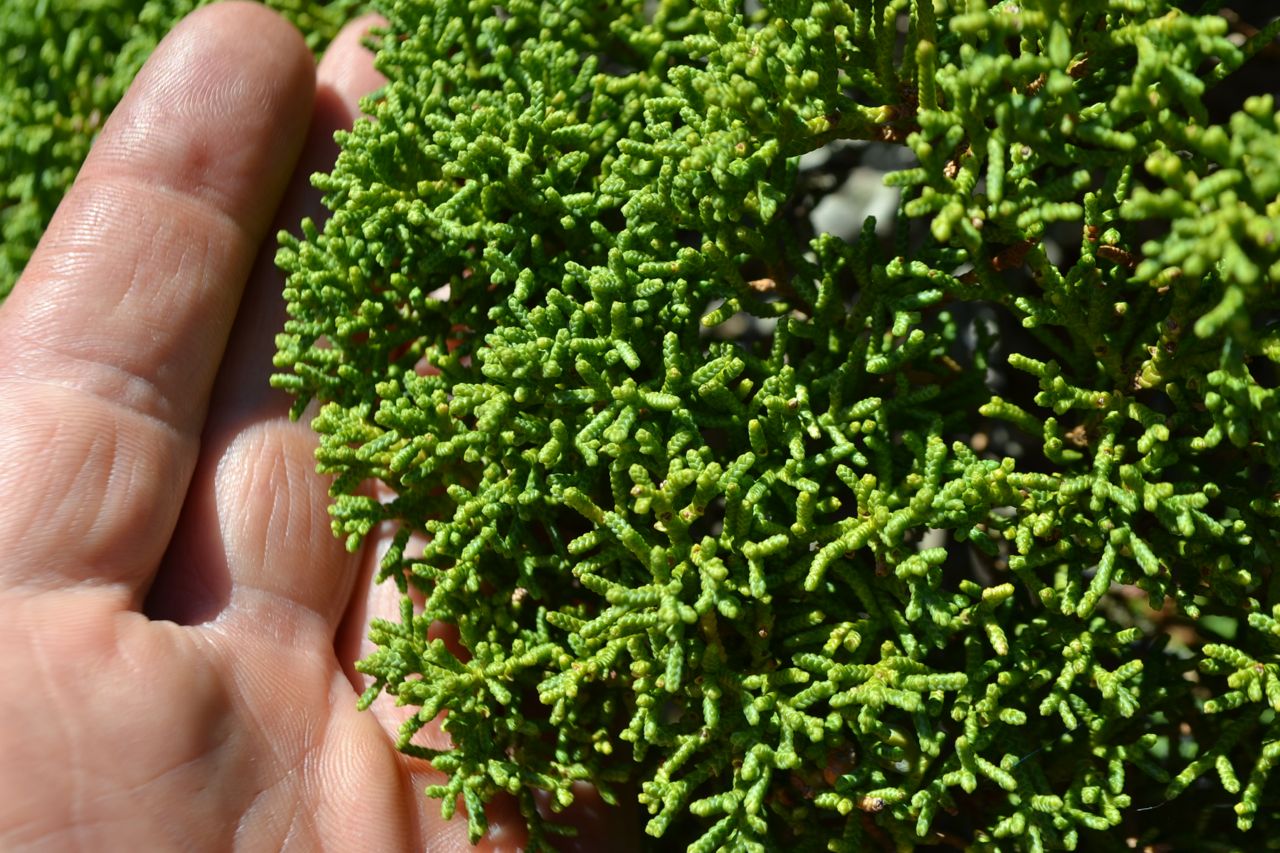
This Kishu shimpaku has no need of any kind of foliage restraint. It’s an old tree and its growth is so slow and contained that it barely changes in size in one year’s time. Eventually the tree will outgrow itself and then some longer branches will need to be removed, and shorter ones will be wired to replace them.
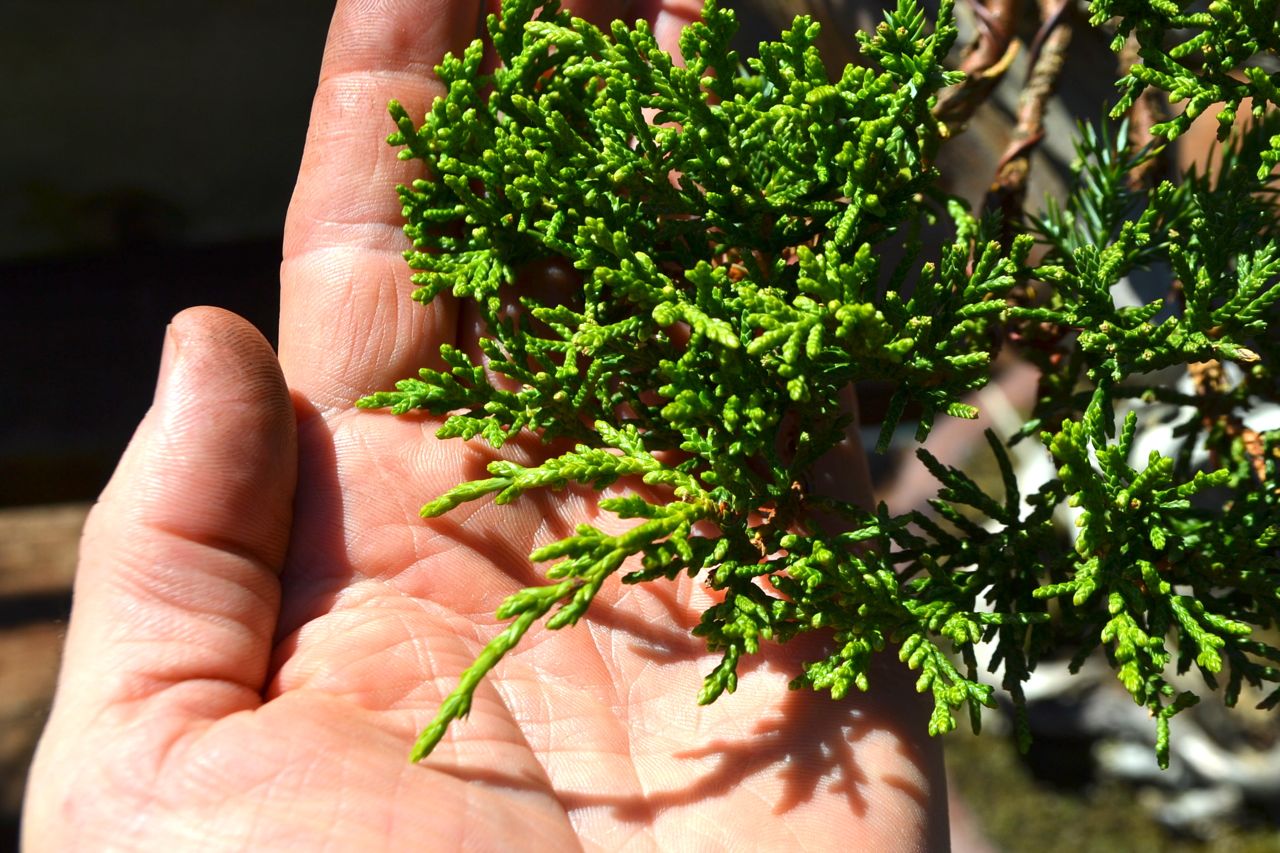
This juniper is also a scale juniper like the Kishu above, and it has two strong shoots that have started to grow beyond the foliage pad. Unless you want a longer branch, basic juniper maintenance is to take your scissors and cut off these two extensions. Nothing else needs removal. If we pinched the remaining slowly growing tips, the tree would panic and weaken. Always leave many growing tips on scale junipers—you can cut shoots off, but don’t touch the tips of those shoots that remain. And the selective strong shoot removal is only done a couple times a year, no more. Now we’ll talk about needle junipers, which is totally different.
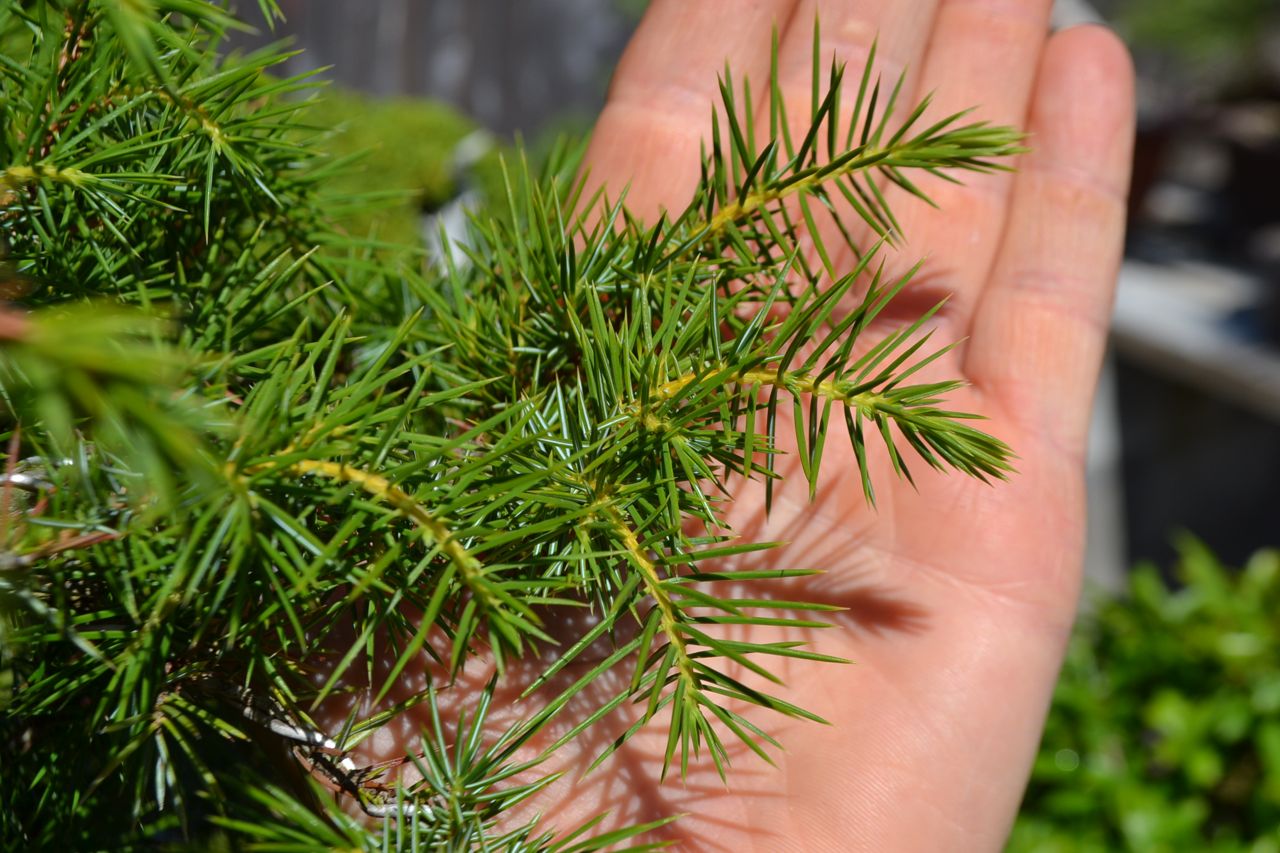
This is a needle juniper, Juniperus rigida. These are much less common than scale junipers for bonsai in the West, though popular in Japan. Unlike the scale junipers, the needle junipers will create long shoots from every growing tip, not just a couple. We need to let all the tips grow out on these trees to at least this long. Then we come in, usually in early summer, with scissors and cut almost the entire new shoot off. On refined trees you’re maybe leaving 1/16″ or a bit more—That’s it! I know it’s shocking, but a tree growing in good soil with lots of roots and strong shoot growth over the entire tree will burst out with many more shoots. Then you get great ramification. If you let the tree grow out like this as you should, there is literally no way you’d be able to do it with fingers, by pinching. The shoot is partially hardened off by then. Both kinds of junipers need sharp scissors, but the growth habits of the two are totally different. Just identify which you have, and apply the appropriate technique and your junipers will flourish. One tip: the needle junipers love water and fertilizer. In the spring they can use as much water as a maple. Also—we can maintain Foemina juniper and Cryptomeria the same way as needle juniper.

95 Comments
Michael,
How about Rocky Mountain Juniper?
Actually I think Rocky Mountain junipers deserve a blog post in and of themselves. It would seem that they are different, but really we treat them just like the scale junipers. It’s just that they look different—they are leggier in growth so that we don’t see the pad developing as well. But the program is the same. You identify the strongest shoots, and maybe there are only a few per pad that seem stronger, and you cut them off, back to another shoot. Everything else you leave. If you do that for several years all the energy of the pad is distributed to the smaller shoots, and eventually the tree gets the hint and all shoots produced are shorter and smaller and you’ll have greater density. It takes time, and it won’t look like much of a pad for a couple years. Be very sure you’re giving Rocky Mountain junipers lots of sun and heat, good watering and fertilizing. They love it in the 90’s.
Excellent article Michael. Actually I was yesterday in the Bonsai club (sunday meetings) here in Guadalajara, and I was talking with the members about NEVER PINCH Junipers as you teach me. And of course I got difference answers from people that always “knows everything”, but I will continue to talk about do the correct technique.
Jorge
Nice! Glad you’re passing on the info. I think much of this idea around pinching with fingers started long ago in translated Japanese articles written by those who really were not experts in junipers. And then we bought into that because it seemed like a way to have fun with our junipers. But pinching, especially over-pinching where every growing tip is removed, has been killing junipers for decades.
Great info. The book I was ‘learning’ from gave me all the Wrong info and I have killed several junipers, arggg! Gary Wharbrain instructed our group after learning from you and now I understand that my dear shimpakus need their sugar tips to grow lush.
Thanks as always for a great blog
Thanks Jorge and you for this information.
Reblogged this on futterwithtrees and commented:
I thought this was worth re-blogging. It’s very interesting info on Juniper training.
Great information!
Not to be a smart ass or anything (well maybe a little), what do you make of this young lad pinching a shimpaku in this here video? (skip to 3 minutes) http://www.youtube.com/watch?v=0fJh9PXEkpI
But here’s an actual question. Where does procumbens fit into all of this? I guess the foliage is more like needle than scale. But I see a lot of them with juvenile foliage, which is still quite small and compact, so I wonder if a lot of people don’t even notice.
Great question—Look very closely at what Ryan is doing—he’s not pinching the tips of the shoots, he’s taking off interior shoots. It’s cleanup.
We treat Procumbens as a scale juniper, even though it’s a bit needley in character. Most junipers are like this. Very few have the great energy of the needle juniper from Japan.
Cool. Thanks!
How about Squamata? Do we treat it as needles or scales?
I would treat those as scales, regardless what they look like…some of these needly junipers can be trimmed like a needle juniper when young, but for maintenance of an older tree we shift to a scale treatment of just cutting the strong growth.
I am the editor for the San Antonio Bonsai society in Texas. Would love to put you post on “Pinching Junipers” or not in our newsletter. I am hoping you can respond asap, I am on deadline right now. Will of course, give full credit and list your blog in the article.
Thanks, Donna
Donna L. Dobberfuhl, MFA, ACLS, NSS Sculptural Designs Atelier 1514 Broadway San Antonio TX 78215-1251 (210) 399-1667 voice/fax (210) 326-0860 cell http://www.sculpturaldesigns.com http://shadolinc.com Blog
________________________________
Yes, please feel free to republish! Thank you-
How about Squamata? Do we treat it as needles?
Sorry, posted in the wrong section.
Could you add a picture showing exactly where to cut on the scale juniper? I know the exact location depends on several factors, but perhaps pointing to a couple of locations with an explanation of why you would cut there would be helpful.
Sorry I did not include an arrow anywhere, I don’t have a image program that offers that. If you look at the long shoot on the scale juniper, essentially you’re putting the scissors slightly inside the foliage pad, and cutting there. So you won’t see the cut. Hope that helps. On the needle junipers the entire new shoot is removed, but it’s easier to see where to cut because the new shoot yellow. And we cut almost all of it off, leaving a tiny stub.
Thanks for the post. Would you elaborate on this topic focusing on the difference between ‘maintaining’ and growing into the envisioned design? Love your blog!
Good question…Yes, there is a difference. Maintaining a juniper is what this post is about. If you’re working on growing out branches so that they are the right length and all, then you would not cut off the extensions as I describe. You’d let them grow until they are about as long as you want the branch to be, then you cut it back somewhat to dampen the extension energy. It will redirect into the side shoots and those will gain energy and you’ll have the beginnings of ramification. At this point you’re at the maintenance stage, and you do what the post suggests—keep cutting off any shoot that shows greater energy than the others—it may only be a few per foliage pad—and the rest you leave alone. Eventually maintenance is simplified because the tree is not shooting out like this very much, and you’re simply cleaning out the inside when older foliage yellows and dies. Which is natural, and will happen mostly in the fall.
Thank you. Now another: I had just finished (a few weeks ago) pinching all the new shoots on my juniper procumbus, as I had been taught. Now that I know this has weakened my tree, what would be the best course of action. Leave it in its current bonsai pot, and don’t do anything else to it for a year or more, or put it in the ground or something else? Thanks!
If it was strong to begin with you should be ok. Simply leave it in the pot it’s in, give it good sun, fertilize moderately, and most importantly do not overwater it. Water only when the tree is getting dry. Then it will recuperate. A tree can usually take one hit. Two or three in a row, like a pest coming in or poor care, and we’re in trouble.
Michael, have you worked with the native J. Communis at all?
I like them. J. communis seems most similar in energy to the needle junipers, so that is the way I train them. Be VERY sure you’ve a gangbusters strong tree, though, before cutting new shoots on them. If you’re not in a volcanic soil like akadama/pumice I really would caution working on them as I do, however.
Thanks, I have been using Turface; does this fit or would you recommend something else? — Also how soon do you suggest removing all of the old soil form collected juni’s? It seems like Walter Pall suggests removing all of the old soil from yamadori immediately… I’ve done this on a couple of recent collections/(pines) to compare but I’m not sure what’s best yet.
This post has been very helpful. I sent the link on to all of our club members who are growing junipers. Thanks for all of the teaching you do on your blog!
Turface is an odd particle. I’ve seen a lot of turface potted plants, and I’ve seen good root systems in it, and as many bad ones. It does not seem to be an ideal soil for trees.
Old soil is best removed eventually, although I was surprised that in Japan some of the old bonsai there still had quite a bit of mountain soil under the base. Frankly, I think in most cases it’s best to remove it. I agree with Walter. Do be sure you do it piecemeal and leave a lot of untouched fine roots on conifers—in contact with soil. Work on sections at a time. That’s really important. Don’t do any of that bare rooting stuff.
Hi Michael
Thought that I’d let you know that your comments are extremely appreciated & helpful, all the way down under in Australia.
JC
Glad they’ve been helpful!
Thst is good advise. The difference between the two types of juniper is clear.
I stopped pinching in general a few years ago. Its nice to read info on this experience. I will certainly reinforce this in my teaching my students.
Yay Aaron!
Also, we are told to give San Jose’s a total haircut. In light oif your info, this sounds like a bad idea.
I don’t think the earlier “pinch me” info is necessarily a mistranslation: I think it is a sign of a paradigm change. As technique matures, old concepts are replaced by better info. Some of the older books and magazines I have (in Japanese) quite clearly indicate pinching.
So: like cigarette smoking, now we know better.
Michael: another issue that may have had some mistranslation, or a change of concept: about thirty-five years ago Murata Kyuuzoh told an audience in Atlanta that one problem with American bonsai was that the soil was all level with the edge of the pot: it should “rise up” from the pot. This was taken to suggest that the soil should be convex across the pot.
Since then, judges have slammed me for that. One has indicated the center should be higher, but the soil should be below the rim at the edge of the pot. So: changing concepts, or bad information/translation? What is current thought? Personally, I think soil level should be: non-boring.
You are probably right about the paradigm shift; we know better now how these trees grow.
The San Jose energy pattern is more closely aligned with the scale junipers, so should be treated that way. Pretty much anything that can produce some scale foliage may be considered a scale juniper. Rocky too.
Ha, yes, non-boring. I think this is a case by case issue; my teacher Shinji Suzuki did a lot of mounded trees, but how mounded it was was very relative. That’s something that you’ll have to feel around rather than take any general guidelines about. And listen to those you respect.
Michael, Thanks for this great post. An excellent followup to your Juniper workshop in Spokane earlier this year. Changing the subject somewhat; but do you believe a similar approach applies to other species with somewhat similar growth habits like hinoki and sawara cypress, cryptomeria and giant sequoia?
Good question-
Yes, the hinoki cypress and any of those cypress trees may be trained as a scale juniper. The cryptomeria we cut all the extensions off like a needle juniper. The sequoias and redwoods are a different matter. They are best grown out a lot to develop the energy of the branches. Then there is the refinement techniques, and actually I’d defer to the Shimons for that info. Their refinement work looks excellent-
I just red this article today, however I was a day too late, yesterday I pinched my juniper like I always did. I will not forget this and will never do it again! Thanks Michael!
Sorry to here this… but keep your tree in good sun, don’t overwater it because it’s now not using as much water, and fertilize moderately. A tree can usually take one insult, but not repetitive ones too well.
Reblogged this on Tony Tickle and commented:
The best post I have read about working with Junipers
Wonderful, thanks for reblogging it!
You are most welcome Michael
Can you comment on using these techniques on Thuya?
Thuya is the same as a scale juniper. Leave many growing tips, and just remove any long extensions.
Wowww,… never pinch juniperus again,… !!! Great article.
I would like to translate into spanich with your permission,… of course telling from were I learn 🙂
Regards
Gabriel
You’re welcome to translate this article– it would be an honor.
Thx!!!!
: )
Certainly! Please feel free to translate into Spanish—
Hi Michael,
Is there an ideal time of year to cut needles? Say if one were to prune only once in a growing season, what time of year would be ideal? This is in regard to this season only, as it’s my first season really focusing on junipers. Next years maintenance schedule will likely be different.
Do you mean needle juniper? Then that would be after the first flush of growth, maybe June or July. But most of the needle junipers will need a second cut in the fall.
Sorry, I forgot to mention I’m working on Shimpaku junipers. Is it drastically different from needle junipers?
Yes, very different. With shimpaku, or any scale juniper, you’re only cutting select strong shoots after they have grown out a bit. And there won’t be many of them, some foliage pads might only have a couple shoots that grow strongly. I hope the photographs show that. The needle juniper from Japan is totally different. All shoots will grow long, and all need to be cut off after growing out a bit. We don’t pinch either type of juniper.
Loved finding this blog! I just won a needle juniper at a silent auction that is claiming to be 35 years old. I fell in love with it right when I saw it and now that I have studied bonsai I realize that what I saw in it that prompted me to bid was the peace I have been reading about that they are intended to generate. This is so cool as I have known about and seen bonsai all my life (I am 50) but now I have “experienced” bonsai. Big difference! Love all the information I have found but this blog is my favorite so far. Thank you!
Good luck with your needle juniper! They are lovely. If spiky. Be sure to protect it from frosts. They don’t like frost very much.
Ok, so the wierdest thing ever has appeared (maybe only to me but…). At the end of one of my branches of my needle juniper there are regular juniper leaves growing – a very strange sight! Is this normal? Should I cut them off? I am perplexed..
I’m a bit perplexed too…Is this Juniperus rigida? If so, I’ve never heard of such a thing. Some of the other needly junipers do throw out a set of scale foliage sometimes.
I’m not that great with electronics but I will attempt to take a photo and upload it here for you to see; it is very interesting and the wierd growth is a scale juniper coming out the end of my needle juniper.
Sure, please send it-
Hi there,
I recently collected a large Juniperus rigida (c 1.5m high, 8cm diameter main trunk) from a demolition site. It had a relatively small root ball and much of the original soil fell off the roots when removed. I took off some of the top foliage and It now looks a bit droopy a week after collection. The soil is moist but I have not watered it after initial watering and its kept in shade. I’ve herd they are notoriously difficult to keep alive once collected. Given it’s late spring here and probably not the best time to collect trees, can you give me any tips on getting it back into a healthy condition?
Tricky, yes, they are—
I would say, don’t shade it too much, but definitely mist the foliage many times a day. If you have or a friend has a greenhouse, that will give you a big advantage. Drying winds are a big problem. And keeping humidity up will help, too. Some bottom heat might help the roots take off. Hope that helps-
Hi Michael, I have read this blog and I appreciate your insights and willingness to answer many posters comments. This is a great help and resource to those searching for Bonsai knowledge. Thank You. After having read the blog I have a couple of observations I would like to add about “Pinching” and the paradigm from old to new mentioned earlier. As I see it, Bonsai is a centuries, if not more than a millennia old and refined practice. As one poster said, they have earlier books written in Japanese that support the “Pinching” process. That makes me think that “Pinching” has been an accepted technique of the Bonsai culture for possibly as long as Bonsai has been in practice. Several times reading this blog I had the understanding that “Pinching” would severely set back the tree and once it was referenced that “Pinching” repeatedly in excess of two or three times would possibly cause the tree’s ultimate death. The paradigm suggested by one poster was that the recent evolution of Bonsai, say in the last fifty years, was as technique matures, old concepts are replaced by better info. But when I consider that “Pinching” has been a popular Bonsai practice for centuries, then that suggests to me that those ancient masters of Bonsai would have discovered the detriments of and reason for the deaths of their trees if due to the practice of “Pinching”, a long time ago. What I am thinking is that maybe this isn’t just a paradigm shift because “old techniques are replaced by better info”, but rather that a manifestation of changing techniques which are based on several other new variable principles such as global location, altitude, climate, chemicals, fertilizers, soils, genetic evolution and the commercial propagation of these types of juniper as just a few variables that have changed in the modern world that have had influence and contributed to this new change in principles and practices. I just have a hard time imagining that this “Pinching” practice went on for many previous centuries without the severe consequences we discuss about it today and surely in the past those Bonsai masters have created some wonderful works of Bonsai art with “Pinching” principles in use. I suggest something has changed and it’s not just that we are smarter and wiser.
Thanks for this commentary. One thing that is not widely known is that shimpaku has not been used for bonsai for centuries. The popularity of shimpaku is only about 100 years old, and I don’t think that much time is too much to discover how to best work with the tree. Especially since until the 60’s and 70’s bonsai training was very much a hands-off kind of affair and modern bonsai techniques were only becoming fully developed even in such familiar trees as Japanese Black pine— the technique of pine decandling is only about 70 years old, and the refinement and understanding of that basic premise is much more recent.
Pinching junipers was a great leap down the rabbit hole, but thankfully that hole did not go deep into the future.
Thanks Michael. There are some records of shimpaku from the mid-19th century (1830-1850-ish), maybe a fair amount of time to discover intricacies of this plants growth methodology. However, not necessarily confining the topic solely to shimpaku, but to generally include all bonsai junipers, it would seem that if such an ultimate detriment (death of plant) existed by “pinching” consistently instead of clipping, that an exposure should have been realized within a few growing seasons. There are also claims by many that pinching is an acceptable technique and there is also chronological photographic evidence to support those claims. So there seems to be some relative evidence supporting pinching. Possibly that makes it more of a matter of knowing “how to pinch” as opposed to just “pinching” in general? There are also claims by some that metal tools, such as scissors and nippers used to clip the plants can cause distress and that the metal used in the manufacture of the tools can cause an adverse reaction to the plant at the cut point. It was discussed here earlier about the possibility of miss-translations which tell us “to pinch”. I’m curious, do we have any past record(s) thru translations that also tell us “not to pinch”? I would have to say that throughout the history of bonsai and due to the tendency of human nature and the tediousness of the task of clipping, that “pinching” was employed more likely than not as a quicker, easier alternative; at least to some lesser degree. Surely, with the ease of seminating information in the new age there has been more opportunity for exposure of techniques and ideas which could bring more obscure practices to the surface. This is an interesting subject, it has it’s pro’s and con’s, I wonder if the answer is somewhere in the middle.
My point was that junipers were not popular before 1900. I’m sure there were junipers as bonsai before that. Bear in mind that modern bonsai techniques are really quite new. The pinching idea was likely very new, tried and taught by several teachers and it spread like many wildfires do until it was stopped by the obvious, that it does not work. It may not be a very old technique.
I don’t know any current Japanese master who pinches the growing tip of junipers on a regular basis. In fact you can just pick up any Kokufu book and see that none of the junipers are pinched. Any long shoot is cut inside the foliage pad with scissors and is buried in the foliage pad so you don’t see it. The trees are full, the tips are undamaged, and they look beautiful. Junipers that are aggressively pinched are a mess, and they look it, and it’s easy to spot them even in a photograph. My point is simple: Pinching with the fingertips is not done in Japan currently. It is done in the West, and our trees look poorly and don’t do well because of it.
It is NOT a matter of knowing how to pinch versus not to pinch, if we’re talking about two things: It being done with the fingers, and on the growing tips. Pulling old, weak growth from the bottoms and insides of the branch pads is not considered pinching, if we’re to use the term accurately. That’s normal maintenance and is often done with fingers.
Thanks for the historical tidbit. I do believe it is easy to over think this. The technique of pinching does not work.
Hi there,
I have a shohin shimpaku which all the growth has become long and leggy. It has a lot of foliage, but not tight and compact like others in my collection. All are growing in the same soil mix and in full sun down here in East coast Australia.
Hi Adam,
its really very interesting and “innovative” not to pinch the junipers.
what I’m confused is how I can get dense foliage on single branch if not by pinch ?
thx
Efi
Not so innovative, it’s just we’ve been taught for so long something that might not have been a major technique in Japan. I’m still not sure of how prevalent the technique was over there, but it sure became the ‘only’ technique over here, to the detriment of our junipers.
For a scale juniper: Let your tree develop a few inches of growth, then cut those off with scissors, but back to where the foliage is still strong and growing. Always Always Always trim back to many growing tips. Growth on the pad will begin to slow down and ramify, and shorten, over a few years. Shimpaku will do this in just a couple of seasons; a Rocky Mountain juniper, twice as long. When the whole branch grows too long over time, several years, then you take some branch pruners and cut back to a nice branch that shortens the profile again. Hard to say all this in words without being in person—but that’s the jist of it.
If you cut with scissors, wont the cut site go brown???
I wish that I had read this about 5 months ago. I just lost a juniper x medis Blauwws that I had been training for 4 years. I was wondering what I was doing wrong, as all the books and websites I was reading were saying to pinch, pinch, pinch. I punchedall the new growth this year in an attempt to get the tree to backbud. Looking back, I can now see why the tree steadily declined. I just bought 5 new junipers to replace the one I lost (yes, it hurt that much..lol). I have a common juniper, 3 j. Chinesis, and a j. X media old gold. I’ll definitely be using your advice with these. Could you please clarify how to backbud a j. Chinesis? Thanks!
Just came across this tradition defying article from2012 and have shared it to out club facebook hope that’s ok .Taunton and Somerset Bonsai Club.. uK
Absolutely! Cheers-
Fairly new to Bonsai and would like to ask a question. I have some pre Bonsai Shimpaku on the go. They are about 2 inches high and throwing out long shoots like crazy. Should I be cutting these long shoots back or will leaving them on provide more energy into growing a thicker trunk? Will these shoots eventually be used as branches or part of a main trunk? Not a lot of info on the net with regards to what to do with very young plants. No club where I’m from to go to for help so any info would be greatly appreciated.
Young plants are like gold, they have infinite potential. What we do with them is nearly the opposite of bonsai training, that is, forget refinement techniques like cutting shoots and whatnot, let them grow. Put them in larger pots. Larger soil, more fertilizer. You will want to wire them to put some early information in the branches, but then don’t cut the extensions. The branches you wire now might be used later as dead branches (jins) in the future design. Hope that helps!
Excellent article very instructive
Hi Michael
This an old blog I am reading. I am a follower, we have worked together. But where do you get the energy. Your responses to some of the questions, very good.
Thanks, Brian
Gracias MIchael lo voy a compartir en mi grupo de bonsai
Hi Michael!
I am a long time follower of your Bonsai adventures from Holland and I reblogged your great article on to my own Bonsai blog and I do hope that this is all right (my first reblog)? But you are so right and I find it so relevant and to the point and better than I could ever explain to my own students…so I took the liberty and I hope you don’t mind?! And I hope that this way it will reach even more Bonsai enthusiasts around the world!
Thanks for sharing your knowledge with the world! And a happy and healthy New Year to you all!
Cheers,
Hans van Meer.
Karamotto Bonsai
Hello Hans, thanks for asking, and certainly you’re welcome to reblog! That is the global network after all. Delighted you liked it enough to do that. Cheers-
If one is removing (scale juniper) strong shoots tips, inside old tips and foliage on crouches how one keeps the pad healthy without leggy growth? Thank you.
Hello, Paolo— taking off the stronger growth leaves the shorter growth. Over a few years all of the growth simmers down to a mild, creeping, 2mm a year growth like one sees on Shimpaku. Just as an easy example, but the other junipers will eventually do that as well. Did that answer your question?
It more than answer my question! Sorry for the confusion and thank you.
Hello Michael for your article ,I have juniperus kishu that its tips dry brown and I really do not know what could be a mushroom? Maybe you have some experience about it, Thanks
Hi Renato, sounds like juniper tip blight, phomopsis. This will take a while to control. Try Mancozeb, an easy to find fungicide, and spray especially in the springtime.
How would you treat a refined san jose juniper tree that is styled and covered with juvenile needle foliage? I assume you’d treat it as a needle juniper here? I notice that when I cut a hardened off shoot (i.e. cut back to 1/16″ at the point where new shoots would emerge), the tip turns brown, while pinching (less hardened shoots) does not.
It almost depends on how developed it is. The Foemina seems to have the energy to be maintained as a needle juniper, but that seems to be an outlier. For the most part, those that have both foliage types should be maintained as scale type junipers.
And yes, you will get a brown tip if you use scissors.
Hi, what about San Jose Juniper which is almost 100% needle on a mature tree. Cheers 🍻
Good question about San Jose! That is a needly one. It seems a lot like Foemina, in that it’s mostly needle when grown normally with regular fertilizer and such. But also like Foemina, if you reduce fertilizer and don’t overwater or over-prune, you can often get almost all mature scale growth. Which would suggest it’s a non-pinching juniper. You could then trim away the juvenile foliage.
Hi Michael,
Thanks for your blog and this article in particular. I struggle with the conflicting information available on this specific subject.
It makes a lot of sense to refrain from pinching. Personally I experienced tip browning after pinching, causing entire branches much distress. Nowadays I only prune the runners, right at the brown wood, never in the green.
The thing is… I do see junipers being pinched in videos of Mirai and Eisei-en. Not just to clean up old needles but also to refine silhouette and create flat undersides of the pads.
What is your opinion on this? Is it okay to pinch for these purposes? And is there a special technique one should use? Or, if you only prune runners, how does one create such a refined silhouette?
Would love your insight on this!
Cheers from the Netherlands,
Willem Droog
Hi Willem and thanks for the question— I think this may be a case of semantics and nothing more. I also do what Mirai and Eisei-en do, but I don’t call it pinching.
When we use the word “pinching” it usually refers to the tips on the top of the foliage pad. What we do on the bottom, cleaning it up, I think that’s “pulling”, because we pull the whole thing off. Pinching leaves something.
Anyhow hope that helps!
Well I think we have found the source of a lot of confusion here. Pulling vs pinching. Thanks for clearing that out.
I know this is an old article, but hopefully you see this Michael…
I have a Foemina that need to prune back after a flush of growth after the first cutback. I did not cut it back very much in the spring and it also have some weak old growth. Will it still ramify or backbud if I cutback harder into older growth? I do know not to cut back to bare branch, but how much foliage needs to be on a branch (approximately) for it to survive?
[…] Michael’s latest post is titled ‘Never Pinch Junipers.’ In his own words… Basically, we don’t pinch junipers. We cut new long extensions with scissors…and I know that will raise some eyebrows. I think the idea of pinching junipers with fingers started long ago in translated Japanese articles written by those who did not specialize in or have much experience in junipers. And then we bought into the idea of pinching because it seemed like a way to have fun with our junipers. But pinching, especially over-pinching where every growing tip is removed, has been killing junipers for decades. There’s more here. […]
[…] Michael Hagedorn’s posting Never Pinch Junipers is excellent and provides much of what you need to know about the […]
[…] Never Pinch Junipers!. Share this:TwitterFacebookPinterestLinkedInEmailPrintRedditDiggStumbleUponTumblrLike this:LikeBe the first to like this. This entry was posted in Advanced basics and tagged bonsai, How-to, juniper, Michael Hagedorn. Bookmark the permalink. […]
[…] was a woman who won it) I will again link to Michael Hagedorn’s article on juniper pruning (here) for the corrected, suddenly uber popular, technique. No more […]
[…] Never Pinch Junipers!. […]
[…] to avoid upsetting people or to avoid arguments. But much like the concerns offered in my post Never Pinch Junipers!, I see so many weakened bonsai as a result of using Turface, Oil-Dri, and Profile that I have to […]