‘Chojubai’ Quince—Diminutive Jewels
This unassuming dwarf quince can steal your heart. There are many who have gone to Japan for the spectacular pines, junipers, and maples, only to discover the quiet but memorable Chojubai. Those ‘many’ included a few friends of mine, and myself. This post is a little longer than most because Chojubai is so little known in the West, and, frankly, I think it deserves better. Also, waiting for you at at the end of this long post is a question…
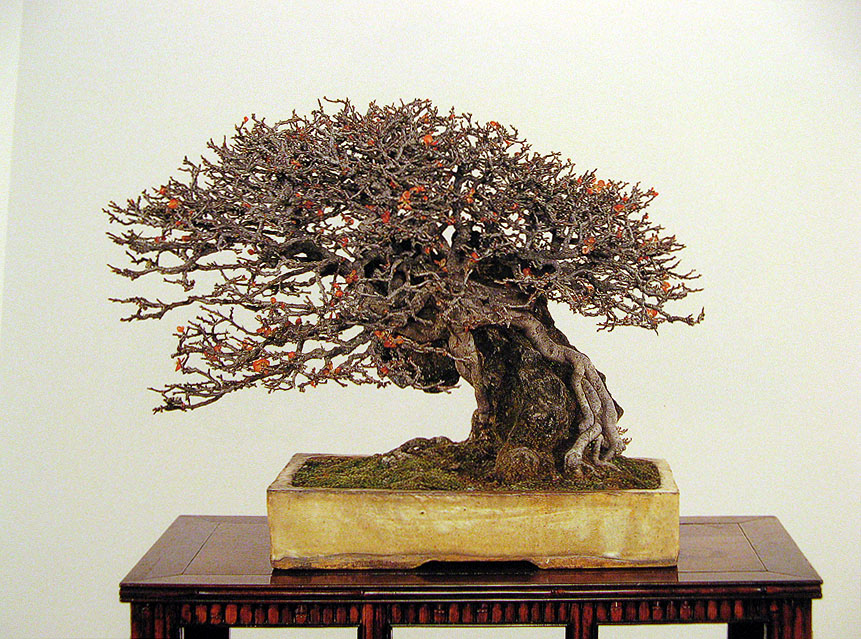
A well-known root-over-rock Japanese flowering quince ‘Chojubai’. 45 cm high

Fairly typical of the multiple-trunk old Chojubai now seen in Japan. 33 cm high
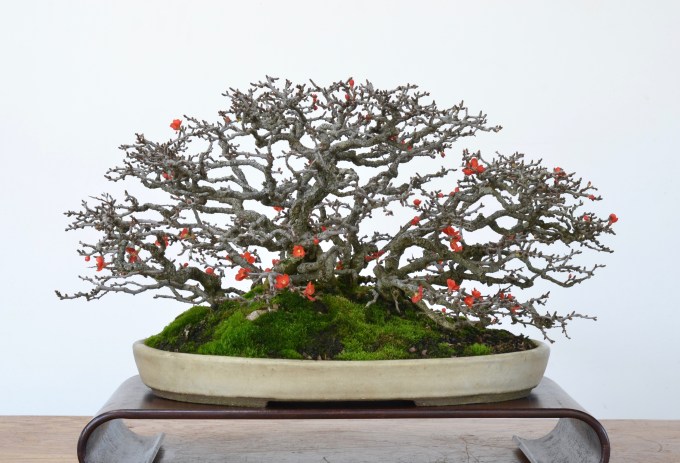
Chaenomeles japonica ‘Chojubai’ is a cultivar of the comparatively coarse Japanese flowering quince. Few plants for bonsai can match its contrasting qualities: Idiosyncratic, craggy branching and twigging, with rough older bark, adorned almost contradictorily with glowing ruby flowers. They flower mostly when out of leaf, in winter, so they lend a feeling of glowing life to the bonsai yard when all else is dull. The details are small, with glossy leaves about 1/2″ long and flowers under 1″ wide. There are several flower variations including white and red, although almost all Chojubai used for bonsai are red-flowered because that variety has the finest twigging.
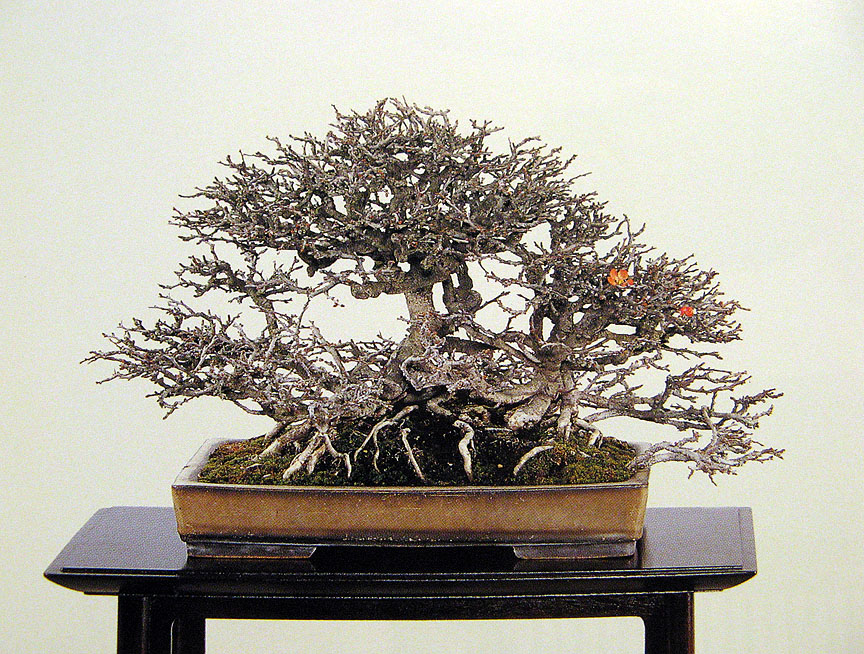
Medium-sized (‘chuhin’) Chojubai. Fine old tree. 29 cm high
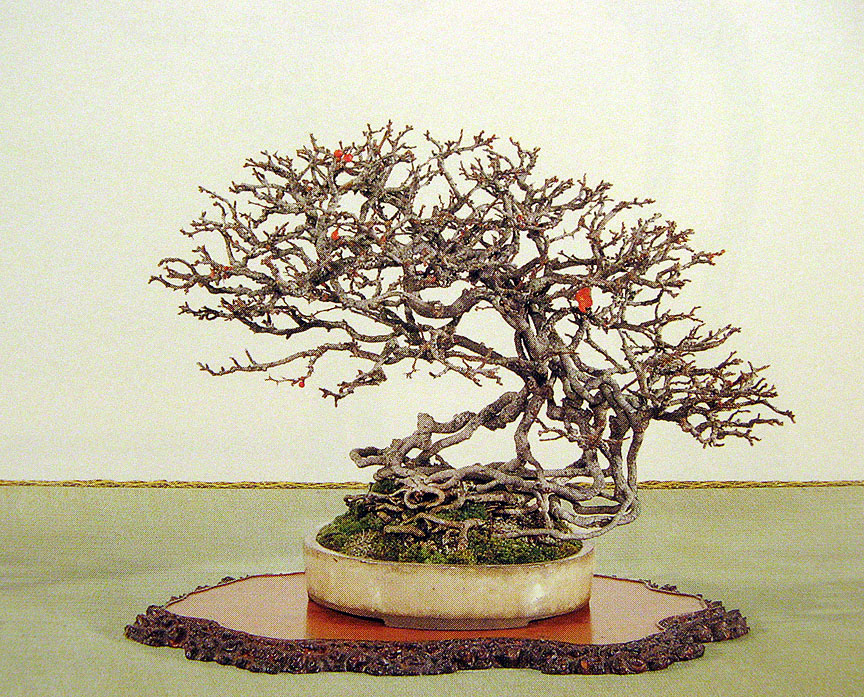
Quirky medium-sized raised-root Chojubai. 30 cm
The history of this tree in Japan is interesting… At first, Chojubai appeared commonly as a small accent plant in the Kokufu show forty years ago, as an unramified twig or two. Only rarely was it seen as a primary tree in the medium size category, and never in the large size. It was a second tier tree. Then something shifted. Around 1990 we began to see large size Chojubai in the Japanese shows. These were trees about 1-1.5 feet tall and twice as wide, multiple-trunked and highly ramified. Occasionally single-trunked trees, which are rare, were seen. In Kokufu book 80, about six years ago, two Chojubai won Kokufu prizes. Two years later in book 82 another won. Chojubai had come of age.
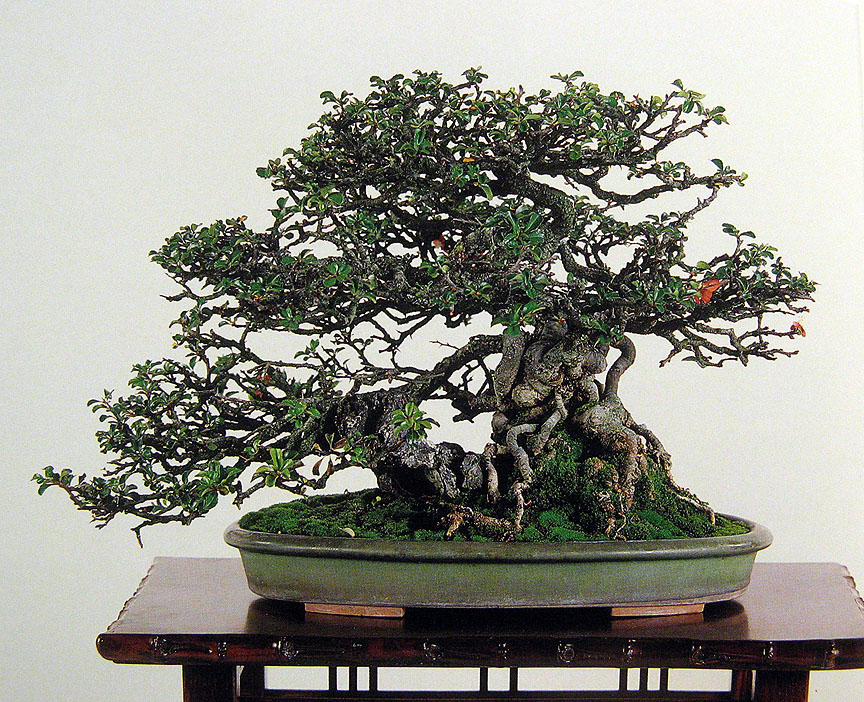
Most Chojubai are enjoyed out of leaf, although the small glossy leaves are perfectly in scale. As Chojubai often flowers nearly year-round there is nothing stopping you from putting them on the display tables any day of the year. 30 cm

You might wonder why I put this in…Well, it is a Chojubai accent plant in the Kokufu show 40 years ago. Interesting, isn’t it, how tastes and techniques have changed? These days, this tree would be unlikely to even get accepted into a local Western show.

The vast majority of Chojubai grown for bonsai are the red-flowered variety; all the other photos in this gallery are of red-flowered trees. This is a white-flowered tree and it won a Kokufu prize. Very hard to ramify the white ones. 33 cm
Chojubai’s ease of ramification is enhanced with training, creating dense forms of intense complexity. Most unique to the Chojubai is the natural eccentricity and unexpected angles and directions in the branching, which are usually encouraged as they represent the special flavor of this variety. If this were a plant trained by music, that music would be jazz.
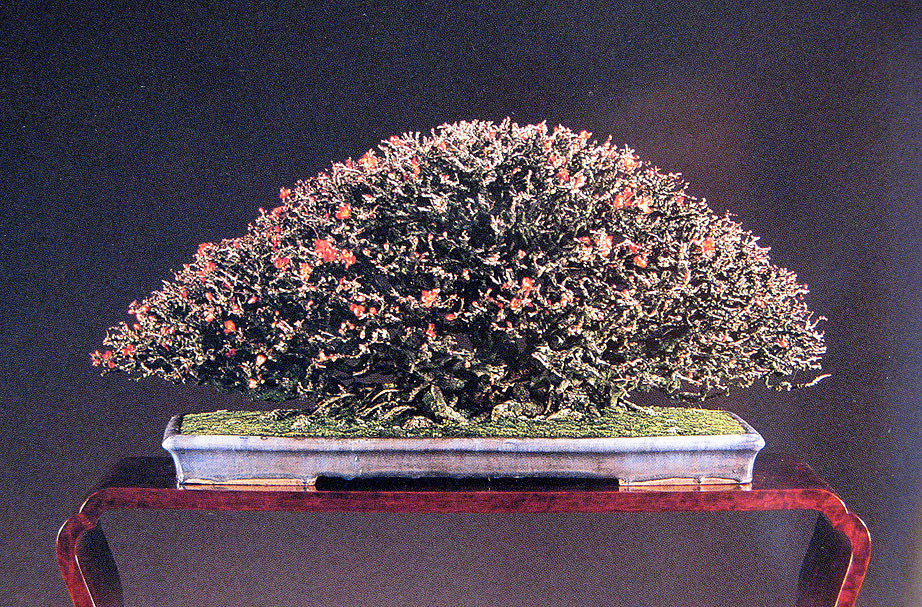
A red-flowered Kokufu prize winner. Very old. This is a good example of the extremes in technique used to create a very crystalized form. Impressive, and yet in some ways perhaps not showing the best of what Chojubai offers. Hmm, I wonder how long I will be in purgatory for that comment… 35 cm

One of the rarer single-trunked Chojubai. Another Kokufu prize winner. If you have a single-trunked tree, be very sure to cut all suckers that come from the root base. Beautiful old tree! The warty bark is evident only with great age. 38 cm
If you have a Chojubai, you’re lucky. Plant in deeper containers to prevent soggy situations. If you have a young plant, put it in a training pot with large size soil mix for a few years, so you have some energy to manipulate. Keep in the sun up to 75 F, then 50% shade cloth through hotter weather. They love water. And they love lots of fertilizer— about as much as a Japanese Black Pine! On young plants, wire main branches and shoots from the base for multiple trunks. Older plants may be maintained exclusively with directional trimming of shoots. Cut back in June to one to three internodes only on refined trees (and again in the fall), leave extensions on younger plants to develop trunk. Always immediately remove shoots that come from the base that you are not intending to use as trunks—they will quickly weaken the older areas, and can kill them off in short order. We’re trying to ‘fake’ a shrub into being a tree. There’s more to it, but that will get you started.
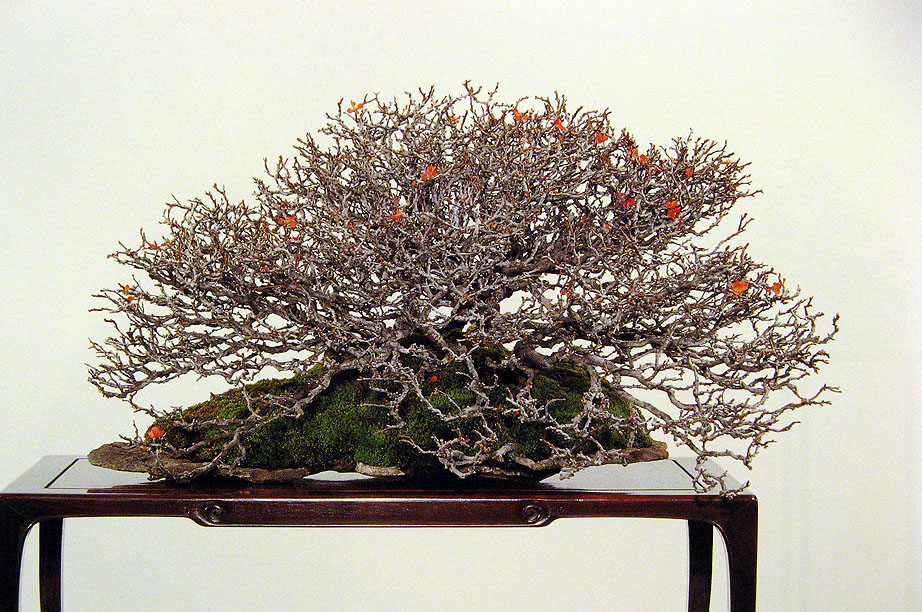
Lovely loosely styled multiple-trunk Chojubai. Many years of careful scissor pruning created this natural form. 40 cm
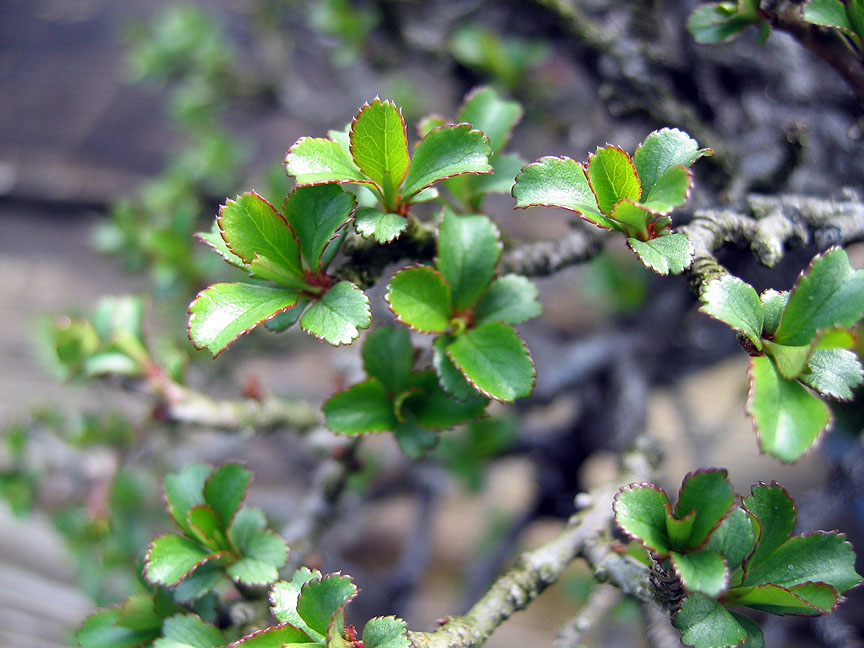
Chojubai just beginning to grow in April at Shinji Suzuki’s nursery.
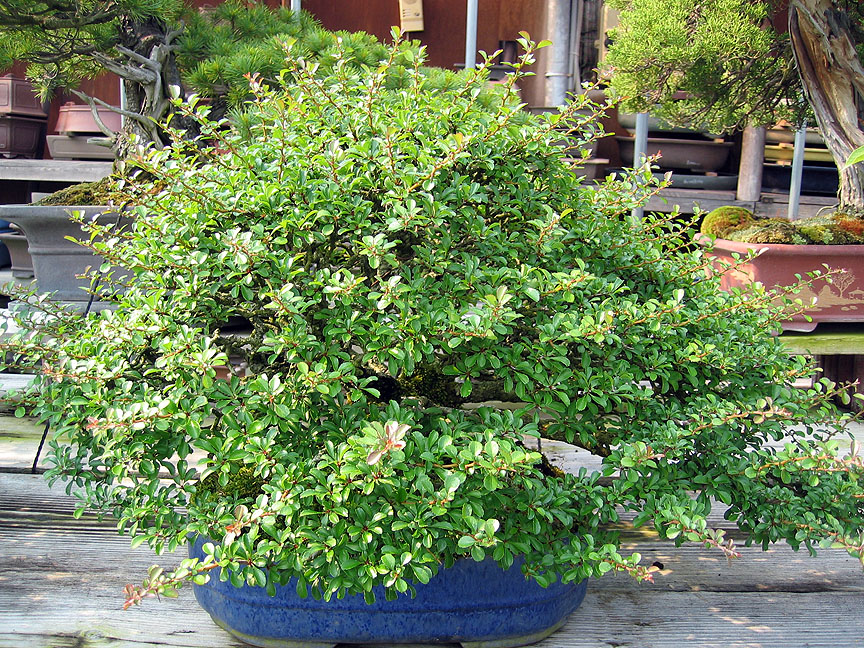
Another Chojubai at Suzuki’s a month later, in May, just before trimming the extensions.

Chojubai at my place in mid-December, showing tiny flower buds. Any strong tree, with timely trimming, will produce this many buds. It has already had a few flowers open, which are about 1″ across, and will continue blooming for 3-4 months until late March when the leaves start coming out. After that the blooming is more sporadic.
Another Chojubai, one of my favorites in the yard.

Same tree in leaf.
After all those words and photos, there’s no hiding that I’m totally besotted with Chojubai. But I have a wondering curiosity if these images stirred—if any photograph CAN stir—the endearments that Chojubai have raised in myself and others lucky enough to have seen them in person. I imagine many of you have never seen Chojubai before. What do you think? Something you’d like to see more of?

67 Comments
Beautiful trees and hopefully your purgatorial stint will be short. They should let you out for good behavior.
Where does one in the U.S. acquire Chochubai? And is the difference between C and other flowering quinces the leaf size, frequency of flowering, or…?
Good questions-
I know mostly of west coast sources: Telperion Farms in Oregon, Evergreen Gardenworks and Lone Pine nursery, both in California. I’ve heard that Julian Adams on the East coast has some as well.
Chojubai is rare in that there are strains that can flower almost year round. They tend to flower most when not in leaf, at least that is their big flowering time. The leaves are the smallest of the quinces, only about 1/4″-3/4″ long on old ramified trees. So they have some unique differences to the other Japanese quince varieties, which are coarser in leaf, flower, and branching—although those other Japanese quinces do trunk up better.
And a Chojubai Christmas to you, too!
Great information and photos – please keep postings coming.
Thanks Judy!
Glad you enjoyed. It is a rather festive plant, is it not…
I picked up a bizarre 1-gallon Chaenomeles at our bonsai club’s give-away table, and indeed it has popped a few flowers since it leafed out. The little guy is very rough at this point and has leaves of anywhere from 1/3″ to just over an inch, with pretty small internodes. Flowers are salmon-colored. Could it be a ‘Chocubai’?” If so, I will follow your advice on getting it sized up.
Yes that could be Chojubai. When it is in a nursery container they can put on some larger leaves. Also, there are larger and smaller leaved varieties, as well as the flower color varietals that range from white, orange, to deep red. The flower size is usually just under an inch.
being a chojubai “nut”, it was nice to see a passionate article on my favorite.
Most prefer the red as the leaves are smaller and so is the flower. The white grows faster and has a bigger leaf and flower. “white” is often a pale yellow in color. I do have a new sport that is a true orange.
My hardest learned lesson so far has been when to repot. I have heard both spring and fall. So last year I repotted most of mine in the spring. I lost my favorite tree and had troubles with several others. I am now a confirmed fall repotter when it comes to these quince.
I had the priviledge for several years to have been a student of michael’s and really leaned how to style them according to his guidance.
Yes yes, another Chojubai fanatic! Our membership is sadly still low in numbers…
The orange cultivars are lovely indeed! Very few are really a true red, anyhow, but the orange ones do glow on an overcast day. The whites are indeed coarse.
The Japanese repot in the fall to reduce the possibility of infection from a nematode that can cause some of the more serious problems with this tree. Although it is of the rose family, and has its share of those diseases, this nematode is the worst problem that it can have. If you repot in the fall, protection through the winter is the most important thing. Try to avoid freezing. So if you have a greenhouse or similar protection, fall repotting is not a bad idea. I have not had problems repotting in the spring in Oregon, however. Also, it is a good idea to leave a lot of root on the older trees, so don’t be too aggressive in removing soil and roots. Sometimes the Satsuki technique of removing pie shaped wedges is a good technique, because Chojubai also have fine roots like azaleas.
Beautiful Trees! I’m curious can you please explain the difficulties or how one might grow out a single trunk tree?
The main challenge is that Chojubai prefers to grow as a multiple-trunked plant. It is a suckering shrub. It can live for many decades and longer than the usual Japanese Quince, so it is a very long lived shrub. But one must be careful to remove the shoots that grow from the root system if they are not desired for trunks. If those are let grow, they will kill off the older trunks and you have a plant that is constantly renewing itself. This helps to understand how to control the growth of the plant. If you want a single trunk tree, it is even more important to keep would-be trunks cut away as soon as they appear, which is usually in the springtime, because a single trunk is not the tree’s preferred way to grow. Otherwise keeping a single trunk tree is no great problem.
Chojubai and Kinrobai I always thought shared the title of most under appreciated material…maybe your post will ignite the creative minds to really experiement with these varieties.Good success with ruby red Chaenomeles variety up here in Vancouver repotting in spring….maybe your next post could be on Kinrobai 😉
cheers Michael
Hmm, yes, under appreciated… actually that might be the next post. Have some thoughts about that one. But I agree, there is much experimentation on Chojubai that might be done, being a malleable type of plant that lends itself to many applications and dreaming. Kinrobai (Potentilla/Cinquefoil) is a wonderful little thing, yes!
Really nice article to begin the blog. The photographs were also very helpful. I do plan to add a Chojubai to my tiny group of bonsai. While I liked the single trunk trees the more natural style (like the one from 40 years ago) was still of interest to me. I think the naturalness, the meandering and the many slender trunks (no pun intended on “…love is a many splended thing” but maybe that fits too) remind me of a gentle dance like a waltz in motion. So one can sit, smile and relax to the gentle quince.
You should write my posts… very poetic. What are your rates? Glad you enjoyed the naturalness of the way they grow usually, I like that to, as much as I admire the single trunk trees those are more a bow to controlling the plant than anything else. Still, I am not sure that Chojubai has been really stretched to it’s limits yet creatively, it is so malleable and easy to form that there might be a great canvas for 3-D thinking. Especially in the medium-sizes, a foot and under.
Michael,
what would you recommend as the best fertilizerand regiment to keep our chojubai happy?
thanks
dick benbow
Chojubai likes fertilizer (and water). For developing trees I begin fertilizing shortly after growth begins, for more ramified, older trees I’ll start after the shoots are a few inches out. I use small pellets now, a substitute for cakes, that are made locally by the Portland Rose Society. You might find something similar, or make cakes. On an eight inch pot, six 1.5″ cakes are not too much.
I got three small ones this yr. in 4″ pots. Repotted them already into a larger pot with 25% organic to help keep it moist during the summer heat here.
But I hadn’t realized the small branches, like 1/8″, how stiff they are already. Not sure how useful wiring is going to be vs. clip and grow. An 6 cakes on a 8″ pot? That’s an aggressive fert program.
I also use some organic for growing stock plants— it offers greater moisture and more consistent fertilizer. Not what we want for bonsai, but for growing strongly it works better.
You can wire up to 1/2″ branches but don’t expect to make severe bends. The smaller shoots are more flexible than you’d think; wire out the suckering growth in the first year for a good framework to build upon. After that its hard to get dynamic movement in them. But then, many of the best Chojubai don’t have dynamic movement, only the erratic lines of cut and grow.
For early development, yes, I recommend an aggressive fertilizing program. And good sun!
Have fun and good luck!
Thank you for posting this! I really enjoyed reading it and looking at the photos, as I’ve also started to become interested in growing chojubai. Unfortunately, it’s nearly impossible to find them in the US. Do you know their hardiness zone? Can the thrive in an urban environment?
Very hardy plants when in the ground, not sure of the zone but in a pot they need some care because they will be actively flowering in the winter. Which means root activity. So when you have sharp freezes they should be protected. They grow well in Tokyo!
Very interesting article… I started mutlitrunk tree from several seeds of Japanese flowering quince and I would like to know pruning tips to refine canopy : defoliating / removing leaves is it possible? when? On the web I found an article advise hard cutting during June July, is it true?
Thanks
Sure– you can defoliate the tree at the same time as cutting back the new growth in June. In June, in most temperate areas, the leaves are beginning to harden. It’s a perfect time to cut back to 1-3 nodes. That way, over a period of years, you can create some unique and quirky angle changes that are so very quince-like. If we don’t let the shoot grow out and begin to harden off, the tree will not develop the energy needed to flower. But yes, when you cut back in June you can also do some defoliation. A strong healthy tree will push out again aggressively. Also fall/winter pruning is appropriate to manage the regrowth from the June cut.
Thank you for this nice article.
I like this variety and I have a problem with it. Did you know why the leaves become yellow?
I live in Marseille, France and we have much sun and wind
Sami
I have joined the ranks of ‘Chojubai’ Zealot, and I must blame you Mr. Hagedorn for this happening 🙂 This would be an altogether joyous happenstance except for the exasperating fact that I am literally at my wit’s end trying to find one!!! I swear on all things holy that I have ripped about the internet looking for some of these craggy creations only to be duped into buying 3 seed packets of another type of quince and 2 white varietals! I need help as my morale falls slightly every time I have a failed attempt. Please, for the love of the ‘Satchmo of Bonsai’, I call upon the heroes of trees in pots all over this fine electronic Web to help me obtain this- Chojubai, my Holy grail of Bonsai. (I apologize for this post, but Chojubai really does bring the poet out huh!?)
Had me laughing! Yes, the holy grail at present. There are several folks who are growing chojubai now for sale, although the demand is far outstripping the cuttings they’ve made and have barely rooted…
I have chojubai for long term projects here, so I’m not able to be a supplier at present. In the future I’ll have trees I’ve worked on for a while for sale, but sadly, I have nothing at present.
Please be patient and, never fear, those who are growing chojubai will keep producing them. At this time I have seen rooted cuttings (not potted up yet) at Telperion Farms and small plants for sale at Bonsai Northwest. Good luck! Keep the faith!
Hi Michael. Thanks for this interesting article. This species has captured my imagination and fascination too. Thanks for the brief history of their rise to appreciation and the great pictures accompanying the text.
More to come, thanks for your enthusiasm!
I have three flowering quince and am wondering, do these root easily from cuttings? I have some branches on mine that are just odd– and removing them would yield 6+ inch already-flowering pieces. Also, would it be possible to grow multiple plants fused to create the illusion of a larger trunk?
Yes, they root very easily from cuttings. But they don’t fuse well, you need a faster growing plant for that, like a maple. Take off the flowers, let it grow, and when the leaves harden off try your cuttings. In most temperate places this is June. Mist often.
I have a sort of exposed root Chojubai. The tree is actually made from cuttings that represent root, and are very well fused on top where the trunk is supposed to actually start. I am still growing it so no styling yet, but I can assure you they are very well fused.
https://www.facebook.com/photo.php?fbid=10200774143187962&set=a.10200673742918018.1073741911.1594227676&type=3&theater
On the picture of the front they dont look so fused, but if you look close you will see that they are fused. Not sure though how long it will take for them to look as one, single tree.
I was thinking of styling this tree in somewhat more conventional style, and a dropping lower branch, and somewhat shorter first top branch, but a bit bushy like the way chojubai are styled, with probably one semi-defined pad like area.
Am I on the right truck or I need to change direction? Any advise will be appreciated.
I think that sounds like a fine plan. The nice thing about chojubai is you’re not railroaded into any particular styling program, they are very malleable that way. Not that we might not have things to talk about with adjustment after you’ve styled it, I’m not saying that. My own preference for chojubai is to let the material speak, which is gently leading the wild growth habit. But that does not mean there is more room out there for more controlled, conventional work. I’d like to try some like that myself some day.
It is possible to fuse chojubai cuttings if tied tightly at their base when young, then grow it. So fusing is possible, but not as easy as some other plants.
Another one that is puzzling me: A literati ROR chojubai…not styled yet.
https://www.facebook.com/photo.php?fbid=10200722563338498&set=a.10200673742918018.1073741911.1594227676&type=3&theater
I think bunjin chojubai are quite engaging, especially if smaller. I saw a larger one this year at the Biten of the Kokufu show and it really threw me, very tall and unexpected. I think in general chojubai should be grown the way they want to grow, as a clump/forest/multiple trunk, but why not take one like this one and do something unique with it? these quinces are blank canvases.
I just bought a single trunk Toyo-nishiki Flowering Quince left over from 2013. It looks healthy, is well branched and buds are starting to swell but the roots are very matted and there appears to be very little soil left. Should I repot and root prune now, or after flowering (quince usually flower in the middle of May in my area), or wait until the fall as most books recommend??????
I have access to “Neptune’s Harvest” crushed crab shell that can be mixed in the soil and should help with nematodes.
There is a lot of controversy over when to repot quince. Mostly the concern is over health issues when repotted in the spring. If you’re in a cold area without the ability to protect from freezing in the winter, definitely do not repot in the fall. Like azalea, they may be repotted in the spring after blooming, or, if you are taking off the flowers, as the buds are pushing. They are very tough plants that may be repotted at several times of the year, with proper aftercare.
I can only speak from my experience and my environment but here in Colorado, I repotted and root pruned my toyo even before bud development without issue. However, Colorado is also known for late season snow storms and I know better than to leave it outside when those storms come calling.
I’ve found these plants to be incredibly resilient.
Absolutely right, they are very resilient, and you can repot earlier than many deciduous-
How about fall foliage color? Do they color nice or just turn a yellow brown?
Depending on your climate a bit, the leaves will yellow and then rapidly fall, but rarely all at once. It’s not a fall color kind of plant. Often they’re already blooming in the fall. In most climates they will be deciduous.
I am new as one can see , yet have joined the bonsai lover group . I have also just learned about the chojubai .I reside in the Usa New York. What can you tell me about seeds sold online ?
I don’t work much with seeds, so I’m not probably the best person to ask, apologies!
Why do they drop their green leaves in the middle of summer only to slowly sprout new leaves late in the summer .My plant has a few new leaves at the outer tips of branches and all inside is bare buds. It does this season after season whether root pruned or not .Still flowers ok and the trunk never seems to thicken too. Im disheartened. I also tried the full sun one year and partial shade the next –same thing. It gets fed every watering .
Chojubai are odd plants. They self-defoliate frequently. Sometimes this is a response to being a bit too dry. But even carefully watered trees will lose some leaves in the summer. The trunk will not thicken much on a chojubai, it takes about 30 years to get 3/4″ if grown in a bonsai container. Just not their thing.
30 years for 3/4″ trunk! I guess I wont be alive to witness it!! he he. I can still enjoy the journey. One more thing Michael,this clump style of many trunks ,are these the suckers or shoots that spring up from the base below the soil? Or is the plant set on its side and the branches wired upward ? How do you get the many new shoots to spring up for clump style.?
Yes, the shoots come from the roots. Over time one creates the clump style, choosing some of them to leave in likely locations. It’s quite improvisational.
I see. I have mine about 3-4 years now and the trunk is still less than 1/4″ thick with no ground shoots coming up . When does something like this start happening?
Usually after 5 years you should see some shoots coming up from the root mass. If not, fertilize your tree more and be sure to cut back in June, and then the fall. You should be fertilizing and watering enough that you get a second flush of growth, if not a third. That tends to push shoots from the root mass as well.
Ok Michael, got it and a big thankyou for helping me out. Yours are surely jewels. I would be worried about caring for them when on vacation. Right now my son has specific instructions but that will change when he leaves our home !!
Could you please tell me if Chojubai would survive in Mumbai, India, where average temp ranges through the year between 25° to 30°C ?
Does it have any other name?
‘Chojubai’ might also be known as ‘Dwarf flowering quince’.
If the temperature does not range any lower than 25C then I wouldn’t recommend trying to grow it. It will likely do fine for 2-3 years, then it will decline. It needs a cooler rest period. And also a range of day to night temperature shifts.
The last October got a Chaenomeles japonica in a bag from 3 years ground growth, poted in a deep plastic pot that month and this year although growing strong and flowering I’m finding it difficult to shape/wire a few 1/2” trunks… could you be more specific about cut and grow? can I cut to no leaves and expect some lower ramification?
Thank you.
Yes, the older growth can’t easily be wired. The young growth up to two years old is fairly simple and flexible. For the older thicker stuff if you want movement you really will have to cut it back and start a new leader. Much of Chaenomeles development is cut and grow. There should be buds apparent, and then you can cut 1/4″ above the bud. If it’s Chojubai, those buds will be close together, if it is a normal japonica they could be an inch and half apart, so be a bit careful. But yes, they will shoot out from cuts—though it isn’t guaranteed from the older wood, I have to caution. Usually they will. I would do the whole plant at once, though, not one branch. That way it is encouraged to flush. Fertilize well before doing this, a couple weeks before.
Are the spikes on the Chujobai branches normal? As I saw those photos, there were not a single spike on them. My young Chujobai has many spike along the branches and is quite long in consideration to the size. Should I cut off all the spikes or they will drop off later?
Merry Christmas!!
Jay
Hello Jay, yes, the spikes form on the ends of the shoots. But curiously not the bases. So during a normal maintenance trim, all the spines are trimmed off. If you have a younger plant that was wired out or something like that, and so you used the ends of the shoots, then yes you can trim off the spines. They don’t drop off. But in general maintenance trimming, where the shape is about what you want, the trim is only about 1/4″ long. Then no spines will be left.
Thanks for the guidance. Happy New Year!!
Hi Michael,
I love these trees. I have been growing them from starters from a local nursery. My experience is the white trees have a very different growing pattern. They grow with strong extentions and few sucked. My red trees seem weak in comparison. All my red Chojubai are just slightly larger the second year at which point they start making more suckers than primary growth. I have generally left the suckers but in the third year the trees become weak and often die. This dose not happen on the white. The ‘sport salmon’ pink variety seem leggier, slightly less vigorous compared to white but not difficult and not many suckers.
Any idea why my success with the red is not going well? I live in San Francisco so we have mild winters, cool wet windy summers. BTW my chojubai never loose all their leaves in the winter. This is when the red trees develop suckers though. I grow in deciduous bonsai soil use osmacote and typically keep these trees a bit on the wet side compared to other trees.
Thank you for your immense contribution to the community.
All the very best,
Mats H
Thanks Mats, chojubai are tricky trees and the whites are generally stronger both in growth and resistance to disease. My preference is for the reds—-though they are more challenging to grow—-they bloom several times a year as opposed to once with the whites, and develop rough bark which the white never does.
You are in a tricky area for chojubai.
Cut off suckers as soon as you see them and consider leaving extensions on the old parts for a year or more. Also consider testing your parts that are dying for fireblight and botrytis, before they dry out. Try more fertilizer—-these plants need as much as Black Pine, and as early in the growing season. And don’t overwater, with deeper pots than suggested by their thin trunks.
Hope that helps!
Hello Michael! I have several Chojubais and I notice some are white and some are black/dark brown bark/trunk color. Is this because of the age or diff species? Thanks
Hi, I just acquired my first chojubai and am considering using it in a tanuki form with a four inch very old apricot trunk. Have you ever seen them used that way and if so any heads up for it?
Hi Paul—-I’ve never seen chojubai as tanuki. My first thought is that as the trunks don’t thicken much, it won’t easily ‘fuse’ with deadwood, as a juniper whip might fill out the carved space, for instance, and appear to meld with the wood. So there…I am in doubt whether this would be very successful. On the other hand, if you don’t care about the fusing aspect, you could suggest a thicker trunk using this method.
Hello Michael, I read this post a couple of times previously as my guide to grow chojubai as well as for inspiration. I have a quite unhappy start with my chojubai experience with my first purchase dying off after a year, until now, of unknown causes. Fortunately, my next two additions seem to be quite happy for now. My question to you is related with the repot period: I live in northern Portugal with a Continental climate and a quite mild winter. In that case, do you recommend to repot in fall or in the spring period? I read somewhere that is the case of mild winter the fall repot should be advisable, what do you think?
Best regards
Nuno Morais
Portugal
[…] a nice link posted by one of the members, crataegus who also was the creator of the article. ?Chojubai? Quince?Diminutive Jewels Crataegus Bonsai If you find any good resources on larger calipered trunk red flowering chojubai stock let me know […]
[…] For more about Chojubai including some famous trees from Japan, see my earlier post Diminutive Jewels. […]
[…] As Michael Hagedorn has become quite taken with the variety, I recommend checking Crataegus.com for more about the variety, and do take note of some of the best the variety has to offer in Michael’s post, Diminutive Jewels. […]
[…] http://crataegus.com/2011/12/22/chojubai-quince-diminutive-jewels/ […]
[…] http://crataegus.com/2011/12/22/chojubai-quince-diminutive-jewels/ […]
[…] Many flowering bonsai are relegated to the back bench when they're not in flower, but this charming Chojubai is fully capable of standing on its own, flowers or no flowers (though best, of course, with flowers). This photo is from Micheal Hagedorn's Crataegus Bonsai. […]