Feeds:
Posts
Comments

Posts Tagged ‘black pine’

Those pines that can be de-candled (de-shooted, de-foliaged—chose your favorite term) include Japanese Black pine, Japanese Red pine and a few of the less often decandled but sometimes very vigorous trees like Scots and Pitch pine.

It’s nearly the last week or two for decandling in many temperate zones in the Northern Hemisphere. Here in Oregon, USA, I’m at a high latitude and must decandle early, so I did it last week. Those in lower latitudes may be waiting another week or two or three so that the regrowth does not have long needles. The longer the growing season, the longer we wait to decandle. Those in the Southern Hemisphere will be doing this six months from now.

Although I won’t go into an exhaustive program of what to do—there are so many ways  of decandling, each for a slightly different purpose, and there’s a lot of detail to it—but I will show one tree here that I’ve shown before, just for continuity and to see how it’s developed over the last few years. It’s a ponderosa pine that I grafted black pine onto back in 2003, (just six months before my ridiculous adventure as an apprentice in Japan). The tree has now been grafted for about 10 years. Several of those years it just grew and so it’s really a bit behind in what could have been done, but—I discovered— it’s hard to cut candles when 7,000 miles away. My scissors are only 7″ long.

The original pine 'as a ponderosa..

A trip down memory lane for those who’ve been following this blog for a bit, here’s the original pine, a ponderosa. Tree was collected by Andy Smith and I remember trading a pot for it at my very first convention in 1992. This photo is from around 2000.

All black pine now, growing with wild abandon in 2010.

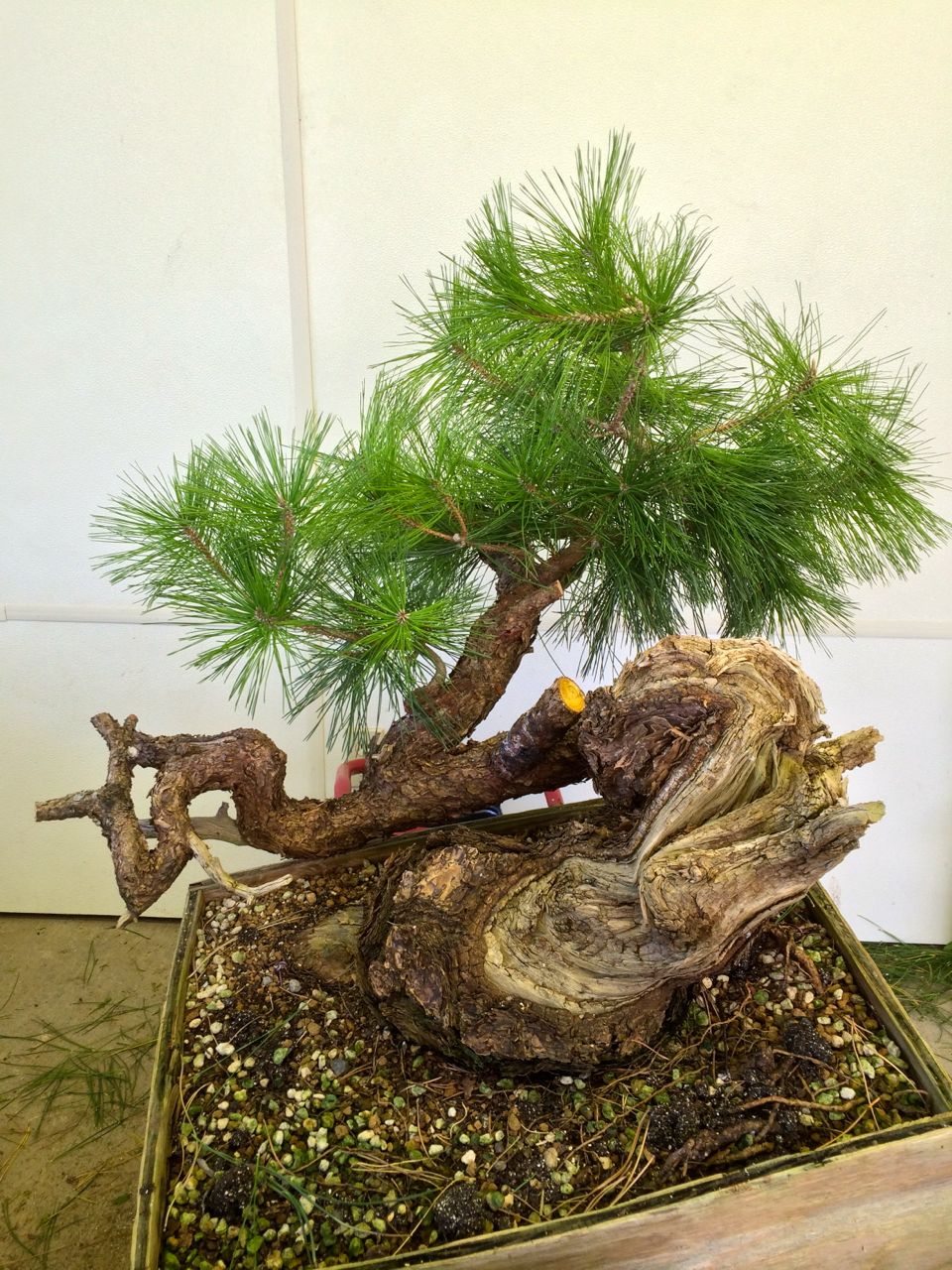
In 2010,  it’s all black pine. Two grafts only. Quite unbalanced, isn’t it?

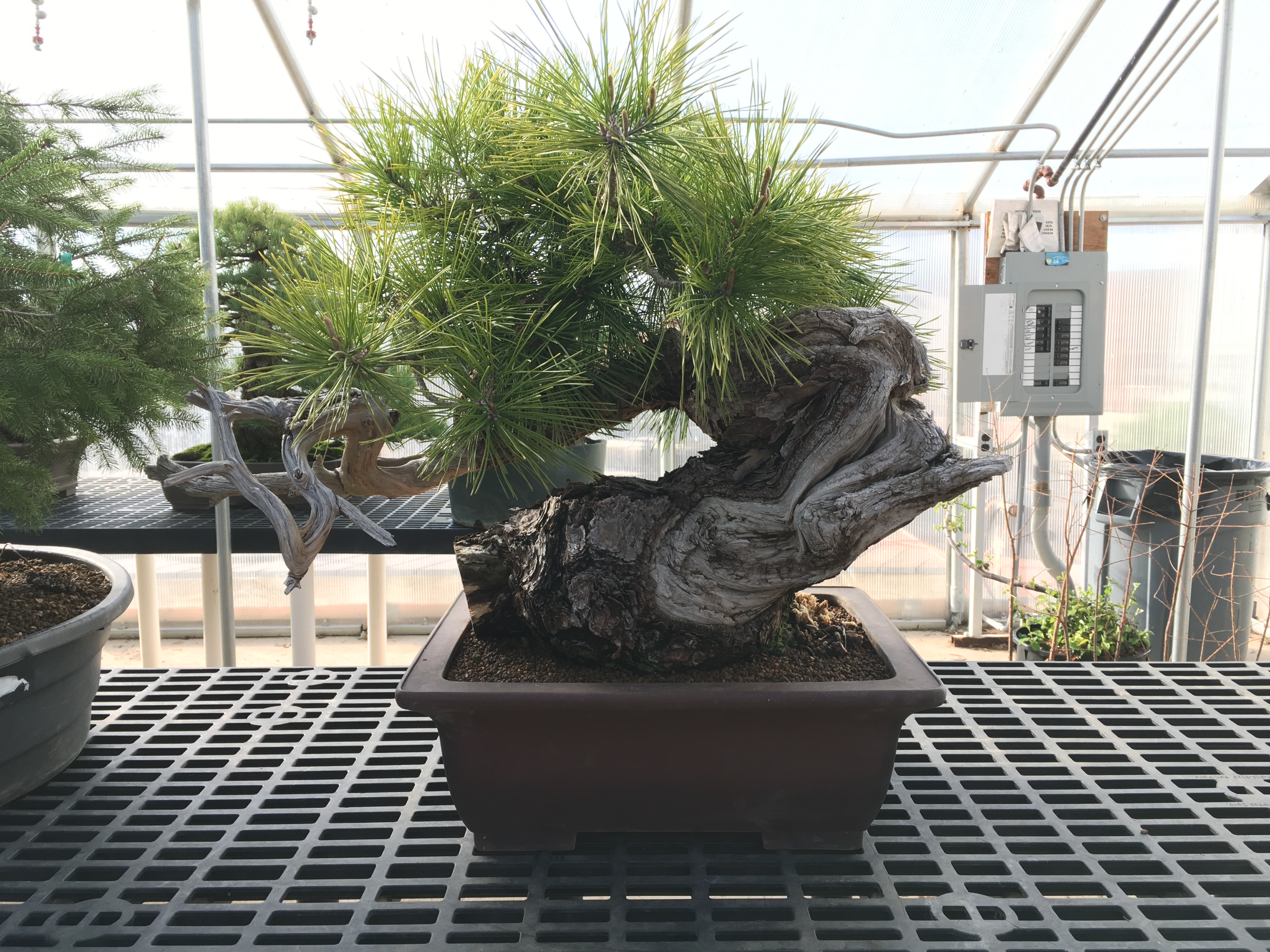
Repotted. I did not cut the candles last year, but will this year. I have found that candle cutting is the same on grafted black/ponderosa trees as black pine on its own roots. Cutting the candles will shorten the needles by about half of what you see here.

Styled and potted at a different inclination.

We decandle the very vigorous species of pine for some good reasons. It helps us to:

  • create ramification
  • counter the strong apical nature of pines
  • get short needles
  • shorten the length of shoots.

I have found that candle cutting is the same on Ponderosa pines grafted with black as just Black pine on its own roots. Here’s a few photos showing decandling of this small tree in a few steps:

DSC_0642

Ponderosa/black pine in 2013 (a week ago), after a couple of years of decandling. Some moderation of energy is happening.

DSC_0648

What I did last week: The first part of decandling is pulling off the older needles and leaving a whorl around each candle. This shoot was on the bottom of the tree, so I left more pairs of needles than the top. I left 7 pairs on this shoot. Approximately… each decision is based on the strength of the shoot next to it, too.

DSC_0650

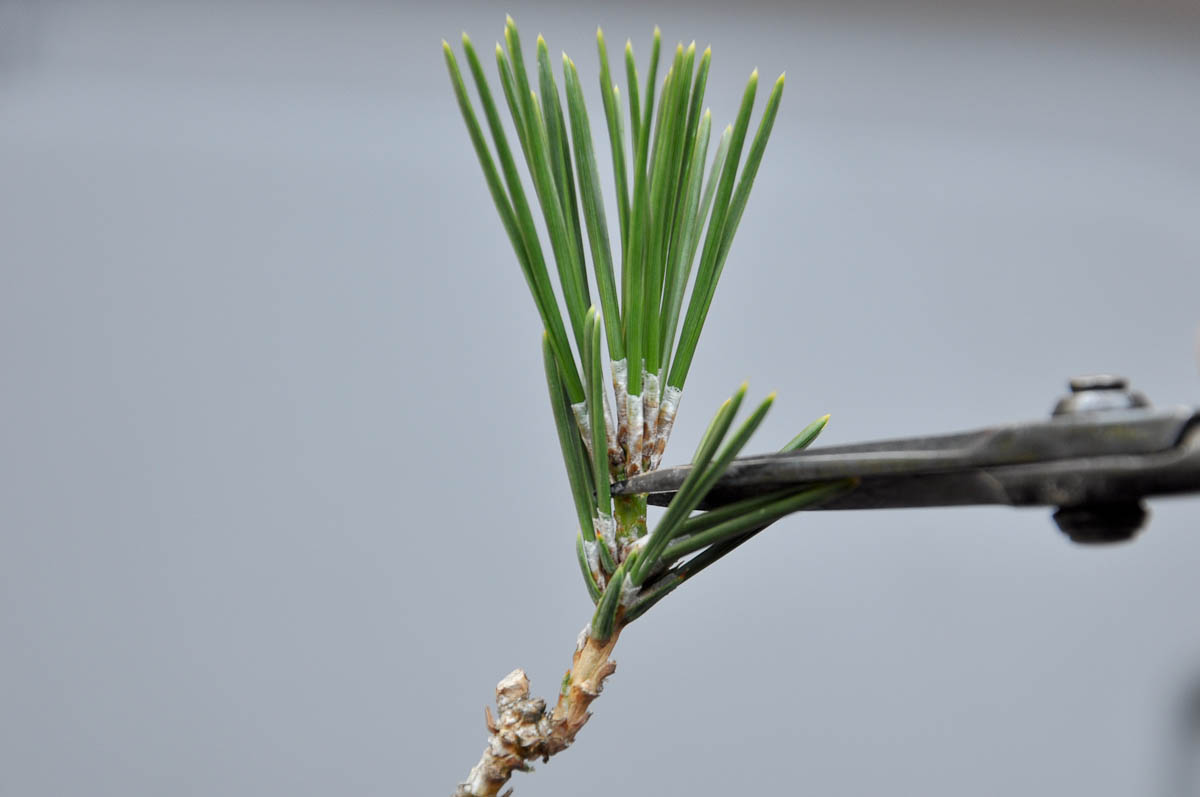
…after taking old needles off, the candle is cut… and where it is cut is also important. A shorter stub will strengthen a shoot, a longer stub will weaken it a bit.

DSC_0651

The decandling process completed.

DSC_0657

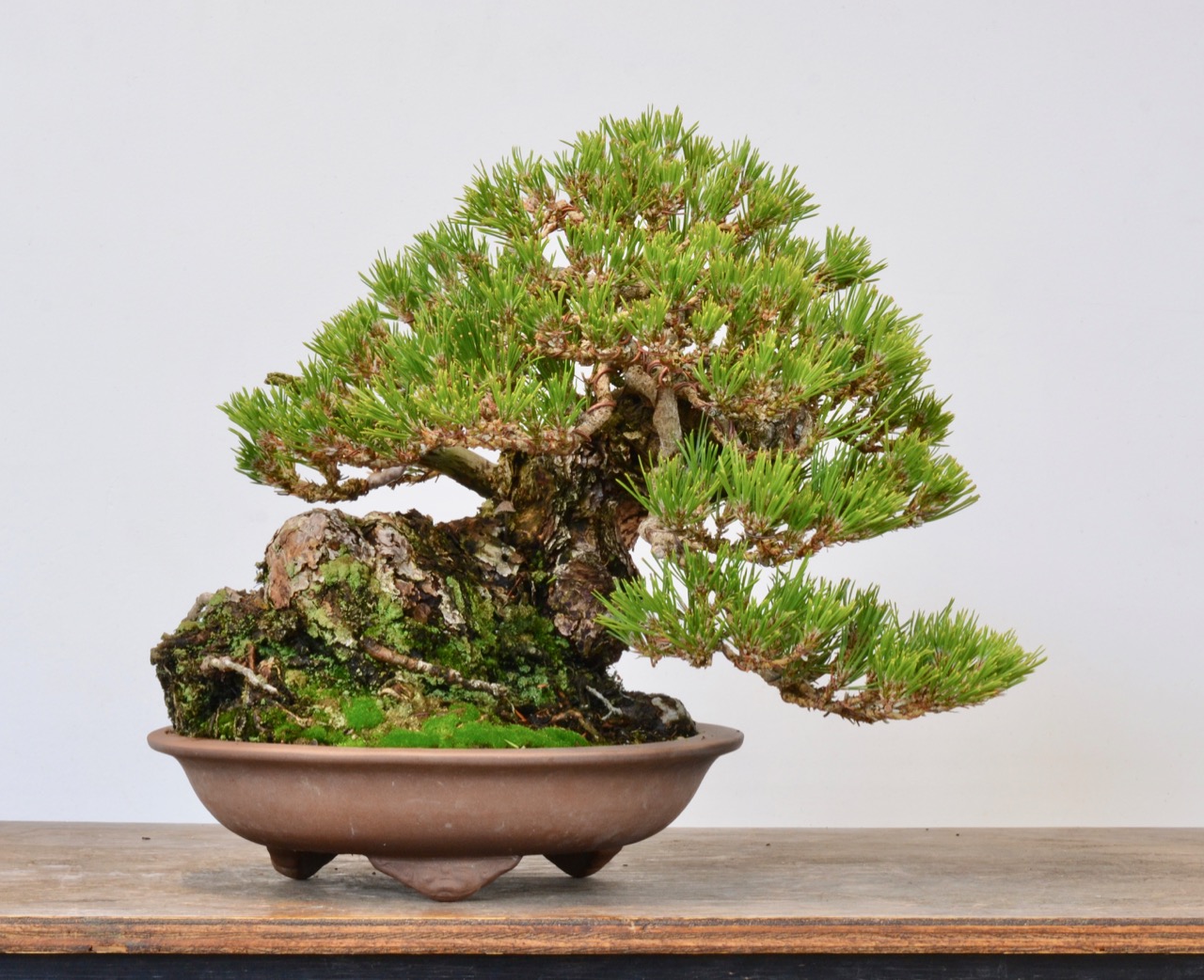
The pine after an hour of work.  12″ high. It looks very sparse, as most decandled pines do. In the fall it should look nice and full again, with multiple shoots having regrown and with—hopefully—short needles in scale with this small tree, and yet not too short that would look weird and weaken the tree.

Please only attempt these techniques on a strong tree…and then watch that you don’t overwater a recently decandled pine as their water needs will drop quite a bit.

* For more info on the details of decandling, I recommend my friend Jonas Dupuichs’ blog, Bonsai Tonight. He’s got some great images there and explains it simply and very well. In the ‘Search’ field type ‘decandling’ and a large number of posts come up that can handle many puzzling questions you might have. I hope this is not passing the buck…I admire Jonas’ blog and think rehashing what has already been done so well is simply daft, and I do enough daft things in life to get redundant. If you’ve questions, I’d certainly be glad to help/confuse you as best I can.

Read Full Post »

The day after my Seasonal students left I was so intrigued by what we had done with the Mountain Hemlock from last week’s post that I put this Engelmann spruce on a plastic slab as well. While the first day with five students it had taken all day to figure out, I did this one by myself in only two hours. Knowing what the heck you’re doing works marvels.

I also include a couple shotgun shots around my yard in this post—

Engelmann spruce on nylon board.

Closeup of the root mass over the nylon board. I hope the moss will eventually grow over the edge and it will be essentially invisible, floating a bit.

Some of the range of styles and trees I enjoy having around. Traditional, powerful black pine next to the ethereal feeling native vine maple. There's a wisteria to the left bursting with flowers (I took 2/3 of them off, it was nuts this year.) The boxwood to the right you might remember from International Bonsai many years back.

The companion plant bench... just beginning to grow. A couple are flowering already, such as cow pie and the indomitable miner's lettuce. If anyone knows what 'cow pie' really is let me know. From Japan, big leaf, white flower. The majority of these companions are Northwest natives.

This narcissus was blooming three months ago, potted in one of the first bonsai pots I ever made. The drainage holes are 1/4" wide. I had a lot to learn. Last year the flowers were 10" high, this year they were 6"--- plants reduce fast in a pot! Bit too flamboyant to display with a tree but fun on its own.

Read Full Post »

This small pine goes way back to when I was a potter, trying to sell them at my first convention in the mid 90′s in Harrisburg, PA. I met Andy Smith there, and we traded a pot for a tree. He collected the yamadori pine in South Dakota.

For years I grew it as a cascading ponderosa, and grew increasingly disappointed with the look of it. About 8 years ago I put 10 black pine grafts on it. This was when I lived in Arizona. 9 took, 1 died the second year, so I ended up with 8 grafts. Definitely overkill. Then I left for Japan. When I came back I had a strong little tree that my friend Gary Wood had kept for me in Alabama. I ended up keeping only two of the grafts, so all the foliage it now has is from just two scions.

This winter I began looking at it again and thinking it was time for a rather major review. This is what I came up with. I don’t think it is in any way a ‘special’ tree of importance, but I’ve been casting about for things to do with small ponderosa that give us more latitude and creativity, and grafting seems one option. This has been my experimental tree… and I’m grafting more these days as a result of the fun I had with it.

The original pine 'as a ponderosa' back in about 1999.

All black pine now, growing with wild abandon on styling day.

After styling in February 2011, with new inclination but before potting (two months later.)

Repotted, 12" high. I did not cut the candles last year, but will this year. I have found that candle cutting is the same on grafted black/ponderosa trees as black pine on its own roots. Cutting the candles will shorten the needles by about half. Incidentally, this pine has a rather serious pigeon breast from this front... it just did not have that many options. I think a pigeon breast is simply a different feeling than a definite 'Don't!' Those with dissenting opinions please comment...!

Read Full Post »

Two Old Pines

These two imported black pines have been through a number of hands in the United States, most notably Boon Manakitivipart, who established the basic branch framework of them. A client owns them.

The refinement work shown here is typical of that applied to very established conifers. Both trees’ key branches needed shortening, having slowly grown too long over years of proper maintenance, and they were shortened several inches. Otherwise the adjustments from the before and after photos are very subtle. The foliage pads are wired and set so as to create small groups—modular sections of larger groups—and wired straight out to suggest the strong personality of black pines. White pines and junipers look better with more lift to the tips of shoots.

The first bonsai is a huge two-person tree, over one meter tall, and the second bonsai, a root over rock pine, is very old but moderate sized.

bigblkpinebefore

lgblkpineafter

rtrockblkpinebefore

rtrockblkpineafter

Read Full Post »

Follow

Get every new post delivered to your Inbox.

Join 1,865 other followers